
Narrowing in on Sandpoint
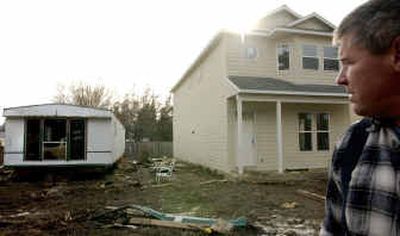

The new skinny houses sprinkled throughout town on streets named after trees and presidents cleaned Sandpoint’s appearance like a mother’s handkerchief on a smudged face.
Dilapidated and unsafe houses disappeared. So did trailer homes so rickety that even mild winds doubled as air conditioning. The people who called those places home also disappeared because they couldn’t afford to rent or buy the new houses. No one knows where they went, because low-cost rentals are so rare in Sandpoint now that people wait up to two years for a vacancy.
“We always have a waiting list,” says Amber Allen, manager of the Bristle Cone Apartments. The 30-unit complex is the only one in Sandpoint completely for no- and low-income tenants. “We’ve had a swarm lately of people looking for a place to live.”
Growing pains hit Sandpoint long before skinny-house developer Forrest Phillips spotted his niche and, as he says, “crawled into it.” But Phillips’ latest project has shone a spotlight on a fledgling problem for which other older resort communities have become known: little if any low-cost housing for the local working class.
“This is very typical of any resorts in the Pacific Northwest,” says Sandpoint Police Chief Mark Lockwood. He worked 16 years in Sun Valley before landing in Sandpoint. “A lot of working class for the resort industry can’t afford to live in town. I have officers now who can’t afford a home in the city on what they make.”
Phillips recognized an opportunity to nourish his fledgling Landmark Development business several years ago. He bought a few small city lots and built modest single-family homes he hoped would serve eventually as his rental fleet.
“When I came to town, I couldn’t find a place to live. I saw a market,” he says. “As the market changed in the last year and a half and Sandpoint got hot, we started selling the units we were building.”
At the same time, Sandpoint’s zoning changed. Twenty-five-foot-wide lots were no longer big enough for manufactured homes. Mobile homes could stay where they were, but if they moved, only permanent wood-frame homes could replace them unless the lot size doubled in width.
Again, Phillips saw opportunity. Many of the small lots held old, rundown trailers. Owners needed to replace them for safety, but couldn’t unless they doubled the size of the lots or built a permanent home. Phillips’ offer to buy the lots solved the problem.
He razed trailers that neighbors suspected were drug houses and police visited regularly.
“We had a lot of calls for service there,” Lockwood says. “Some were drug-related, lot of domestic, drunk and disorderly, fights, possession. The brand new rentals rent for higher prices and more working-class people are renting them.”
Phillips’ new homes were 15 feet wide and two stories tall, a style common in the eastern United States but not in Sandpoint. They had three or four bedrooms, two bathrooms and garages and rented for $850 to $1,000 a month. He built single-family homes and townhouses, inserting them wherever land became available in the city.
“The first couple of houses we had go up on 25-foot lots brought a lot of phone calls,” says Joan Bramblee, the city of Sandpoint’s associate planner. “Some people complained they looked like two-story trailers. I personally like them.”
To fit the houses on the narrow lots, Phillips started them five feet from the sidewalks and stretched them to the property’s back end. He added sidewalks and improved curbs and gutters – work required by the city but appreciated nonetheless for the neater look.
Phillips bought all the city lots he could and built or made plans to build about 65 houses, townhouses and condominiums. He figured his future was secure with his growing rental fleet. Then, people began lining up to buy his homes.
“There’s an incredible need for entry-level housing,” he says. “Everyone’s building at the top level now, but people still need affordable housing.”
The growing interest nationwide in Sandpoint motivated most builders in the last year to focus on high-end homes. Available houses in the $140,000 to $160,000 range were becoming scarce, so buyers were eager for Phillips’ models. He was selling homes he’d planned to rent because the market was so strong.
But the people who were buying Phillips’ new homes were not the financially struggling families who had lived in the old rentals he had razed. Those people had nowhere to go but out of town.
“Some of those places were terrible places to live and needed to be replaced with something safe and sanitary,” says Brenda Hammond, a family development specialist with the Community Action Partnership office in Sandpoint. “But then the price goes up.
“The handwriting is on the wall. Sandpoint is going through major changes and how much control we have is up to what we do.”
The National Low Income Housing Coalition, a policy advocacy group in Washington, D.C., that studies the affordable housing crisis, shows 3,255 renter households in Bonner County and $593 as the fair market rent for a two-bedroom apartment. To pay that rent and have enough money left over to live on, a renter needs to earn $11.40 an hour, according to the coalition.
Kathryn Tacke, regional labor analyst for the state Department of Commerce and Labor, says 25 percent of the jobs in Bonner County pay less than $7.50 an hour.
“We saw considerable movement in the hourly wage in Bonner County this year,” Tacke says. “Wages have increased but not at the rate housing prices have risen. General wages have not kept up with the increase in housing costs.”
When families go to Hammond for help with housing, she suggests the Bristle Cone apartments, then Oak Street apartments, which offer a few rent-reduced units. She also suggests joining the waiting list for a low-income apartment or home through Idaho Housing. But North Idaho’s 24-month wait is the longest in the state.
The apparent extinction of Sandpoint’s housing for lower-income families concerns Hammond, but she’s not panicking yet. She’s on a planning team with movers and shakers all over town that’s surveying Sandpoint residents now about what they want in their city in the near future.
It’s not too soon to start, says Police Chief Lockwood.
“It’s a perplexing tale for all resort communities,” he says. “But the proper vision can lessen the impact. Comprehensive plans have to look forward. People have to get over their shock and meet a real challenge.”