
Rock, rattle and roll

Interest in esoteric nursery gadgets is surging, fueled by the anxieties of increasingly older first-time moms and dads, a book-inspired parenting fad and the falling cost of fabricating electronics.
There’s an ever-expanding array of devices meant to soothe, watch and even understand your offspring, from a robotic rocker designed to put the fussiest newborn to sleep, to a nursery monitor that can ring your phone when baby wakes, to a cry analyzer said to interpret an inconsolable infant’s howls.
“There’s certainly been an explosion of baby products and a lot fall on the gadgety, techie side,” said Alan Fields, a contributor to the book “Baby 411: Clear Answers and Smart Advice for Your Baby’s First Year.”
But while the gadgets, gewgaws and gizmos promise a great deal, there’s no way for parents to know if they’ll work, warned Joan Muratore, senior project leader for Consumer Reports, a magazine published by the watchdog organization Consumers Union of Yonkers, N.Y. There are safety standards for strollers, car seats and cribs, she said, but “there is no organization that tests these kinds of devices to see if they back up their claims.”
Much of the interest has been stoked by a currently popular theory that newborns “still need the sound, the motion and the cocooning effect of the mother’s womb to calm and soothe them,” said Fields.
The notion was popularized by Harvey Karp, a Santa Monica, Calif., pediatrician whose book “The Happiest Baby on the Block” outlines a method for calming fussy, colicky babies that includes rocking and white noise.
In that vein, a Scottish company just unveiled a device that can rock a stroller or car seat at about the same rate as mothers instinctively rock their children.
The Robopax BabySitter, available in May for 68 British pounds (about $127), is a rocking platform that moves up to 35 kilograms (about 77 pounds) of baby and gear seven centimeters (about 23/4 inches) forward and back at a rate of 60 to 70 times per minute, said Bill Godfrey, sales and marketing director for the manufacturer, Dream Technology Ltd. (Americans may order online at www.robopax.com; it costs $93 to ship the BabySitter from Scotland.)
“The one thing babies don’t like is silence and stillness,” Godfrey said, citing Karp’s book. Put an infant’s stroller in the BabySitter, “and within minutes, the baby will stop crying.”
Another device, the SleepTight Infant Soother ($140), uses a vibrating attachment under the crib mattress and a speaker attached to the railing to imitate the feel and sounds of a 55 mph car ride, according to manufacturer Sweet Dreems Inc. of Westerville, Ohio.
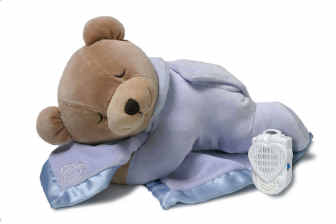
Then there’s the Original Slumber Bear ($20 to $25), which plays recorded womb sounds. “It’s something that reassures and comforts your child after entering into a whole new world,” said Michael McConnell, director of marketing and design for Prince Lionheart Inc. of Santa Maria, Calif.
The bear was first marketed in the 1970s, but Prince Lionheart last year updated and re-released it in response to renewed interest.
Karp, the pediatrician and author, said technological tools can calm fussy babies, but only if used as described in his book.
For example, the quality of the white noise makes a difference – it should be more like the roar of a vacuum cleaner than a babbling brook, he said. The swinging or jiggling motion he describes isn’t necessarily the same as rocking or vibrating. And he recommends three other steps: swaddling; letting the baby suck a pacifier, bottle or breast; and positioning the baby in stomach-down or side-lying positions, all in a specific order.
Karp’s ideas are controversial in pediatric circles, Fields said, but they’ve been a runaway hit with manufacturers of baby products. While some studies show motion and white noise can help infants fall asleep, “the baby products market can take that to excess.”
Today’s older first-time parents can afford to assuage their insecurities with gadgets.
“The average age of first-time parents is 30 today,” Fields said, compared to 20 in 1970. “At 30, you know a little too much, you have more money, and because you’ve waited until later in life to have children, there can be a lot of pressure to `get it right.”’
For some parents, getting it right means automating their anxieties with monitors of all sorts.
BabyCare, by Polish company Psiloc Mobile Solutions, is a $19 software package that can turn some programmable cell phones into baby monitors. Just put the cell phone in baby’s room and when it detects a set noise level, it rings a preprogrammed number and lets a parent both listen in and speak to the baby. Parents can also call BabyCare-equipped phones and silently listen in to the nursery.
For those who’d rather see what’s going on, wireless video and sound monitors sell for as little as $100, versus $300 a few years ago, given cheaper electronics coming out of China, Fields said.
And for parents who just can’t understand what baby wants, there’s the WhyCry Baby Crying Analyzer, distributed in the United States by Lentek International Inc. of Orlando, Fla. Created by a Spanish engineer stumped by his newborn’s wails, the device – $79.99, plus shipping and handling – uses the frequency and pitch of an infant’s howl to sort it into one of five categories: hunger, boredom, discomfort, sleepiness and stress.
Karp was skeptical. “The cry of a baby, especially in the first few months, is like the ringing of a telephone,” he said. “It’s just a general message that ‘I need you.’ It usually takes three or four months for kids to have a spectrum of cries.”
At Consumer Reports, Muratore advised buyer beware, whatever the device.