
Sacked by a scam?

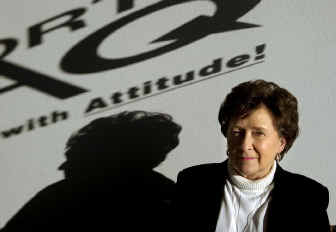
Lola Emter is exhausted.
From the moment her little Spokane Valley sports-bag company went public, her life has been dominated by angry investors, lawyers, unscrupulous stock dealings and the U.S. Securities and Exchange Commission.
Courtside Products Inc., which she runs as CEO with her son, Curtis Medlen, is entangled in a new SEC effort to short-circuit penny stock fraud.
In trying to stop so-called pump and dump schemes that have flourished with the use of e-mail — where a stock is hyped to inflate the price, then sold — the SEC has suspended trading in three companies whose over-the-counter shares are listed on the National Quotation Bureau’s “pink sheets.” One of them was Courtside.
John Reed Stark, chief of the SEC’s Internet enforcement division, is investigating.
The episode, which has garnered attention from the New York Times and Wall Street Journal, serves as a cautionary tale.
Admittedly naïve about the finer points and seedy aspects of dealing in securities, Emter hopes her company’s reputation is protected and that its business won’t be forever harmed by a public offering gone awry.
Courtside, she said, is based on a good product – the Sport Saq – along with integrity.
She took the company public, she said, for two reasons:
The first is purely personal. She wants to recoup her investment and collect back wages.
Since the early 1990s, Emter and her husband, Lloyd Emter, have invested more than $400,000 cash in Courtside. The couple sold several rental properties and took out a second mortgage on their Bella Vista home to keep the business going.
Furthermore, Emter hasn’t taken a paycheck since 1996. All she hopes to collect in accrued wages is about $250,000 – a very modest wage of less than $30,000 a year.
“We used to have a pretty good lifestyle, but not anymore,” said Emter, who is 65 years old. “I’ve taken one vacation in eight years, and that was to see family in California.”
The other thing Emter wants the money for is to see the company grow. She’s a believer in the bags her son Curt Medlen first designed and stitched together at home in 1993.
Medlen says the idea of making sport-specific gear bags “came to me in a vision. I woke up at 4 a.m. at a motel room in Phoenix after a dream.”
He was there at the time professional basketball star Charles Barkley was playing for the Phoenix Suns. A basketball enthusiast, the then-26-year-old Medlen sketched a bag design, made it on Lola’s sewing machine and asked her for money to market and sell the bag. He started selling the bags out of Emter’s antiques shop.
The first real success for the $70 bags was sales to area sports teams including those at Hoopfest.
Though sales ebbed and flowed over the years, revenues at one time topped $500,000 annually, Emter said. Courtside once contracted with 28 sales representatives to sell the bags nationwide.
Sales, however, dipped in 2003 and 2004 with the loss of a couple large customers. Emter contends it had nothing to do with the product, but rather with over-zealous sales expectations from some accounts.
It cemented her belief that Courtside needed to expand and avoid the pitfall of relying on a few customers.
By last May, Emter had identified three funding options: A bank loan, finding a large private investor, or taking the company public by offering shares on the pink sheets.
Emter ended up working with Keith Robertson, a former Merrill Lynch broker. Robertson looked for a private investor but reported back in June that issuing shares would be more promising.
Robertson has been with four different investment firms in Spokane, beginning with a three-year stint at Metropolitan Mortgage & Securities Co. in 1994. He left Merrill Lynch last March, after working there for six months. Robertson now is a self-employed financial adviser; his service is called C3 Consultants.
Emter said she gave Robertson the green light to set up a public offering when she understood that Courtside could reap at least $3 million from the sale of stock.
Robertson, in turn, said he was introduced by an undisclosed third party to Michael Paloma, a stock promoter from Phoenix. Paloma markets himself as an actor, musician and business promoter.
From the moment Paloma was hired to handle the sale of Courtside shares, Emter said she’s faced angry investors and “sleepless nights filled with stress.”
Unknown to her at the time, Paloma has a rocky background.
He ran afoul of the SEC for securities fraud and paid $534,000 to settle dual allegations that he issued press releases falsely claiming his company, Desert Winds Entertainment Corp., had signed a big contract with Warner Brothers Television, and then filed false financial reports listing the bogus contract as an asset and using the information to sell restricted shares of stock.
His partner in Desert Winds at the time, Matthew Bardasian, pleaded guilty to an unrelated criminal matter, according to an SEC report.
Paloma and Bardasian have been barred by the SEC from acting as directors or officers of public companies.
Robertson said he knew of Paloma’s background, but thought such tough lessons would ensure a clean offering for Courtside.
“We were manipulated,” Robertson now says.
Paloma did not return a phone message left for him at his current company, Pine Canyon Enterprises.
Robertson said once Paloma and Courtside were hooked up, “everything was immediately screwed up.”
Paloma was given 7.5 percent of Courtside’s stock as part of the agreement to act as promoter, and according to Robertson, engaged brokers to move the shares. Within days of going public, a blizzard of faxes and e-mails calling Courtside “one of the most amazing opportunities ever!” were sent to people worldwide. Emter and Robertson say they don’t know who sent the stock solicitations. After that, Emter said she received threats, including one targeting her family. Shook by the event, she was later shocked when she learned about the e-mail spam. She called investors to apologize and explain what had happened.
Meanwhile, Robertson said he “placed 200 calls to Michael and he wouldn’t tell me anything.”
Courtside shares were selling on the pink sheets for up to 80 cents by late October.
The price gyrated as more faxes and e-mails were sent out.
By the time the SEC stepped in and halted trading Jan. 28, the shares had fallen to about 4 cents. Trading is expected to resume soon.
Emter has been told by her Bellevue, Wash.-based lawyer, Tolan Furusho, that the promoters behind the faxes and e-mails may have collected as much as $4 million using the pump and dump scheme. Courtside’s proceeds so far have been about $75,000. Furusho said he believes Emter and Robertson are not culpable.
“The company here is the victim,” he said. “Courtside will be OK, but this is a cautionary tale of what happens if you want to go public and don’t do it the right way or don’t fully understand the securities market.”
“There’s more sharks out there than goldfish.”