
Sites unseen
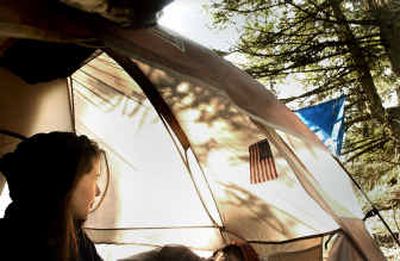
Tiffany wears pajamas with threadbare knees, loosely knotted tennis shoes two sizes too big, and a sweat shirt that she wipes her nose on because she’s sick – and has been for several weeks. At 20 years old, she could be mistaken for a girl much younger, perhaps in junior high. A former heroin addict and mother of three, she has camped in the Dishman Hills Natural Area, off and on, for five years.
“I’m ready for anything here,” she said, perched on a rock eating a miniature chocolate bar. “I have spears in case an animal comes.”
Tiffany, whose children live with relatives, has just moved her camp again, this time to a ridge hidden from a nearby footpath, after Spokane County parks workers ordered her out of another camp last week. When the workers left, she and her boyfriend moved a few hundred yards away to establish the new camp. Under the cover of darkness, she will sneak down past a pizza parlor to “fly a sign” – street parlance for standing on the corner, begging for money, as the traffic rushes past her.
“It’s so degrading,” said Tiffany, who asked that her last name not be used. “You feel this tall. I hate asking people for stuff. But a closed mouth don’t get fed.”
The latest chapter in the struggle between law enforcement and the homeless is set in the urban forests around the cities of Spokane and Spokane Valley. Only a tiny percentage of the 8,000 people who seek homeless services in the city are believed to be regular campers, but social workers and advocates say they have seen an unmistakable migration out of the city in the past six months.
Many contend a recent ban on camping in Spokane pushed more homeless people outside city limits, presenting new challenges to social service agencies and the homeless themselves. Mental health workers say they are unable to locate people who need help. Social workers say the homeless are miles away from food banks and day centers. Nearby landowners complain the illegal campers spread tents, sleeping bags and garbage in the woods, increasing the risk of fire.
Last month, government workers discovered four more camps within a half-mile of Tiffany’s camp, including two sites with 15-foot-tall tepees.
For weeks, rumors have circulated at homeless shelters of a large encampment of homeless people in the Dishman Hills. A Spokane County official said as many as 90 people could live in the camp, though no one has located the site.
On the streets, the camp has reached mythological proportions: It is booby-trapped by homeless veterans who honed their skills in the Vietnam War. It is protected by a ring of scout camps. It is underground, or in a series of caves. The police sent up a helicopter to search for the camp, but it was so well hidden they could not find it.
“You’ve got veterans out there that survived in Vietnam,” said Dave Bilsland, head of People 4 People, a homeless advocacy group in Spokane. “They know how to camouflage. These are guys and gals that know how to hide.”
Unseen in the woods
Some rumors are easy to dispel.
A spokesman for the Spokane Valley Police Department said no helicopter searched the area, though officers located several camps this month.
But other rumors persist, in part because it is so difficult to track the number of homeless across hundreds of acres of forest.
Paul Nutting, who oversees Spokane Mental Health’s outreach workers, is reluctant to send counselors hiking through the woods.
“It poses a bit of a risk to go out there,” Nutting said. “We feel like if there are people out there deeply embedded, self-contained, we tend to respect their privacy.”
Many believe the police-backed ban on public camping last year pushed the homeless outside city limits and into the woods.
“It’s only logical,” said Debbie Detmer, a Spokane County development specialist who handles homeless issues. “You push here, and they’ll show up over there.”
A spokesman for the Spokane Police Department, which teamed up with downtown business owners to support the ban, said there have been no arrests under the new law, which made it illegal to camp under city bridges, in alleys or on sidewalks.
Spokesman Dick Cottam, in an e-mail, wrote, “Police say the downtown parks are cleaner and safer since the campers packed up.” Cottam said the motivation for the ordinance was “sanitation and the safety of both the campers and other citizens.”
Dishman Hills, a 500-acre landscape of granite gullies and ponderosa pine forest just southwest of the Spokane Valley, provides one of the closest forests for homeless campers. Transients have camped in the area for at least 70 years. Today, rusted pots and pans dating to a Depression-era camp are scattered at the base of the hills, near a long-abandoned rail line.
“There are various reasons why people go to the woods. One is to hide,” said Mike Hamilton, a retired geologist and president of the Dishman Hills Natural Area Association. “Right or wrong, we do make the assumption that these people are hiding from something.”
In recent years, hikers found two bodies in the hills, Hamilton said. Both apparently froze to death, he added. Makeshift methamphetamine labs have also been found.
Hamilton recently received a telephone call from a local landowner about a new camp on the east side of the hills. With a backpack and a contour map of the hills, Hamilton set off in search of the camp last week. After an hour, he hiked down a slight depression and came upon a stone pathway leading to a tepee constructed of building wrap, tree boughs and small pines.
He found cans of a dietary supplement, a double-bladed ax and a fire pit in the tepee.
“I’ve never seen this before,” Hamilton said, peering inside the tepee. “They’re creating their own world here.”
A day later, he found a similar site several hundred yards away.
“They’re creating a community out there,” he said later. “It’s a fire danger. It’s a mess. It’s illegal. This area is not set up for camping.”
‘I’m cold. I’m sick.’
Tiffany said she is no risk to anyone. After years on the streets, she avoids the homeless shelters, where women sleep several to a room and couples cannot stay together. Instead, she cooks food on the fire and piles on blankets during the coldest winter nights. When she needs to clean up, she bathes in the sink at a gas station.
When she gets stressed out, she sometimes turns to drugs, she concedes.
“Things get so stressful out here,” she said. “Since we’ve been sick, we’ve had no food for two days.”
She works as a day laborer at construction sites, though she stands barely 5 feet. Last month, in an act of desperation, she said, she tried to steal $300 worth of DVDs from a ShopKo. A security guard caught her, and she spent 10 nights in jail.
“People probably think I want to be out here,” she said. “I don’t want to be here. I’m cold. I’m sick.”
But she’ll stay, she said, so she and her boyfriend aren’t separated.
“If it weren’t for each other, what would we have?” she said.
Yet there is a sense of pride that she can survive in the woods.
During long walks in the maze of steel-gray canyons, when one rock outcropping blurs into the next, Tiffany knows she can search out the moss – which grows on the north side of the trees – to find her bearing.
She knows when the skies are clear, the night will be cold. She knows that at the corner of an intersection, with a homemade sign and an outstretched hand, there’s money to be gained, even if a bit of dignity is lost.
She knows that in the spring, the people from the county will be back to sweep the canyons because that is their job. She knows that when they leave, she can slip one canyon east or west, into a crevice in the rocks or an opening in the pines with enough space to pitch a tent.
Then she can disappear again into the woods.