
Break out the lumber
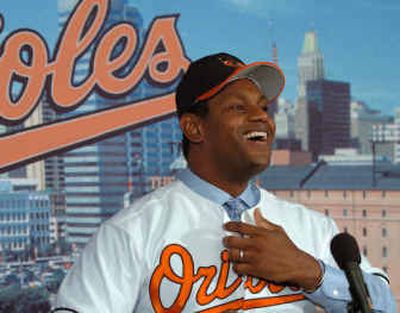
WASHINGTON – To recap: Randy Johnson is a Yankee. Pedro Martinez is a Met. Sammy Sosa is an Oriole. Oakland’s Big Three is now a Big One. Jason Giambi used steroids. Barry Bonds did, too, but he says he thought they were something else. Jose Canseco wrote a book. The Montreal Expos are now the Washington Nationals, but their paychecks are still signed by Bud Selig.
Winter, as defined by baseball, is nearly over, with the Nationals among a handful of early birds whose spring training camps open for business on Tuesday when pitchers and catchers report. Soon, baseball’s winter soundtrack – cell phones ringing and cash registers cha-chinging – will give way to spring’s score of bats meeting balls and balls meeting leather.
That means it is now seven weeks until the New York Yankees and Boston Red Sox, the combatants in the last two thrilling American League Championship Series, meet each other in the nationally televised Opening Night, April 3 at Yankee Stadium, with New York’s Johnson facing former teammate Curt Schilling – provided the latter is healthy and the gaseous emissions from media overhype do not wipe out the entire East Coast.
This was a winter that, in almost every way, went against convention. (Actually, that trend began as far back as October, when the Red Sox, in a memorable march toward immortality, defied 86 years of organizational futility, and one Ruthian curse, to win the World Series and wipe out New England’s communal angst.) When the offseason began, it was widely assumed the Red Sox would re-sign Martinez, the Yankees would land free agent prize Carlos Beltran and the Cubs would be forced to hang on to Sosa and his supposedly untradeable contract. The players’ association was quietly spreading the word that another winter of diminishing free agent contracts could lead to another battle over collusion charges.
Instead, the Mets threw giant bags of money at Martinez and Beltran, landing them both with barely a mumble from the Red Sox and Yankees. The Cubs got Sosa to waive his lucrative trade clause, paving the way for them to dump him off to the Orioles. And to the surprise of many observers (and the acute chagrin of many owners and league bigwigs), the free agent market exploded into an orgy of spending that reached unprecedented heights.
More than $1 billion in free agent contracts were signed this winter, with more than half of that coming from the Mets, Red Sox, Los Angeles Dodgers and Seattle Mariners alone. Giddy agents – Scott Boras alone saw seven of his clients rake in nearly $400 million combined – explained the spending spree as the natural outgrowth of an industry-wide growth in revenues, while angry owners blamed a handful of reckless colleagues.
“You look at some of the contracts this winter,” said Pittsburgh Pirates owner Kevin McClatchy, “and it’s obvious some (owners) are drinking some funny water.”
For once, though, no one can blame the Yankees, who, while passing the $200 million payroll figure for the first time ever, spent only a fraction of what their crosstown rivals did. They are still the biggest, baddest team in baseball – and the only one that would have even considered giving two more years and $32 million to the 41-year-old Johnson – but they are also nearly five years removed from their last World Series title and once again riddled with question marks.
“There’ve been four different World Series champions in the last four years,” said Tom Glavine, the Mets’ veteran lefty, “so I don’t think anyone is worried any more about how the Yankees are dominating the game.”
The steroid question still informs the game’s debate, perhaps even more so, despite an historic mid-term pact between the league and the union to revise the Basic Agreement and strengthen the drug testing program to include out-of-season testing and suspensions for first-time offenders.
Revelations from the ongoing BALCO probe in San Francisco and Canseco’s dubiously sourced book have cast a wider net of suspicion around the game. Observers no doubt will be watching closely this spring to see whose arms look punier and whose hat size has miraculously shrunk. Meantime, the BALCO case could go to trial this summer.
“Nobody has been convicted or indicted,” Commissioner Bud Selig said this past week, as Canseco’s book shot up the Amazon.com pre-sale bestseller list. “The fact of the matter is, players of this generation are magnificent and have done some great things.”
True, and no one has been more magnificent or done more great things in this generation than San Francisco’s Bonds – but nobody, outside of Giambi perhaps, has been more tainted by the BALCO scandal.
The sport’s brightest and darkest possibilities for 2005 intersect at Bonds’s locker, with its big, overstuffed recliner. He begins the year with 703 career homers. If healthy (he is expected to miss much of spring training following a second knee surgery earlier this month) he should pass Babe Ruth for second place on the all-time home run list by early May, and if both healthy and lucky he could threaten Hank Aaron’s all-time record by the end of the season.
He could also find himself further implicated in the steroids scandal, with who knows what ramifications for himself and his sport.