
Measured success
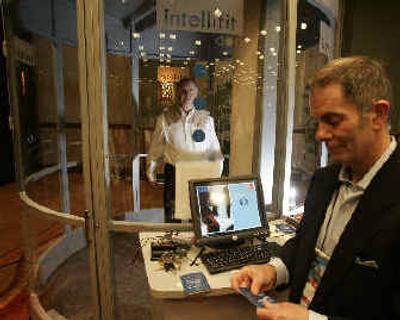
SCOTTSDALE, Arizona. — People entered the cylindrical plexiglass booth one by one and stood motionless and erect for 10 seconds as a tall wand circled them, emitting low-power radio waves.
No, it wasn’t a Star Trek convention and these were no wannabe teleportationists.
The isolation booth mapped detailed holographic images of each visitor for a company called Intellifit Corp., a hit of this week’s DEMO technology conference, a high- powered annual gathering of inventors, entrepreneurs and potential investors.
The Intellifit System technically disrobed the fully clothed conference-goers — measuring everything from the length of their thighs to the circumference of their knees and the thickness of their necks.
No one got to see the images, but there was indeed an incentive for getting gauged. In exchange for entry into Intellifit’s database, participants got to go online and order a complimentary pair of custom-fit pants from Levi’s.
The technology, which Macy’s and Lane Bryant stores have also piloted, was developed jointly by the Pacific Northwest National Laboratory and the Department of Energy to detect nonmetallic weapons. It creates a 200,000-datapoint image of a single body, company president Ed Gribben said.
Some of the most impressive technologies on show at this year’s DEMO were, like Intellifit’s product, stepchildren of the realm of security, defense and aerospace research.
NASA’s Mars Rover project gave rise to an imaging tool that builds, in seconds, three-dimensional models from digital photos taken by a handheld stereo camera. A decade-old project at Sandia National Laboratories is becoming a new kind of joystick that provides tactile feedback from companion 3D computer imaging software.
Then there was the plastic explosives-detection technology a Perth, Australia, company called QRSciences Ltd. developed with airline security in mind. Company president Kevin Russeth says the technology draws heavily on the expertise of Russian scientists from Kaliningrad.
DEMO Producer Chris Shipley had selected 73 companies for the two-day innovation smorgasbord, which ended Tuesday. And while there was no overriding theme this year, the show’s 15th, the inventions tended to flow from the inevitability of ever faster and cheaper data processing and telecommunications.
The companies that took the stage for DEMO’s customary six-minute presentations included specialists in tailoring e-commerce to local markets, programmers intent on making online publishing and collaboration less onerous and startups surfing the rising multimedia tide.
Computer security, not surprisingly, was well represented, as were companies sketching the blueprints of Internet telephony’s bright future.
And then there were simply the cool ideas:
Digital Monkey Pty Ltd. of Adelaide, Australia lets budding musicians practice with a symphony orchestra performance as aural backdrop, as the sheet music scrolls up their computer screen beneath video of the conductor. The software also listens — to tempo, pitch and timbre — and gives text, audio and visual feedback.
“Practice is no longer boring. It’s more like a video game. Kids play longer. Kids play better,” the company’s 29-year-old chief executive, David Evans, told a rapt DEMO audience in showing the product called “In The Chair.”
Evans’ lone partner, for now, in this flight simulator for musicians is his hometown symphony.
Hands-on experience was the only way to truly appreciate the new “joystick” from Novint Technologies Inc. that lets you feel the smack of a ball hitting a virtual catcher’s mitt or the tension of a bow string tensing as you pull it back before releasing a virtual arrow.