
Grocery donations get fresher
Second Harvest Inland Northwest is riding a tide of grocery industry innovations to secure more vegetables and dairy products for cash-strapped families.
For the past year, the food bank has worked with Rosauers Supermarkets to rescue groceries that are past their prime, but still fresh and safe enough to eat.
However, distributing perishable foods through the existing network of aging neighborhood food banks is posing challenges nationwide. Many smaller food banks, for example, lack adequate storage coolers that could keep fresh foods from spoiling.
“We know that a box of apples would go a long way for those families, but there’s logistical challenges in moving those apples through a system that can’t handle a lot of fresh produce,” said Jason Clark, executive director of Second Harvest Inland Northwest.
Second Harvest provides food to 317 Eastern Washington and North Idaho agencies, including 21 Spokane County food banks that receive an average of 70 to 90 percent of their food from Second Harvest.
Years ago, donations included truckloads of overproduced canned and dried goods. Today’s inventory systems cut down on losses, substantially reducing large-scale donations.
“We’re working harder and harder for smaller and smaller quantities,” Clark said.
Through Grocery Rescue, Rosauers Supermarkets, including Super One Foods and Huckleberry’s Natural Markets, have donated 40,000 pounds of groceries per month. That’s enough for 2,600 families to receive 15 pounds of groceries each.
Rocket Bakery and local dairies are starting to make donations. Clark is working with a second grocery chain and hopes to add 15 to 20 stores in the next 18 months.
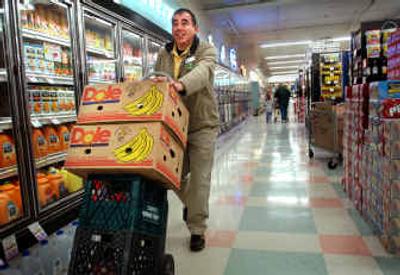
Angelo Chavez is one of three Second Harvest drivers who pick up donations from area stores.
On Wednesday, he visited Rosauers on 29th Avenue, where he collected a dozen boxes filled with frozen macaroni and cheese, cantaloupes, salad mix, bakery bread and Valentine’s Day cakes.
The store was the first to participate in Grocery Rescue and worked with Second Harvest to devise systems to keep incoming inventory separate from donations and ensure food safety. “They take pride in giving us stuff we can use. We get a variety of different things and good foods,” Chavez said.
Once collected, drivers deliver food to area agencies or Second Harvest’s 75,000-square-foot warehouse. Representatives from smaller food banks – which collectively serve 16,000 Spokane County residents each month – choose foods that fit their storage capabilities and clients’ needs.
However, many food banks operate in churches and community centers that have little refrigeration capacity to accommodate fresh products. They operate with minimal budgets and rely on thousands of volunteers.
Some are open just one or two days a week, following a model built to accommodate government food commodities that are quickly disappearing.
The limitations cause some agencies to decline produce and dairy in favor of dry goods, which are in short supply, Clark said.
“There’s a big difference between agencies open five days a week and one day a week and that difference is fresh produce,” Clark said.
“If you’re only open one day a week, you’re only going to get a snapshot of what’s available.”
Spokane Valley Food Bank, open two days a week, is one of a dozen agencies renting space and providing wraparound services at Spokane Valley Community Center.
The community center board wants the food bank to increase its days of operation to serve a 20 percent increase in need and changing donations.
Valley Food Bank, like many others, was started decades ago by area churches. It operates on $67,473 a year and relies on 350 volunteers, primarily seniors and women.
Barbara Bennett, food bank director, said to expand hours and inventory she’d need to add storage and additional refrigeration, find more volunteers, access a refrigerated truck and hire an employee to lift heavy boxes.
“The challenge for me is lack of space. I would be delighted to have those things that are the products that most families want,” Bennett said.
There is evidence that need for emergency groceries in the Valley area may have outgrown the food bank’s current capacity.
A system of ZIP code-reporting shows that although the Valley Food Bank served 2,901 different households last year, there were a total of 4,764 Valley households who received help from all area food banks, Clark said.
Generally, the working poor visit outside food banks because of convenience of location and hours of service, Clark explained.
St. Vincent de Paul Society’s food bank is open on weekdays and serves about 100 people a day, many from ZIP codes served by other food banks.
“We do get a lot of people who come down here because we’re not open just one day a week,” said Debbie Downs, director.
The agency stocks as many fresh items as possible and Downs said those foods move quickly.
“With the price of milk going as high as it is, clients rely on us, but we don’t always have it.”
Some food banks are finding creative ways to distribute fresh foods. Airway Heights Food Pantry-Thrift Store has limited refrigeration but offers a weekly produce day when clients receive goods right off the Second Harvest truck.
Salvation Army is fund raising to remodel the Sterms Building on East Nora into an emergency shelter with a main-floor food bank.
The new food bank will be triple the size of the existing facility and be designed like a mini-grocery store, with dairy cases and a produce section.
“It’s innovative. We’ll actually be able to get the product to the people before it spoils,” said Gerriann Armstrong, social services director for Salvation Army Spokane Corps.
The “store” will allow clients to shop using a point-system based on nutritional value and availability. The client choice model is gaining momentum because pre-selected foods don’t always suit dietary requirements and tastes of families and seniors.
“We’re changing our program to meet the needs of the clients. They will literally be shopping for the things they need,” Armstrong said.