
Desperate moms
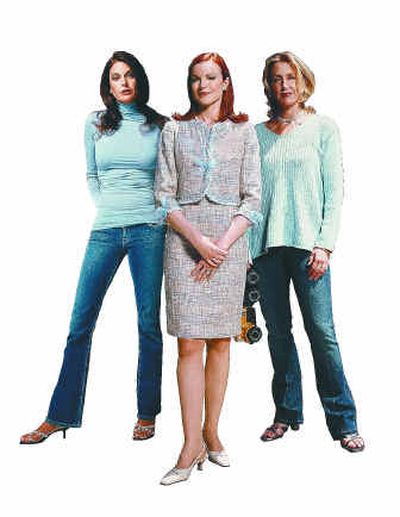
The desperate housewives of Wisteria Lane are the ones getting all the attention. But scan the broader television landscape and it’s scattered with women juggling children and pressure-cooker situations.
Expectant mom Claire (Emilie de Ravin) of ABC’s “Lost” has endured a plane crash, a kidnapping, amnesia and a psychic’s creepy warning that she must be the only one to raise her child.
On Fox’s “The O.C.,” Kirsten (Kelly Rowan) has a full plate, too. Her marriage is being threatened by her husband’s fugitive ex-sweetheart. Her adopted son is dating her newly discovered half-sister.
The most shocking matriarch on TV is Dina Araz (Shohreh Aghdashloo) of Fox’s “24,” whose Muslim family is actually a terrorist cell. In one episode, she poisoned her teenage son’s girlfriend to protect her and her husband’s mission to help launch a nuclear meltdown.
The storyline has drawn complaints from American Muslims for the disturbing twist it gives to a familiar stereotype. Movies and TV series have made villains out of Middle Eastern characters before. But a terrorist who’s a suburban soccer mom?
Although Dina is an extreme prime-time character, she’s proof that television is populated with all kinds of mothers these days.
Moms are scrutinized for weaknesses on the nanny and wife-swapping shows of reality TV. Their formats tap into a deep maternal fear: You’re raising your kids the wrong way.
ABC’s “Desperate Housewives,” in particular, have become synonymous with the stress that real women feel to be perfect parents.
This season, it seems as if TV is catching on to the complexities of modern maternity.
Why are so many TV moms anxious, overbooked and downright scary? Some of it has to do with TV’s constant need to get attention. When reality shows ran out of ideas about swallowing worms or surviving in the jungle, they turned to motherhood as fresh fodder.
When ABC hit the ratings skids, it tried something completely different: a dramedy about the secret lives of women who stay home.
But there’s also a backlash brewing in popular culture that is seeping onto the airwaves. Women, both those who work outside the home and those who don’t, are exhausted by trying to achieve an impossible ideal of motherhood, or so argues the Feb. 21 cover story in Newsweek on “The Myth of the Perfect Mother.”
It’s written by Judith Warner, author of the new book “Perfect Madness: Motherhood in the Age of Anxiety” ( Riverhead, $23.95). She explores how post-baby boomer women raised to believe they could do anything are now having a hard time handling the balancing act of motherhood.
“Most of us in this generation grew up believing that we had fantastic, unlimited, freedom of choice,” writes Warner. “Yet as mothers many women face ‘choices’ on the order of: You can continue to pursue your professional dreams at the cost of abandoning your children to long hours of inadequate child care. Or: You can stay at home with your baby and live in a state of virtual, crazy-making isolation because you can’t afford a nanny, because there is no such thing as part-time day care, and because your husband doesn’t come home until 8:30 at night.”
Warner was surprised to find many women were haunted by the old television cliches of pearl-wearing, coffee-pouring, unflappable moms.
“What I found in talking to all kinds of women is that they’d internalized some kind of June Cleaver image that was even more demanding than the old version,” she says.
Some current shows dealing with motherhood, particularly “Desperate Housewives,” are tapping into today’s tensions, according to Warner. “I think some of the stuff you’re seeing is a bit of a protest, silly as it is, glossy as it is. It’s a way of holding up a mirror to say something crazy is going on here.”
Of course, TV is often a funhouse mirror that specializes in dramatic distortions, like moms stuck on desert islands. Reality TV, especially, mixes real-life issues with pumped-up drama in shows like Fox’s “Nanny 911” and ABC’s “Wife Swap.”
“They’re encouraging mothers to judge other people’s parenting styles,” says Susan Douglas, co-author of “The Mommy Myth: The Idealization of Motherhood and How It Has Undermined Women” ( Free Press, $26). “They seek to construct a new common sense about motherhood.”
Although “Desperate Housewives” is usually a campy romp, an episode that resonated strongly with female viewers was the one where a sobbing Lynette (Felicity Huffman) told her friends they should have warned her how difficult motherhood could be.
“Women everywhere were talking about that,” says Douglas, who’s a communications studies professor at the University of Michigan. “It was one of the few times where mothers on TV were telling the truth. That scene hit a nerve.”
Dina, the evil mother on “24,” has touched an even more sensitive spot. The Council on American-Islamic Relations has complained about the show’s portrayal of a Muslim family as a terrorist cell.
“That is something new, something we haven’t seen,” says Rabiah Ahmed, communications coordinator for the council.
Recently Fox addressed the council’s concerns and aired a disclaimer that showed “24” star Kiefer Sutherland reminding viewers, ” The American Muslim community stands firmly beside their fellow Americans in denouncing and resisting all forms of terrorism.” The network has also distributed a public-service announcement from the council to its affiliates.
Ahmed, a Muslim who is of Pakistani descent, says she’d like to see more Muslim mothers and other women in positive or even neutral roles on television. “Why not show the civil rights issues they’re facing post 9/11?” she asks.
Aghdashloo, who was born in Iran, was nominated for a best supporting actress Oscar for her role as a mother caught up in a dispute over a home in “House of Sand and Fog.” She has urged viewers to keep watching “24” before they jump to conclusions.
In recent weeks, Dina has been showing a more human side. When she found out her husband was planning to have her son killed, her maternal instincts kicked in. Now she’s working with Jack Bauer, the series’ hero, to save her son’s life and stop the nuclear reactors from melting down.
Politics aside, even Dina may have something to say about motherhood. “Even if you divorce yourself from the whole picture of Arab-Americans, it’s probably the worst struggle a woman can have, between husband and child,” says Mary Ann Watson, professor of electronic media and film at Eastern Michigan University.
Maternal figures have always been important to viewers, according to Watson. “TV mothers matter, because these are images of mothers that people kind of take to heart,” she says.
Still, some mothers say television can never do justice to the real demands of the job.
“They don’t really show the major stresses,” says Phoebe Vanderburg, a Detroit mother of three. “I don’t think they make it realistic enough. It’s just for entertainment.”
Vanderburg wishes there were more realistic portrayals of motherhood on the tube, women of all ethnic groups. But she’s not expecting to see that any time soon.
“If they really showed what’s really going on,” she says, “there wouldn’t be any TV shows.”