
Volunteers fill paratransit gap
The ax was coming, and Brandy Gilbane was worried.
Gilbane, 27, has cerebral palsy, and uses crutches because of balance problems. She doesn’t drive and relies on Spokane Transit’s paratransit service to get to and from doctors’ appointments and shopping.
But in a systemwide paratransit reduction, Gilbane’s Mead mobile home court is set to be cut out of the service area for riders with disabilities.
Come Jan. 16, Gilbane and more than 200 other paratransit riders were slated to lose service to their homes. Under previous STA service, paratransit rides could be arranged by people living 1½ miles from fixed bus routes. The proposed changes could cut that boundary to ¾ mile.
“I’ve used paratransit for six years. I was freaked out,” Gilbane said after a meeting for affected riders.
Then came a stay.
STA, the local faith community and community service groups have joined forces to create a stop-gap solution called the Rural Feeder Service.
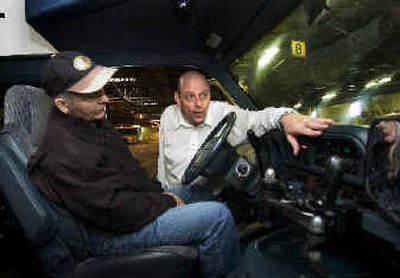
Volunteer drivers will use STA pool vans to take those who’ve lost service at their homes to various transfer points within the new boundary. There, they’ll be able to take paratransit vans to their final destination.
The process works in reverse on the way home.
Starting today, one call to STA will schedule both the paratransit and rural feeder trips, which begin Jan. 16.
“The reason I got involved is a lady in our church was going to lose her service,” said Chuck Wilkes, associate pastor at Spokane Valley Church of the Nazarene.
“This kind of help is precisely the kind of thing that churches or in a broader sense the faith community, ought to be doing. We often build churches and church buildings and tell people to come to us. But the model we ought to be following is finding things that need to be done and people that need to be helped and we have to go out into the community to do that,” Wilkes said.
Leading the charge is the Spokane Valley Foundation, which already offers transportation services to some disabled and elderly people in the Valley.
“I’m already doing dispatch. It’s an easy expansion of our program,” said foundation CEO Norm Patton.
The Coalition of Responsible Disabled (CORD) has been working to draw up policies and procedures and is conducting background checks on volunteer drivers.
“Several people kept calling us and were upset about the boundaries, so we knew we had to do something,” said Linda Schappals-McClain, CORD’s executive director.
Riders won’t have to pay anything more than their usual paratransit fare thanks to a $44,000 Washington state grant obtained by STA. That money is expected to last through June.
STA employees were the first to consider using their van pool service as an alternative to paratransit service. The difference is the clientele. Most STA van pools are operated and used by people commuting to jobs at large companies.
“The one program we have that wouldn’t be constrained by the ¾-mile limit was the van pool program,” explained Steve Blaska, STA’s operations director.
So far, more than 80 people have signed up to use the rural feeder service, which is still a work in progress.
Volunteers were being trained Friday by STA, and the search is on for many more drivers.
The Spokane Valley Foundation will be paying four people to drive routes and some CORD employees will drive during the initial roll-out. The hope, though, is that more community volunteers will drive routes so the service can be expanded.
Right now there are enough people to drive people to the most important destinations, like medical appointments and work, but other trips could fall through the cracks.
At a meeting last week, one group home operator asked about dances that her residents like to attend. Would there be service available on weekend evenings?
Probably not right away, was the answer.
“It will go off like a Pinto rather than a Cadillac,” said Patton in a later interview.
Initial bumps aside, most are relieved that service won’t disappear altogether.
“For the most part, I’m pretty happy,” said Schappals-McClain. “But it’s a short-term solution.”