
A to Z Artful

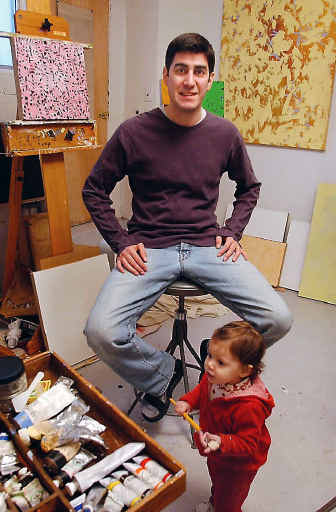
For Michael De Feo, the letter A stands for ant, a giant one, that he glued to a concrete wall in Manhattan. And B is for a beach ball, a giant one painted in primary colors, tacked on the side of a Dumpster. C is for cherries, hanging from under a chain-link fence, and D is for deer, frolicking in the plywood exterior of a boarded-up building. For De Feo, 32, an accomplished street artist and art teacher at Westhill High School in Stamford, Conn., the streets of New York are his canvas.
Although De Feo has always favored sharing his art in an unorthodox way, earning himself a few police summonses, he has gone legitimate, sort of, and produced a children’s book.
“Alphabet City” (Gingko Press, $19.95), a collection of his street art representing the letters A through Z, makes its debut this month. Its flip board-book style was a deliberate attempt to appeal to hip parents and children alike, and put his street art in a new, accessible format.
Although the book project was conceived before the birth of his daughter, Marianna, who just celebrated her first birthday, children were his inspiration.
Kids have long been the biggest fans of De Feo’s street art, which he has been gluing to walls in Manhattan and other cities since his days at New York’s School of Visual Arts. He is known in the street art world as “The Flower Guy,” for his signature Keith Haring-inspired flower, which he has tacked all over New York, 15,000 of them by his own estimate.
“I would be putting it up, and they would stop and point it out to their parents,” he says. “Sometimes, it’s kids who pay closest attention to the details of their environment.” since De Feo’s work has always been driven by a friendly desire to get people to stop and pay attention (and maybe see their urban environment a little differently), he was inspired to do something kid-specific. He pitched the book to David Lopes, publisher of California-based Gingko Press. Lopes has published other street artists’ collections and saw the potential for a board book in De Feo’s work. Lopes says it’s the first time his imprint has ever presented street art in a format for children.
“Michael is playful about his art. He doesn’t take himself too seriously, which is what sets him apart from some other street artists,” Lopes says. “He also has intentions for his art I think are very good.”
De Feo says the concept of creating the book so energized him he spent two years creating his alphabet, posting it in odd places in New York and photographing his finished displays.
“It was fun coming up with ideas for the alphabet that weren’t traditional,” he says. Some of his favorites: His G is a giant giraffe displayed in SoHo; his N, a bird’s nest on a barren brick wall; and his M, a funky mushroom sprouting in a field of worn graffiti, brick and some promotional posters. His J, an edgy jet plane, is not typical of his usual open style. “But in a time of war, I felt it worked,” De Feo says. He deliberately juxtaposed it with the gentler image for K, a girl flying a kite, letting the imagery speak for itself.
De Feo is not a traditional, hip-hop-style graffiti artist or tagger, but a street artist who often begins his projects in his studio, where he usually works in paint and paper. He then takes his finished work outside and glues it to brick, concrete, plywood. He works somewhat covertly and never asks permission to hang his art.
“Some street artists get dressed up in uniforms, maybe a red hat, a vest and a badge, and pretend they are doing something official, but I don’t bother,” he says. “I’m proud of what I do. Yes, it’s illegal in the sense that I can be fined the same way a graffiti artist can be for using a can of spray paint, but there’s no harm in what I do. Eventually it disappears. It’s not permanent. The rain and the elements wash it away.” He says he is rarely stopped or questioned about what he’s doing when he works, often going out to glue paintings to city surfaces before dawn. “I’ve gotten a few police summonses,” he says. And, “I’ve had some interesting conversations with homeless guys who wanted to help me hang my work. One guy told me he wanted to curl up and sleep under my giraffe. That was kind of strange. But I’ve never been arrested.”
De Feo, who has been teaching at Westhill for seven years, says he doesn’t see conflict between his art and his role as an educator, despite the fact that he often defies the law to show it.
“I feel comfortable defending it, because if it was completely legal, street art wouldn’t exist. And it has a legitimate place in the urban landscape,” De Feo says. By displaying his art the way he does, he says, “I really feel like I’m having a dialogue with people. I could show my work in galleries. … I do show my work in galleries … but that isn’t the same, because it’s not accessible in the same way. Part of my goal as an artist is to be true to myself, and this is how I accomplish that.” Although he doesn’t advertise it, he has never kept the fact that he’s a street artist from his students.
Many of them, he says, are interested in his book and the concepts behind his work.
“I try to be low-key about what I do outside the classroom with art, but it’s impossible with my students,” he says. “They Google their teachers. They go on my Web site. They’ve heard about the book, and they have been excited and supportive. No one at school has complained.”
De Feo says he is excited about the book because it puts his work in another context that is true to his artistic intentions. “My work is always done with the intent of being friendly and approachable,” he says. “And put in the format of a kids’ book, it is exactly that.”
The book already has one critical fan. His daughter, Marianna, got her copy earlier this month and immediately started flipping through it and staring at the pictures.
“I took that as a good sign,” the artist says.