
Pets need TLC in the heat

Kaye Kamp, a 4-H leader and Math and Science teacher at Post Falls Middle School, currently owns two rats, three rabbits, five laying hens, three dogs and four cats. She knows the importance of keeping her animals cool.
“One year when I was a kid I had a hamster,” she said. “I went away to summer camp and my mom put it outside to get some fresh air even though I’d asked her not too. Hamsters are burrowing animals in the wild. They are used to going down in the ground to keep cool. There was strong sun and it died.”
Kamp has learned a few tricks since then.
“For one thing indoor animals are usually easier to keep cool,” she said. “If you have a basement that’s cool you might move cages to that spot – especially if you don’t have AC.”
If the cages aren’t moved, she encourages careful placement of them. “Maybe the winter sun was OK, but the summer sun will really heat up more,” she said. “And if your animal is outdoors, it needs to be in a shaded area. Always keep in mind the place the sun rises and sets.”
Both Kamp and Toni Sumerlin of Ferret Rescue of North Idaho believe in using full frozen water bottles to cool smaller pets.
“Ferrets don’t do well over 80 degrees, and at 90 degrees you’ll start losing them to heat stroke,” Sumerlin said. “Freeze a bottle of water and wrap a towel around it, put it in the cage.”
Kamp said the animals can lean against the frozen bottle and lick the moisture from its sides. But, she warns, when you prepare the bottle to freeze, make sure it isn’t completely full, because when it freezes and the water expands, “it could explode.”
Sumerlin also suggests using a large plant saucer. “As long as they can cool the pads of their feet it brings the body temperature down,” she said.
Kamp worries especially about rabbits and guinea pigs during the summer months. “They are really susceptible to heat,” she said.
The following tips, she says, can be used for most small animals.
“Get some burlap or heavy-weave cotton, maybe an empty feed sack – something that will hold the moisture. Wet it completely and wring it out so it isn’t dripping,” she said. “Drape it across the small animal cage, or on the side. This creates kind of a swamp-cooler effect. As the air goes through, it cools the air in their cage.”
Another old breeder’s trick for rabbits, Kamp said, is placing a misting sprinkler or a small fountain sprinkler several inches under the cage. “This allows the water to mist below the cage, not actually in the cage, and it can cool the air several degrees.”
Our feathered friends have worries of their own when the days get hot.
Doug Marler, owner of Only Birds in Spokane, pointed out that “The thing that shocks birds is the same thing that would shock us – moving from one temperature extreme to the other. The best thing to do for birds is keep them in a cool place and give them plenty of bathing water. Keep them away from the window and in a relatively cool house anything under 90 degrees.”
Birds get thirsty, too.
“They should have fresh water twice a day if you can, and certainly every day,” he said. “Little parakeets can go as many 12-15 days without water, but they certainly should have it. For my birds I change the water and give them clean water bowls twice a day.”
Doves and canaries use even more water. “They are great bathers,” he said.
Anyone who has a cat would recognize a cat’s preferred napping place – right in the middle of the nearest sunbeam. What cat owners may not realize is that their pets don’t always know when to leave their sunny spot.
“It’s always surprising; they’ll still seek the sunlight and lie in it,” said Dr. Patrick Carter, owner of Spokane Cat Clinic.
“When they start overheating they’ll start panting quite a bit and their breathing will get rapid,” he said. They may experience open-mouthed breathing and they will appear extremely uncomfortable.
“When they get to that point, one of the simple things you can do at home is take a cloth, moisten it with cool water and put it of their foreheads and neck,” he said. “Put the cat in a room with an oscillating fan, then repeat the cloth application. Repeat this until the animal seems to respond.”
A third home-cooling method is to “wet their whole body down,” he said.
Carter encouraged cat owners to take their pet to see a veterinarian right away if they don’t respond to the cool-down treatments.
For fair-haired and light-skinned or white kitties, the sun danger can be even more serious. “Everybody is real cancer conscious with our skin,” he said. “Light-colored cats are especially prone to cancers.”
Carter suggested keeping cats indoors between the hours of 10 a.m. and 4 to 5 p.m. to lessen their exposure to direct sunlight.
“Short-haired cats, especially light-colored ones, can get sunburned,” he said. “There is a sunscreen that you can apply as a preventive measure, but the best thing is to keep them indoors during those hours.”
Finally, Carter said cat owners could have their pet’s hair clipped shorter for the summer season to help keep it cool. This is highly important with a thick-haired animal.
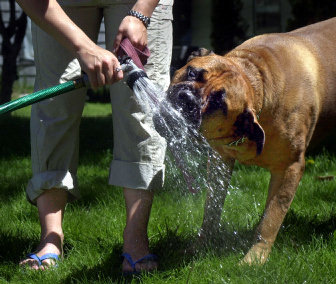
Remember, the Humane Society recommends that dogs have access to plenty of water at all times, and that they should have shelter from the sun and a way to cool off when the sun rises. The organization cautions pet owners to be aware of the signs of heat stress – heavy panting, glazed eyes, rapid pulse, vomiting or a deep red or purple tongue. Steps similar to those Carter mentioned for cats should be taken to cool the dog.
The Humane Society’s Web site offers this advice: give the pet water to drink, cover his coat in cool water, and get him out of the sun. Never immerse the animal in ice cold water as that could be a shock to his system. Seek veterinarian care if symptoms are not significantly reduced in a few minutes. Take care to monitor body temperature and keep your dog cool when transporting him to a veterinarian.
One way to be certain your pet is prepared to face the upcoming heat is to research your animal’s origin.
“Find out where it came from in the wild, before it was domesticated,” said Kamp. “That is the kind of environment you want to emulate. Some pet stores could tell you the history of the animal. You always want to make sure that you don’t put them in a type of environment that is different.”
This summer when the mercury rises, and you feel like drowning in gallons of fresh lemonade, heading for the nearest swimming pool or relaxing with a romance novel and an oscillating fan – wait. Before you get too settled in, remember the pets.