
Appeal the world over
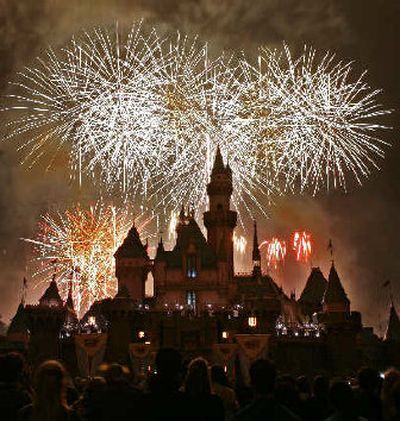
ANAHEIM, Calif. – Uncle Walt, the storyteller, saw it this way: “Disneyland is like Alice stepping through the looking glass; to step through the portals of Disneyland will be like entering another world.”
And if the locals were at first perplexed – “What’s a Disneyland?” – lore would soon have it that the magical kingdom sprang from the orange groves as if, well, by magic.
In the 50 years since Walt Disney flung open his gates on July 17, 1955, more than 500 million “guests” have stepped through his portals, willingly surrendering to his fanciful notion that “Here you leave today and enter the world of yesterday, tomorrow and fantasy.”
Disney’s vision has transformed not just Anaheim, but the American consciousness. His creation was a story he would tell Americans about themselves, about “the essence of the things that were good and true.”
Yet the storyline appeals to people the world over. When Hong Kong Disneyland opens in September, it will make for a total of 11 Disney theme parks on three continents, each as much a state of mind as a destination.
There was pixie dust in those California fields – in Disney’s imaginative ideas about how we experience the world around us, what urban planners call a sense of place.
At the very moment Disney was searching for fertile ground, postwar Americans were moving in droves to the suburbs, where they would come to lament the loss of unique urban identities. That yearning persists for public spaces where people can naturally gather. It’s evident in Anaheim and other cities across the country where developers have revived fading downtowns and designed new “town centers” and “village squares” that connect people with their environment.
Disneyland is a realm “at once new and familiar,” explains Linda Berman, a vice president with Caruso Affiliated, a Los Angeles developing firm that specializes in public spaces. A realm where the currency is happiness, right down to the yellow “HAPPY” stamped on visitors’ hands for in-and-out privileges.
In the early 1950s, Disney the filmmaker and Anaheim’s ambitious city fathers were partners in search of one another. The post-World War II population and economic boom was on, and Anaheim intended to ride it.
Many of the servicemen who had passed through California’s military bases – half a dozen in Orange County alone – made the Golden State their home. One, an Army veteran named Keith Murdoch, had become Anaheim’s city administrator.
The city aggressively courted industry and annexed land at a furious pace. It stood ready to provide prospective businesses all the necessary infrastructure.
Still, Anaheim was, as they say in the movie industry, a bit of a sleeper. At mid-century it had just 14,556 residents. Founded by German immigrants in 1857, it was dominated by the orange groves that replaced vineyards wiped out by a late 19th century virus.
But this agricultural community also had an eclectic flair for the entertainment business. In the 1880s, it built an Opera House (where plays were performed, though never an actual opera). A Halloween parade grew so popular it was televised.
A future mayor, in 1952, opened an entertainment center described as “part zoo, part park and part nightclub” and featuring Jerry, “The World’s Most Human Chimp.” Jerry was known to wait tables.
Walt Disney, meanwhile, had commissioned the Stanford Research Institute to survey Southern California for a place to build a theme park – an idea percolating in his frustration as “a daddy with two daughters wondering where he could take them where he could have a little fun with them, too.”
He considered and rejected 16 acres next to his Burbank studios. He wanted a bigger, blank canvas, “to mold his own hills and mountains, and dig his own lakes,” says Tim O’Day, a Disneyland spokesman and student of the park’s history.
Seventy potential sites were studied. Prevailing winds, average maximum summer temperatures, freeway master plans – this and more was taken into account. All roads, many of them still dirt byways, led to Anaheim.
“I don’t know, Keith, that we really want a honky-tonk amusement park,” Murdoch remembers Mayor Charlie Pearson saying.
The mayor fretted over the prospect of streets littered with peanut shells. Disney – armed with movie cells to illustrate his elaborate dreams – promised there would be no shelled peanuts. A deal was struck.
Not quite a decade later, in 1963, renowned developer James W. Rouse, in a keynote address to the Harvard Graduate School of Design, issued this pronouncement: “I hold a view that may be somewhat shocking to an audience as sophisticated as this: that the greatest piece of urban design in the United States today is Disneyland.”
On opening day, 15,000 people were expected. A “Disneyland” television show on ABC – now owned by the Disney company – had built audience interest for almost a year.
It worked, all right. Some 28,000 people showed up. They counterfeited tickets and climbed walls to get in. High-heeled shoes, in the 100-degree heat, stuck in newly poured asphalt.
The three hosts – Ronald Reagan, Bob Cummings and Art Linkletter – struggled with the unpredictability of live TV, before an estimated 90 million viewers.
On Main Street, actor Fess Parker, dressed as Davy Crockett, rode up to new employee Martin Sklar, then 21.
“Marty,” Parker instructed the man who is now vice chairman and principal creative executive of Walt Disney Imagineering, “get me out of here before this horse hurts somebody!”
Disneyland’s old-timers still call it “Black Sunday.” But something important happened that day, and a singular moment captured it: A beaming Frank Sinatra was filmed riding Tomorrowland’s Autopia, an idealized version of the highways then transforming the American landscape.
Here was a prosperous, clean, safe and – above all – fun world. Americans saw what was on the other side of those portals Disney talked about, and they wanted in.
Disneyland, as Rouse would say, was “a brand new thing.” Costumed street sweepers kept it spotless. It was staffed for “guests” by well-mannered and clean-cut “cast members.” Public areas were “onstage,” with park operations kept out of sight “backstage.”
Disney made his reputation in 1928 with the film debut of Mickey Mouse. And guests approached Disneyland like a film.
The main gate was the lobby, and the view down Main Street the “long shot.” At its end, Sleeping Beauty Castle beckoned viewers, drawing them to a plaza that formed the hub of a wheel. Each spoke led to a different “land,” orienting visitors – “You always know where you are,” says O’Day.
Scale was kept at a human level. Sleeping Beauty Castle is only 77 feet from moat to the highest spire.
It was all about storylines and illusion.
If there was a Main Street, it should have a newspaper. Disney hired Sklar, new editor of UCLA’s college paper, to create one.
Once Sklar and a photographer drove down a dirt road paralleling Frontierland’s Rivers of America. They passed a man in a floppy hat and construction boots. It was Disney.
“What are you doing with that car in 1860?” he demanded to know, poking the photographer in the chest.
“That was my lesson in theming and story,” Sklar says.
The overall effect was summed up by the late John Hench, one of the park’s lead designers. Disneyland, he liked to say, allowed you to say hello to a stranger. Sklar believes the park is not so much about escapism as an acute sense of optimism and reassurance that comes directly from Walt Disney.
The Disney company and Anaheim have worked hand in hand since the 1990s to give the Disney area and Anaheim itself a distinct, pedestrian-friendly, palm tree-lined resort look – a signal to visitors that they have arrived someplace special.
Billions of dollars have been pumped into reinforcing that all-important sense of place. The additions of a new park, California Adventure, and the Downtown Disney retail and dining district reinforce Mayor Curt Pringle’s assertion that “Mickey Mouse is right in the middle of everything here.”
That mouse helped transform Anaheim into California’s 10th largest city, and the transformation began immediately. In the first years after opening day, it was the nation’s fastest-growing city.
Ron Dominguez grew up on one of the family farms that made up Disneyland’s original 60 acres. His grandfather planted orange groves there in 1910. As a boy, Dominguez built forts and had orange fights. His home stood about where the entrance is now to the Pirates of the Caribbean ride.
He started with Disney on opening day, as a Main Gate ticket-taker, and retired as an executive vice president in 1994. His last working years were spent reimagining Anaheim.
“We were trying to make a statement that this is our town,” he says.
And perhaps that was Walt Disney’s secret all along.
“Disneyland is your land,” he said that sweltering July day in 1955.
Which is why the guests streaming in this summer are in such a celebratory mood. They are donning commemorative golden mouse ears over the traditional black at a rate of eight to one.