
‘Mystery trip’ to Utah’s national parks brings more than a few surprises
My wife and I were nearing the halfway point of the near-mile-long Canyon Outlook Trail when I began thinking we’d made a bad decision.
We’d just arrived at the trailhead, in Utah’s Zion National Park, having made the three-hour drive from Las Vegas. And after waiting in a long line just to enter the park, we then joined the parade of cars, vans, buses and the occasional motorcycle all intent on seeing the ample natural beauty that Zion has to offer.
One example of that beauty mentioned in the guidebooks is the trail mentioned above, which is located just east of the Zion-Mount Carmel Tunnel.
Park information describes the trail as “moderate,” but we soon discovered what that meant. We found ourselves clambering over rocks, trying not to stray too close to the trail’s edge, which at spots falls away for hundreds of feet with no fence. Meanwhile, we had to dodge the scores of other hikers coming from both directions and pushing to get past us.
It was at that point, just as I began to question what we were doing, that I noticed a guy carrying a baby. Scampering behind him came a couple of children who seemed barely out of diapers. Wow, I thought, when did I get so old?
I should make it clear here what our objective was. For reasons that I won’t go into, my wife, Mary Pat Treuthart, had dreamed up what she termed as a “surprise mystery trip” for me. It wasn’t until just before we left for the Spokane International Airport that I opened the envelope that divulged everything.
It turned out to be a sojourn that was to begin in Las Vegas, would include a helicopter trip over the west rim of the Grand Canyon and watching the Gonzaga University men’s basketball team play Alabama. Then we would take a road trip through what is known as Utah’s “Mighty Five” national parks: Zion, Bryce, Capitol Reef, Arches and Canyonlands.
I was surprised and a little anxious about such an ambitious plan. But I was game, especially at the prospect of getting to see each of the national parks.
Let’s consider each of them, one by one.
Grand Canyon
Our sunset helicopter ride – which we my wife and I shared with two couples from Great Britain and our pilot Chris – ended up being a three-hour-plus round trip from Las Vegas’ Harry Reid International Airport.
Having flown over Hoover Dam and past Lake Mead, our Maverick Helicopters aircraft soared some 10 miles along the canyon’s west rim before dipping down toward the Colorado River. Our pilot landed on a ridge above the river where the six of us enjoyed some snacks and drinks while feeling overwhelmed by the surrounding majestic rock formations.
Then we headed back into the fading sun toward the brightly lit Las Vegas Strip, having been awed by the vast canyon’s grandeur – an overused word, I know, but appropriate. The next day we headed out in our rental car to explore the so-called “Mighty Five.”
ZionZion has been described as “a true heaven on Earth.” And that’s a good description as any, considering the park’s array of craggy sandstone cliffs and other awesome geologic features.
We benefited from visiting during the week of Thanksgiving when the park wasn’t nearly as crowded as it can be during the summer months. A shuttle-bus driver told us that during the summer as many as 30,000 riders a day travel on the park’s free shuttle system, with stops that include the visitors center and the nine points of the Zion Canyon Scenic Drive.
After having finished our Canyon Overlook Trail trek, we drove to where we’d booked rooms at the Zion Wildflower Resort in Virgin, Utah. Returning to Zion the next morning (which was Thanksgiving Day) we jumped on the shuttle. After checking out the Zion Lodge, we hiked to the Lower Emerald Pool (one look at the steep incline to the Upper Pool and we nixed going any farther).
There is so much more to do in Zion, not just for campers and day hikers but also for the casual visitor. Yet we had many miles and more parks to see. So, we opted to leave. Before returning to our resort cabin, however, we drove the scenic 20-odd-mile road to the Kolob Reservoir. We ended the day enjoying Thanksgiving dinner at Springdale’s Spotted Dog Restaurant.
Bryce Canyon
I first visited Bryce Canyon during the mid-1950s, and even from the back seat of my family’s station wagon I could see how much Bryce differs from Zion. Whereas much of Zion requires you to look up at dark craggy slopes, in Bryce you tend to look down at a brighter, what looks to be pinker, landscape.
While Bryce Canyon’s 56-square-mile size is far smaller than Zion’s 229 square miles, what it features is every bit as picturesque, beginning with the Red Canyon tunnels that you drive through even before you arrive. We headed to Inspiration Point, which sits at an elevation of 8,320 feet and offers you a spectacular view of the park’s trademark features: its hoodoos, said to be the largest collection of such rock spires in the world.
You might think that after our Zion hiking experience we would be reluctant to roam Bryce Canyon’s trails. We weren’t, but then we saw that most of them, including the Rim Trail at Bryce Point (elevation 8,330 feet), were either closed or too ice-encrusted to walk along safely. Be careful and live to hike another day, I always say.
Capitol Reef
Leaving Bryce Canyon, we drove Highway 12 toward the park that we knew least about, Capitol Reef. The road from Bryce to Capitol Reef is a scenic wonder in itself, said by Forbes magazine to be one of the country’s memorable driving routes. Especially impressive was the view from Escalante Overlook, which takes in the whole of the Escalante River drainage, described as “a labyrinth of canyons, mesas and rolling slickrock.”
Capitol Reef comprises a widely spaced desert landscape (378 square miles) and, according to the National Park Service, 15 official hiking trails. Choosing between “easy” to “strenuous” trails, we (surprise) opted for the former. Capitol Gorge took us a mile over a dry streambed and between towering rock cliffs. After that, we attempted the harder Chimney Rock Loop, but good sense kicked in and we stopped before things got too, uh, strenuous.
Most entertaining moment: When we passed a family walking with a dog who warned us, “Watch out for the poop.”
Arches
After staying overnight at the Capitol Reef Resort, we headed toward Moab, Utah, and our final two parks. After lunching at Duke’s Slickrock Grill in Hanksville, Utah, we made it to Arches National Park just before 4 p.m. Over its 120 square miles, the park is known for having the “highest concentration” of natural stone arches, many of which are accessible through trails.
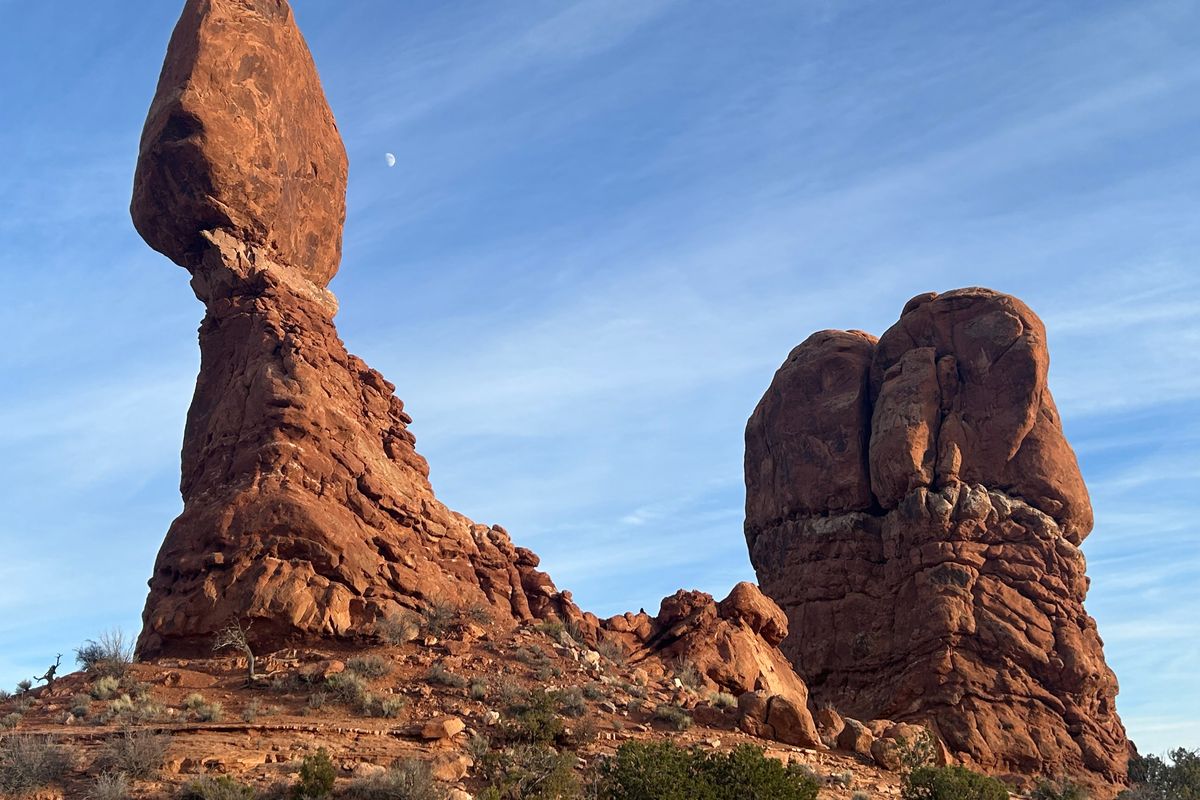
Driving the twisty road from the park entrance, we stopped first at Balanced Rock, the 128-feet-tall sandstone rock sculpture that begs to be photographed. Then we headed to Delicate Arch, which can be seen from two viewpoints, lower and higher, that sit a mile away.
We could see in the distance far more ambitious (and I hoped much younger) hikers who were navigating a 3-mile roundtrip to the arch itself. As the sun was setting, we called it a day.
We returned later to see more of the park and to make up for missing our hikes in Bryce. This time we explored the half-mile Windows Trail, made our way through the narrow cliffs toward Sand Arch, past Broken Arch (which isn’t actually broken), before finishing with a series of easy hikes to Skyline Arch, Pine Tree Arch and Tunnel Arch.
Canyonlands
After overnighting at the Moab Springs Ranch and eating dinner at the upscale Desert Bistro, we drove to Canyonlands National Park. At 537 square miles, this park is Utah’s biggest and is split into distinct parts. We explored what is known as Island in the Sky, so named for its trademark red-and-white-banded rock pinnacles.
A bout of rain, sleet and cold dampened our enthusiasm even to exit our rental car. Still, we did traipse 20-odd minutes toward Mesa Arch along a relatively well-marked trail. Then we drove to the end of the road, parked at the Grand View Point Overlook and hiked maybe a mile before the weather pushed us back.
We made several stops on our way out, the most impressive being the Green River Viewpoint, which offers a majestic view of the desert landscape that makes Canyonlands so special.
Before heading back to Las Vegas, though, we spent the night in Monroe, Utah, site of Mystic Hot Springs. It was dark when we arrived at the springs, which offers only sparse accommodations and is hard to navigate in the dark.
But as we relaxed in the warm water, under countless billions of stars, we couldn’t stop talking about what we’d seen of Utah’s parks.
Turns out we’d made some good decisions after all.