
U.S., N. Korea hold lengthy talks
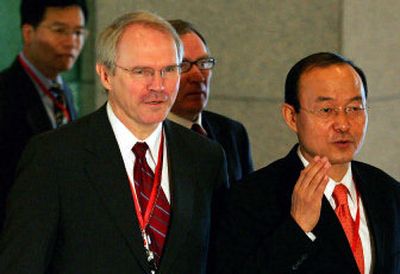
BEIJING – U.S. and North Korean envoys held their fourth one-on-one meeting this week today as six-nation talks aimed at persuading Pyongyang to abandon its nuclear weapons program stretched into the longest such negotiations since the process began in 2003.
U.S. Assistant Secretary of State Christopher Hill began a one-on-one meeting with North Korean Vice Foreign Minister Kim Kye Gwan at the state guesthouse where the talks are taking place, China’s official Xinhua News Agency reported.
No deadline has been set for the nuclear talks in the Chinese capital to wrap up, unlike other sessions that lasted about three days.
“We’ll just keep at it just as long as it’s useful to keep at it. I’ve got plenty of patience,” Hill said today.
He said his meeting with the North Koreans would focus on discussions of denuclearization of the Korean Peninsula – the buzzword of the negotiations whose definition remains a point of contention.
North Korea insists the United States remove its alleged nuclear weapons from South Korea as well as its “nuclear umbrella” of security guarantees to its ally, while others say denuclearization means just getting rid of nuclear weapons from North Korea. The United States has refused to make any concessions until the North is certified as nuclear-free and inspectors can monitor that it stays that way. “We had some of their ideas, which we did not feel were usable, but we had some of their ideas that very much correspond to some of the ideas we have,” Hill said. “We’ll have to wait and see how it goes.”
Earlier talks produced no breakthroughs, and many delegates said they didn’t expect any in this round, which convened after a 13-month hiatus during which the North refused to participate, citing “hostile” U.S. policies. Most parties have said they hope merely to set a date for a fifth session.
Despite the meetings with the North Koreans, the U.S. ruled out negotiating a bilateral agreement. “That approach was tried and it failed,” White House press secretary Scott McClellan said Thursday, referring to a 1994 pact that collapsed after U.S. officials accused North Korea of running a secret uranium enrichment program in late 2002. The North later pulled out of the Nuclear Nonproliferation Treaty and restarted its nuclear reactor, spawning the current crisis.
Hill said earlier that he hoped to start drafting a statement by the end of today with results of the talks so far – a possible indication that negotiations were inching forward. American officials have said the document would contain “agreed principles” for future negotiations. “We’ve had a lot of discussions with a lot of the delegations, so we’d like to see if we can put some of these thoughts down on paper and see where we are,” Hill said Thursday. “We have a long way to go still.”
The six-nation talks that began Tuesday are the fourth round in which China, Japan, Russia, South Korea and the United States have come together to press North Korea to give up its nuclear ambitions.