
Valley firefighters triage area homes
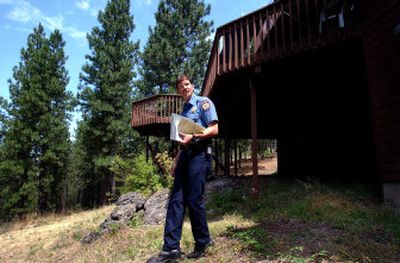
Richard Burd knows a wildfire is just a spark away.
That’s why the Liberty Lake resident has taken numerous precautions to protect his home.
His roof is cement tile, the numerous pine trees around it are trimmed, the driveway provides good access for fire trucks and he’s eliminated almost all types of plants that could fuel a fire.
Burd’s home is one of 37 properties off of Greenridge Road, a heavily forested area in Liberty Lake, that Valley firefighters are assessing in case of a wildfire, said Capt. Jon Sprague, of Spokane Valley Fire Department.
“I expect we’re going to have a significant amount of fires next month,” Sprague said Thursday. “It’s tinder dry after last week’s hot weather and it’s going to get nasty. The fuels are there, the drought is here … everything is in place for a big one.”
Temperatures drying out the unusually high amount of vegetation that sprouted from a late wet season aren’t expected to let up in the next seven days; an additional concern to firefighters. The National Weather Service’s forecast for high temperatures over the next seven days ranges from 88 to 97 degrees.
“It’s at least a 10-minute response,” Sprague said of the Greenridge area. It’s important to get out and let homeowners know what they can do.
The assessment, or “wildfire triage,” is a program to inform residents of what they can do to improve the survivability of their home, and it lets officials know which ones can’t be saved without risking firefighters’ lives.
The Valley has about 800 to 1,000 homes that are potentially at risk if a wildfire strikes, and the Valley fire department has 10 stations, Sprague said. The math is obvious when people think about the amount of resources on hand.
“During a firestorm, the first one who cries gets the resources,” Sprague said. Wildfires are seasonal. The big ones may only hit every 15 years or so, but a fire department can’t budget for that, so departments do what they can with the resources they have.
The wildfire triage is being done to help residents help themselves.
Liberty Lake has 300 homes that are potentially at risk, which is the largest amount for one area, Sprague said.
Burd was one of the better prepared homeowners in the Greenridge area. He said the precautions he took were thanks to advice from the Department of Natural Resources, Washington Forestry Department and Valley firefighters.
“A DNR man marked all the trees with a blue line that we could save,” Burd said. “The rest of the trees have slowly been cut down. We also cleaned out all the trees lost during the ice storm.”
“But you are only as safe as your neighbors,” Sprague said.
Down the road was a home where Sprague had numerous concerns. The home had an aged wood-shake roof sprinkled with moss and pine needles – “no matter how defensible the space around the house is the roof is a problem. It’s one of the worst roofs I’ve seen.”
Along the driveway were overhanging branches and a dead pine tree that, if it caught fire, could fall across the driveway and block firefighters in. Both would prevent firefighters from possibly saving the home.
The home did have a couple good points, a well posted address at the roadway and 30-foot clearing between the house and a majority of the trees.
“We will always show up to do what we can,” Sprague said. “But we’re not going to put the firefighters in danger.”
Fire officials in Spokane County Fire District No. 8 are also preparing for the wildfire season.
The district has 14 volunteer wildland firefighters on standby from now until about mid-October. District 8 protects several of Spokane’s forested areas including Park Hills, the Ponderosa community, Painted Hills and Bella Vista.
“This year there are a lot of flashy fuels, like tall grasses that are ladders for fires to get up into the pine trees,” said Deputy Fire Chief Dan Blystone.