
Priest River Experiment Station
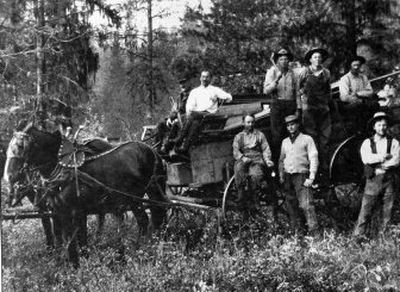
In August 1911, a party consisting of Raphael Zon, head of the Forest Service’s Office of Silvics, and Robert Y. Stuart and F.I Rockwell from the District (now called the Regional) Office visited the Benton Ranger Station in the Priest River Valley bringing in the basic supplies needed to establish the Priest River Experiment Station.
In addition, the Chief of the Forest Service, the Regional Forester, and other prominent foresters visited and approved of the area. The location offered the ability to study climate and ecology of forest types. Within a half mile of each other were found available sites illustrating the entire range of conditions in the region from the moist northeastern slopes to the dry southwestern slopes with an intermediate type in between.
The Savenac Nursery, rebuilt after the 1910 fire, also was vailable to supply seeds and other assistance.
There were two main drawbacks to the area. One was the isolation of being 15 miles from a railroad, which meant mail was delivered only twice a week in the winter and three times a week in the summer; however, a railroad was anticipated within a few years. The other drawback was the expense of freighting heavy equipment and building supplies to the area. Both problems were seen as minor compared to the advantages.
By Sept. 1, 1911, Zon and Rockwell along with William W. Morris, on temporary assignment from the Coeur d’Alene Forest, and Donald H. Brewster, on temporary assignment from the St. Joe Forest, began the preliminary work of creating the physical facilities.
Along with 10 men, including “Dad” Crosby, teamster Howard Simpson and Douglass MacDonald, the cook, they set up camp, and by October preliminary work had been completed, and the remainder of the work was left to Brewster and MacDonald, who had been appointed Forest Guard.
Although there were few residents in the area, a number of ranches within a short distance of the station could supply fresh milk, butter, eggs and vegetables. They would also provide labor for extra work at busy times.
The station was already connected with the Kaniksu telephone line providing access to Priest River and Coolin a few miles away. A journal entry in Donald Brewster’s log book indicates that the Forest Service personnel were accepted by the local ranchers and that a “house warming in the laboratory building ended at 6 a.m. and was attended by about fifty people. Every one voted it the most successful affair of the season.”
To replace the tents and temporary structures, several buildings were built and other improvements were made. These included a trail 8 feet wide to connect the weather stations with the laboratory, a road 12 feet wide connecting the buildings with the ranger station and stage road, and a foot path along the north side of the creek to the stage road. Several areas were cleared to prepare for a nursery and other buildings. A gravity water system that made 13 gallons per minute was installed with a pipe about 3,200 feet up Benton Creek.
Along with the laboratory, an office building of 24-by-26-feet, a story and a half tall and containing five rooms, was built by late October. The office also contained a large laboratory, workbenches, filing cases and a herbarium with specimen cabinets. A kitchen completed the first floor.
During the first year, the building was used by Brewster for his residence, while McDonald and his family occupied a one-room cabin (12 by 20 feet) built on the site. A greenhouse (12 by 18 feet) was constructed on the southeast side of the laboratory so that it would receive the best sunlight.
The Forest Service had also provided tools and equipment such as aneroid barometers, anemometers, photometer, camera and tripod, microscope, herbarium, seed sampling machine and a pendulum clock for maintaining standard time.
According to the Annual Report, the grand total for establishing the Station was $3,071.04.