
Off limits to off-roaders
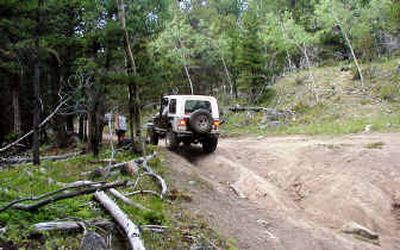
For decades, off-road vehicle enthusiasts have been mostly free to roam federal forests and rangelands at will. But their freewheeling days could be numbered.
In a move expected to generate controversy, the U.S. Forest Service and Bureau of Land Management are developing plans to restrict the vehicles to designated routes and areas.
Federal officials say the proposal is essential to curb environmental damage and ease conflict among users of public lands. Nationally, they cite a sevenfold increase from 1972 to 2000 in the number of off-roaders to 36 million.
“The days of blazing new trails are coming to an end,” said Leo Drumm, off-highway vehicle coordinator for the Nevada BLM. “Off-highway vehicles are a legitimate use of public land, but there has to be some controls.”
Nowhere would the proposed changes have a bigger effect than Nevada and its wide-open spaces.
The federal government controls 87 percent of the state, and Nevada is home to the largest national forest outside Alaska: the 6.3-million-acre Humboldt-Toiyabe.
While the vast majority of Nevada’s backcountry is currently unrestricted to off-roaders, federal land managers have begun the process to ban travel off designated routes and areas.
And while the changes might be most dramatic in Nevada, similar efforts to address off-road travel are under way across the West.
“We’re all recognizing at the same time the need to work on this issue,” said Bob Vaught, supervisor of the Humboldt-Toiyabe. “There’s widespread agreement that we need to do a better job of managing off-highway vehicle use.”
Even though a Forest Service national off-road policy awaits final action nearly a year after it was unveiled, individual national forests are being encouraged to address the issue because of soaring off-road use.
Federal land managers are taking a cue from Forest Service chief Dale Bosworth, who identified unmanaged recreation as one of the four biggest threats to national forests.
BLM Director Kathleen Clarke shares Bosworth’s concerns.
Environmental and motorized recreation groups praise federal officials for confronting the issue, but they say a battle looms over which roads and trails to close and keep open.
Conservationists said they’re concerned not enough roads will be closed to protect wildlife and habitat.
Most hunters welcome the push to keep off-road vehicles to designated routes and areas, said Stan Rauch, hunter outreach coordinator of the Washington, D.C.-based National Trails and Waters Coalition, which seeks better management of the vehicles on public land.
Traditional sportsmen have accused those who go off road to hunt using all-terrain vehicles of disturbing their hunts and punching out more new roads in remote regions across the West.
“It’s a good positive development for the land and users looking for a quality experience on public land,” said Rauch, a big-game hunter from Victor, Mont., and member of the National Rifle Association.
Vehicle enthusiasts will try to keep as many roads and trails open as possible, said Brian Hawthorne, public lands director of the BlueRibbon Coalition, a motorized recreation advocacy group based in Pocatello, Idaho.
“What we want are managed off-highway trail systems and areas that are sustainable and that we can enjoy for generations to come,” Hawthorne said.
Federal land managers, including those on the Colville National Forest, are working with various groups to identify roads and trails suitable for vehicles.
Every national forest is different and has to evaluate its own needs and abilities to provide for motorized use and recreational use at the local level,” said Jerry Ingersoll, the Forest Service’s Off-Highway Vehicle Program manager in Washington D.C.
“The answers they get from doing travel planning are likely to be just as different as the national forests are different from one another,” he said.
Implementation will vary, but some districts are shooting for as early as 2007.