
Illegal thinning of trees and brush along Centennial Trail draws the ire of walkers
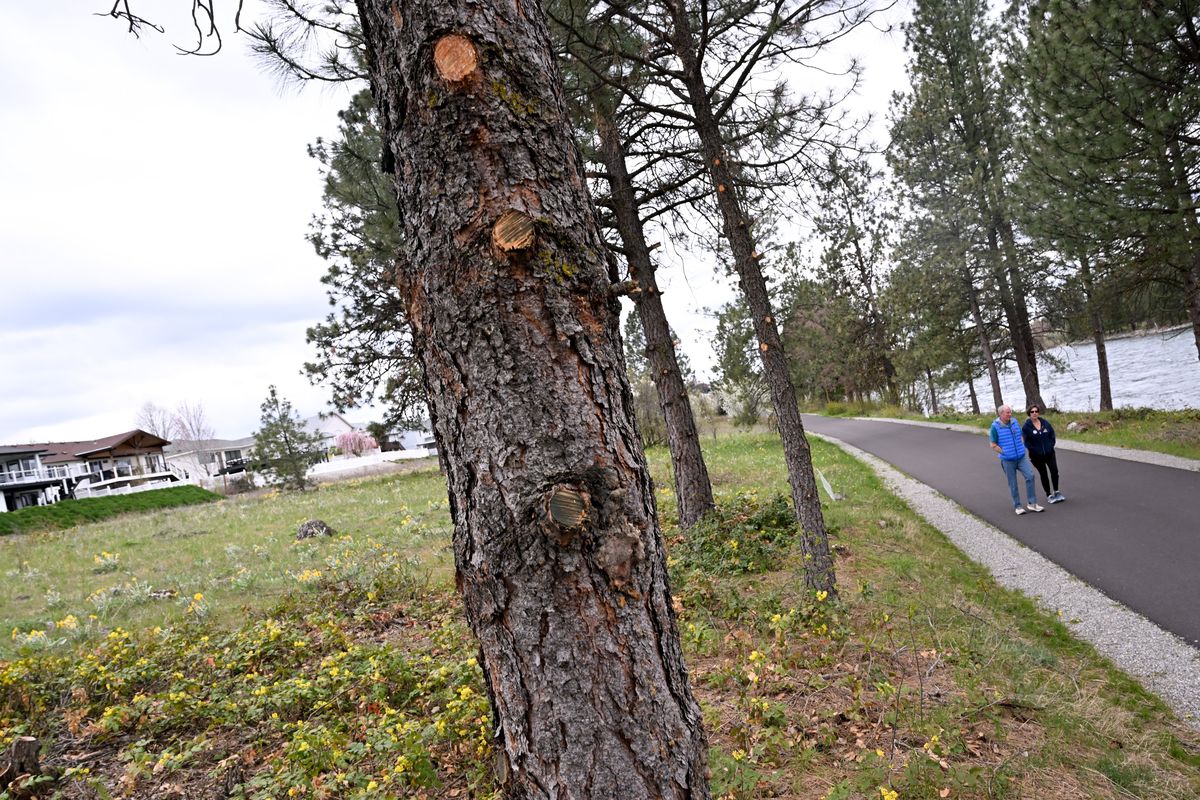
About a half-mile from the Barker Road Trailhead, the brush changes.
Stewart Bowmer walks the Centennial Trail with his wife, MaryMargaret, several times a week, taking in the bushes and trees alongside the Spokane River, watching them bloom and come back to life in spring. It was on one of these walks that the Bowmers noticed several sections of vegetation mowed down and trees delimbed or removed.
The Bowmers suspect that the thinning and removal of trees and brush were done by homeowners along the trail who wanted unobstructed views of the river.
Removing plants at state parks is illegal. People who do so along the Centennial Trail are subject to state Department of Ecology penalties in accordance with the Shoreline Management Act of 1971, according to Washington State Parks communications manager Sarah Fronk.
“Unfortunately, we’ve had several instances where we’ve discovered limbed trees and trees or bushes that have been removed from state park land along the Spokane River Centennial State Park Trail,” Fronk said. “These activities, they’re unpermitted and they’re illegal. What makes it worse is they’re most often occurring within the riparian area.
“All of that property is located within the shoreline jurisdiction.”
State park rangers have knocked on doors in the neighborhoods near the thinning trees to inform people about the vegetation and to discourage people from delimbing trees on state property, Fronk said.
Seeing the fresh cuts on trees along the trail and the mowed brush infuriated MaryMargaret.
“This is my happy place,” she said, gesturing to the trail. “Don’t mess with my river!”
The state cannot pursue prosecution unless someone is caught in the act of delimbing or illegally trimming vegetation. Without knowledge of who is responsible for the thinning areas along the trail, the state itself is required to replace the vegetation.
“We’re really hopeful that just by explaining why these areas are so important, that we can resolve all the issues along the Centennial Trail,” Fronk said. “Most people who visit state parks are there because they love nature and want to care for it, and we know that people who choose to live near our state parks and our state park trails also live there because these are beautiful places.”
The trimming and thinning vegetation also affects wildlife and the ecosystem along the river, Fronk said.
“The vegetation is there for the wildlife,” Stewart said. “It’s not the homeowner’s property. They think they can just do this outside their property, and I don’t like it at all. … It’s a criminal offense.”
The parks and trails will not stay beautiful if people keep interfering with the natural habitats, trees and plants that grow there, Fronk said. When people try to preserve a view of the river from their home, it affects the health of the river, she said.
Destruction of trees and native plants allows for invasive species to move in and change the plant community, which can significantly alter the local habitat, Fronk said. The roots from plants that naturally grow along the river catch storm water and filter it as it enters the river, which reduces heavy metals and other pollutants. Those plants also provide shade for young salmon, trout and fish that swim in the river, many of which are endangered, Fronk said.
Mike Allen, who lives just above the delimbed trees and mowed brush, said he hasn’t seen anyone cutting vegetation down – but he knows it’s been happening.
“I don’t know what happened to all the limbs. I imagine they were thrown in the river,” Allen said. “… Makes me sick.”
Allen’s been living on Riverwalk Lane for decades, and he said the delimbing, tree-trimming and bush mowing started recently.
“I didn’t see anybody do it,” Allen said, “but it’s pretty obvious.”
Allen has theories on who cut down the tree limbs and brush, but he doesn’t have any evidence to prove it.
Randy Woesner and his family were out of town when the brush and trees were trimmed. He was shocked by the way it changed their view of the river, but he said people need to get permission before doing that.
“You shouldn’t go rogue and do it yourself,” Woeser said. “You would think somebody would have heard it, the chainsaws and ladders. It’s crazy.”
The Spokesman-Review knocked on a dozen doors of houses along the Centennial Trail and left messages and notes seeking comment at the doors that weren’t answered.