
Misunderstood dogs have a friend in volunteer trainer
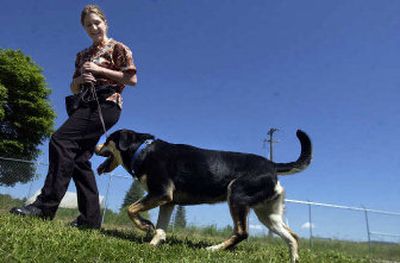
Otis greets familiar friends with two paw prints to their chest, but he doesn’t do that to Monica Mosqueda. For his volunteer trainer at the Kootenai Humane Society, he doesn’t dare jump up. He sits, heels and begrudgingly lies down, even though that’s not a command he enjoys.
To Mosqueda, Otis represents so many dogs that are misunderstood by humans. Owners of the three-year-old beagle mix felt he was aggressive and not good with young children. After a few sessions with Mosqueda, he still approaches strangers by snarling and backing away.
That behavior relegated Otis to a kennel in the back room of the shelter and off the adoption floor until he could be determined safe for handling. Mosqueda figured him out within five minutes, she said. His lack of socialization and fear was the problem. He growls because he’s unsure whether humans will hurt him.
“It’s all a secret language, and we as trainers need to figure it out,” Mosqueda said.
After several lessons with his trainer, Otis walks nicely on a leash, is less shy and happier to see her.
“His tail wags a lot more,” she said.
Mosqueda, a North Idaho native, graduated from a professional dog training school in Missouri six months ago and has been donating training time to shelters since then. She worked at vet clinics prior to school and has never been without a dog in her life.
“The first time I went to the shelter I cried and cried and had to leave,” she said. “The second time I cried and volunteered.”
Shelter manager Kerri Bailey and her Kootenai Humane Society staff members point out dogs in need of evaluation. Mosqueda takes on one at a time and teaches them skills they’ll need to fit into a home.
“If we see any kind of dominance or dog aggression, I have her take a look at them,” Bailey said. “We’re very lucky to have Monica do this for us. It’s a wonderful option.”
Tugging on leashes, jumping up and chewing are easy fixes, believes Mosqueda. They are not reasons to give up a dog.
“I believe that every single animal is fixable,” Mosqueda said. “It’s up to the owner and their determination, what they’re willing to learn.”
Challenges don’t scare Mosqueda. Her eyes light up when she hears of a blind dog coming to the shelter. She tells Bailey that she definitely wants to work with that one. She’ll teach him by sound.
No magic is involved in Mosqueda’s methods. She believes time and consistency are key. She uses a combination of motivation and correction: treats in her pockets and a calm, firm voice. She visits the dogs she works with four or five days per week for 15 to 30 minutes. Once she has established herself as the leader, dogs follow her commands. She rewards them with playtime and affection, which can be a scarce commodity in a shelter filled with 200 animals. Her future goals include teaching shelter volunteers to practice her techniques so dogs receive a consistent message.
Success stories include Bigness, a dog whose size and hyperactivity made him a placement problem. Mosqueda’s influence helped calm him. A family came to the shelter seeking a petite chihuahua, but chose Bigness instead.
Echo had another happy ending. The April 23 Handle Extra “Feature Creature” spent most of his first year of life in the shelter. The overgrown puppy asked for playtime by jumping up and yanking on his leash. A volunteer believed in him so much that she paid Mosqueda to spend time with him. He was a quick study and able to heel within a few lessons. This month he found a new home.
Mosqueda’s own beloved dog, Luke, was a 6-month-old shepherd mix who wasn’t wanted by his owner. He was chewing “everything” and piddling on the floor.
“He had a lot of issues,” Mosqueda said.
She knew before she met him that she’d keep him.
“This sounded like a dog that once I get somewhere with him, it will be more gratifying,” she said.
She took Luke on as her student at dog trainer school and he passed with flying colors. He recently began training for search and rescue missions and is close to final testing.
“He knows he’s working, and he likes to work,” she said. “A lot come to me. They’re on the verge of getting rid of their dog because he chewed some shoes. I say, ‘Now let me tell you the story of Luke.’ “
Luke used to growl at every man he saw. Mosqueda took him to parks and asked strangers to toss him a treat or a ball. Otis will get the same conditioning until he learns that he can trust the world.
Besides volunteering, Mosqueda started her own training business, The K-9 Zone, and offers discounts to owners who adopt from any shelter or rescue group.
“So many return dogs to the shelter for things that, to me, are so easy to fix,” she said. “I became a dog trainer because I care so much about the dogs. I see so many that need good homes.”