
Guardsman glad to be back
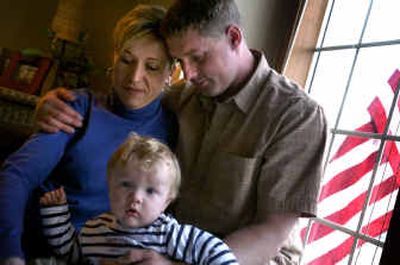
Jim DeWitt is making up for lost time.
The Washington Army National Guard specialist just returned from nearly a year in Iraq, 11 months out of his life and those of his 1-year-old son, Jack, and his wife, Carri.
Though he was allowed to delay his departure until after the birth of his only child last March, he has missed so much.
“It was painful and I had to do my best to block it,” said DeWitt, who was still dealing with fatherhood when he left for Iraq on March 31. “But I knew if I didn’t stay focused I would put other people at risk that depended on me over there.”
He said he had to turn his thoughts of home on and off “like a switch” in order to do his job without distraction.
As an Army broadcast journalist with the 122nd Mobile Public Affairs Detachment, Dewitt chronicled the work of the 1st Cavalry Division in Baghdad.
“I would go out there with my video camera and try to capture it,” he said. Though he never felt he was a specific target of the enemy, he came under fire while in ground convoys or aboard Black Hawk helicopters. There were also close calls with improvised explosive devices and car bombs.
On July 15, he called his wife, Carri, on a cell phone immediately after a car bomb exploded near him inside the Green Zone, where U.S. and Iraqi interests are supposed to be protected. He said 13 people, mostly Iraqis, died in the explosion, but his wife knew he was safe before the story broke on CNN.
His most memorable story as a journalist, DeWitt said, was Operation River Watch along the Euphrates River in December. It was at a time when Defense Secretary Donald Rumsfeld was taking heat after it was disclosed that the U.S. military had left a huge weapons cache unguarded during the invasion the year before.
River Watch was the effort by the 2nd Brigade of the 1st Cavalry to reclaim some of those weapons through house-to-house searches of Latifiyah. DeWitt was present when U.S. soldiers uncovered an illegal weapons cache owned by an Iraqi contractor who worked for the United States. The contractor also had material for making false IDs and film of a U.S. forward operating base.
“He must have been responsible for many of the mortar hits on the base,” said DeWitt, who later recognized some of his videotape on CNN.
As an Army journalist, “there is not a lot of time to build a rapport with the guys” he depended on to watch his back, DeWitt said. At the same time, he had to prove he was not “just another journalist they had to baby-sit.” He was a soldier who they could depend on, too.
His fondest memories of Iraq, he said, will be the contact he had with its people.
“I was witness to so much kindness,” DeWitt said. “Though their lives are ruined in so many ways, they open their hearts to you.”
But he also will remember “the other side of humanity” – the cruelty that he would not believe if he had not seen it himself – insurgents who were capable of things that defied their own ideals of religion and family.
While DeWitt was away, his wife depended on the kindness of relatives and friends, including a couple of people who have become “lifelong friends” after first reading about the DeWitts in an April article that appeared in The Spokesman-Review.
“They just didn’t let me crumble,” Carri DeWitt said.
Spc. DeWitt must return to Fort Lewis in a few days for “demobilization,” where his health will be evaluated by professionals who will ask him about exposures to smoke and fumes while in Iraq. After that he plans to stay home with Jack before finding work. His wife’s job with an insurance company will hold the family until then.
The guardsman went to Iraq as a “steadfast supporter” of President Bush. At times, he saw operations that could have been better carried out, but he believes no one could have foreseen every contingency in the occupation. As far as weapons of mass destruction are concerned, he still believes the war was justified despite the lack of a smoking gun. Iraqis were worse off under Saddam, he said.
“I still have faith it was the right way to go.”