
How to get the most out of the MAC’s Impressionist exhibit
What: “An Impressionist’s Eye: Painting and Sculpture from the Philip and Janice Lavin Foundation.”
Where: The Northwest Museum of Arts and Culture (MAC), 2316 W. First Ave.
When: Now through May 15, Tuesdays through Sundays, 11 a.m. to 5 p.m.
How much: $7 for adults, $5 for seniors and students.
Why should we care? Because this is Monet and Renoir and Degas, right here in River City, that’s why. This is the first true world-class exhibit the MAC has hosted since its recent expansion.
Who the heck were Monet and Renoir and Degas? 19th century art rebels, who chose to render the world through their own, somewhat fuzzy, eyes.
What exactly is impressionism? It was art’s first big liberation from mundane old realism. For centuries, painters tried to render scenes with natural precision. Then came the invention of photography in the 19th century, which could out-real any realist. So in the 1870s, a group of painters led by Monet began to experiment with the ephemeral play of light on objects. They fuzzed up the outlines, used short discontinuous brushstrokes and broke up the colors into bright patches that the eye could combine. In other words, they painted the viewer’s momentary impression of an object, rather than the solid object itself. It was, in some ways, more “real” than realism.
What should you check out first? The exhibit begins with one of the exhibit’s small treasures, Eugene Boudin’s “Crinolines on the Beach, Trouville.” This beach scene had a great influence on the more famous impressionists to follow – and it might end up as one of your favorites as well.
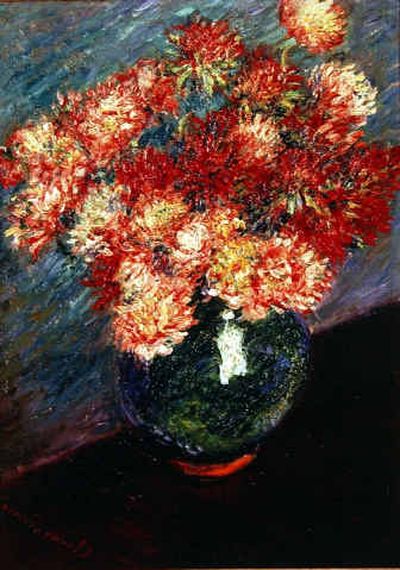
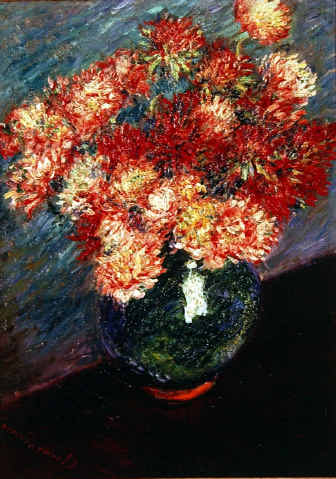
Which pieces are the heavy hitters? For name recognition alone, you must check out Claude Monet’s “Chrysanthemums” (yes, a pot of flowers) and Pierre-Auguste Renoir’s “Seated Female Nude,” a nude model in soft focus, and “Landscape with Figures.” However, you may well find that your eye is drawn more toward some of the only-slightly-less- celebrated names, such as Edgar Degas, Henri de Toulouse-Lautrec, Camille Pissarro, Mary Cassatt and Edouard Vuillard. And you may end up liking Berthe Morisot’s quietly domestic “Girl at the Window (Julie at the Table)” as much as anything.
How long will it take? Less time than one lousy episode of “Survivor.”