
Critical condition
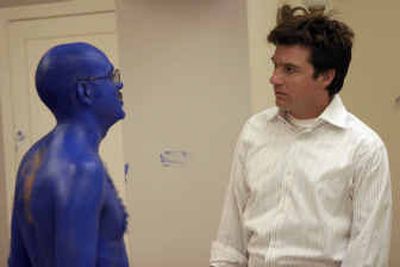
Deep within the Fox Studios production lot in Los Angeles sits a nondescript soundstage in which actor/comedian David Cross is happily ridiculing the man who controls his fate.
“Rupert? He and I go way back,” Cross says. “See, before he was this huge media mogul, he used to come in with the tax guy and take children away from people who couldn’t pay their taxes. Actually, he was the assistant to that guy.”
Cross, who portrays Tobias Funke, the incompetent psychiatrist- turned-unemployed-actor on Fox’s award-winning sitcom “Arrested Development,” is referring to Rupert Murdoch.
The Australian-born media magnate owns the network, the studio and the table on which Cross is leaning. Nevertheless, the actor continues spinning his barbed tale:
“I was friendly with an Aboriginal family in Australia, and he was taking away some Aboriginal orphans. So we became friendly. He’s an absolute delight.”
“Arrested Development” may not be quite as subversive as Cross’ spontaneous rap. But the Sunday night sitcom – with its faux-documentary structure, handheld video camera look, quirky characters and complex plotting – is far from mainstream television.
And though “Arrested” is commonly called TV’s best sitcom by the nation’s critics, and it wins the industry’s biggest awards – the outstanding comedy show Emmy last fall, and best comic actor for Jason Bateman at January’s Golden Globes – its Nielsen ratings hover somewhere between shaky and completely unacceptable, at around 6 million viewers per week.
It returns to the air with a double episode tonight after taking two weeks off during the February rating “sweeps” period. Fox has halted this season’s production early, at 18 episodes; the season finale will air April 17, with the new animated “American Dad” taking the 8:30 p.m. Sunday time slot during May sweeps.
Meanwhile, the derivative-to-lame likes of “According to Jim,” “Two and a Half Men” and “Hope & Faith” attract audiences (and thus network advertising support, which attracts even bigger audiences) that “Arrested Development” can only dream about.
How long can “Arrested Development” go on like this? How long can the TV industry? How long can we?
“Look, ‘The Simpsons’ is the exception,” says Matt Groening, who created Fox’s most-beloved, longest-running hit show. “We were left completely alone, because (co-producer) James L. Brooks had a lot of clout, and because (the execs) were completely uninterested in animation.”
When it comes to programming broadcast networks, experimentation and risk-taking are not top priorities. Not that you can dispense with them entirely; part of what they’re selling to advertisers is this intangible thing called “buzz.” But network executives prefer taking risks in small, finely measured amounts.
The result is a medium increasingly dominated by shows that resemble other, more successful shows.
“They always chase the last big thing rather than the next big thing,” says Victor Fresco, creator of “Andy Richter Controls the Universe,” another Fox sitcom whose audience numbers fell far short of its critical acclaim. It was canceled after two partial seasons.
“And no TV executive has ever lost his job for pulling a show too quickly,” he adds. “But they can lose their jobs if they leave a show on too long. Especially now with reality shows. They can put on ‘Who Wants to Kill My Parents?’ quickly, and get a much better number, with a cheap show.”
Fresco will be back on Fox later this month with “Life on a Stick,” a far more traditional sitcom about a group of teenagers who work in a mall food court.
Though “Life” is a genuinely funny show stocked with vivid, idiosyncratic characters, it follows all of the most familiar comedy archetypes on TV, from its multicamera format to its pretty cast of post-adolescent goofballs.
“Richter,” on the other hand, was full of flat-out weirdos whose strange, unsentimental stories were told by a narrator who often contradicted himself in midtale.
The move back toward the mainstream was dictated both by Fresco’s superiors at Paramount Studios and by his reading of an industry that has ratcheted back comedy production to the barest trickle.
Still, the creative impulse remains. Fox, in particular, has aired an array of brilliant comedies in recent years (“Richter,” “The Tick,” “Action”).
And though it has sunk to uncharted depths every so often (“Who’s Your Daddy,” among others), such bottom-feeder programming may in fact increase network chief Gail Berman’s desire to keep “Arrested Development” as a way to prove that Fox is also capable of making great shows.
But, given the ratings, for how long?
“I’d be surprised if we weren’t renewed,” lead actor Bateman says, “based purely on how much I know Gail (Berman) enjoys and respects the show.
“It’s got a lot of in-house support. And as a complete layman in these things, I have to think that as long as I’m not losing a ton of money on the show, it’d be really difficult for me to pull the plug on something that wins so much critical respect.”
But Cross, still fresh from his flight into Murdoch fantasyland, doesn’t share his co-star’s confidence.
“I’d be surprised if the show weren’t canceled, for no other reason than that the ratings just aren’t very good,” he says.
Adds “Arrested” creator Mitch Hurwitz: “The awards are really nice internally. But we need viewers.”