
Stalkers

They’re out there.
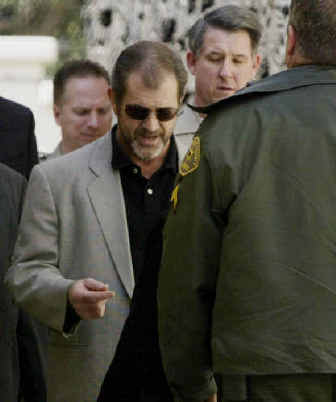
Catherine Zeta-Jones, Sheryl Crow and Mel Gibson recently faced theirs in court.
Anna Kournikova’s took a nude swim to find her. Janet Jackson’s showed up at a “Saturday Night Live” rehearsal carrying a knife and a box cutter.
They’re celebrity stalkers, perpetrators of an emotional crime that’s often – but not always – the result of mental illness.
Despite a recent rash of cases, experts say the act of celebrity stalking isn’t increasing, but stars are more willing to go to police when confronted. And, of course, the media are more likely to cover subsequent arrests and trials.
Last month, a 33-year-old woman pleaded no contest to stalking and threatening Zeta-Jones.
Dawnette Knight was accused of sending threatening and violent letters to acquaintances of the actress, including her agent and her husband, actor Michael Douglas, whom Knight said she was in love with.
Last Friday, an Idaho drifter who claimed he was on a mission from God to pray with “The Passion of the Christ” director Gibson, was convicted of felony stalking.
Zack Sinclair was arrested after repeatedly going to the gate of the actor-director’s Malibu estate and once showing up at his church.
Also last week, Jackson filed for a restraining order against a man she says has been stalking her for nine years, including the “SNL” incident last April.
“It is only a matter of time before he has the opportunity to harm me,” she said in court papers.
Following the murder of “My Sister Sam” actress Rebecca Schaeffer in 1989, the government, Hollywood and the world began to take celebrity stalking more seriously.
As many armchair sleuths have learned from “CSI,” material crimes like burglary and murder leave copious amounts of physical evidence, but stalking is harder to prove.
Witness the love-struck Crow fan who was acquitted last November after ardently pursuing the singer for 15 months, claiming he communicated with her telepathically and even visiting her sister and father.
“Stalking is much more nebulous, much more of a challenge,” said John Lane, a former Los Angeles Police Department detective. “It is very difficult to investigate.”
Laws now exist in all states to combat stalking in some form or another. In Los Angeles, the LAPD’s threat management unit exclusively tackles stalking. In 2004 it handled 60 celebrity cases.
That’s typical, according to the unit’s leader, Detective Jeff Dunn.
“I think there’s a rise in reporting,” said Dunn. “Early in the ‘90s, there was reluctance for fear of negative publicity. I don’t think they were widely reported.
“Now in 2005, you can’t turn on the TV without seeing a story about some sort of stalking. It doesn’t carry the negative stigma anymore.”
In recent years, the likes of Pamela Anderson, Madonna, Steven Spielberg, Nicole Kidman, David Letterman and Gwyneth Paltrow have claimed stalkers.
Dante Michael Soiu developed a “rescue fantasy” involving Paltrow after seeing tabloid and TV reports about her relationship woes with Ben Affleck. After being convicted in 2000, he was sent to a high-security mental facility after the judge determined he was insane.
In the Kournikova case, a man was arrested Jan. 30 after swimming nude across a Florida bay toward the tennis star’s $5 million estate, then turning up on the pool deck at the wrong house and yelling, “Anna! Save me!”
Dunn said for every celebrity stalking case that’s splashed across headlines, 20 are never heard about. Those type of cases often fall to Lane, who after helping establish the LAPD anti-stalking unit, started his own personal security firm, Omega Threat Management Inc.
It’s one of several such companies that take care of celebrities’ threats – for a price.
“In this day in age, public figures of all types have a much better idea of the risks that are present that come with their visibility,” Lane said. “The incentive to hiring a private firm is to help resolve the issue, to help control the threat.
“Some of these cases do get dangerous.”
While it often is the case, stalking isn’t always the result of a mental disorder.
“Most of the time what you’ve got is an individual who is lonely or socially incompetent,” said Mace Benson, a psychiatrist at the University of California-Los Angeles who has worked on many stalking cases.
When mental health is an issue, disorders such as schizophrenia or some form of dementia and an emotional real-life trigger are usually to blame. These elements combined make it easier for an individual to break down that invisible wall.
“Usually, there’s been some kind of major loss in the life of the individual – either one event or a series of events,” said psychologist J. Reid Meloy. “They then create a private, bizarre reality that is very defined.”
Meloy has researched stalking since 1989, was the editor of the first science journal on the subject and has consulted on high-profile cases like Madonna’s and Paltrow’s.
“Somehow, they connect at very deep emotional level,” Meloy said. “With the Paltrow case, he saw her in the movie ‘Shakespeare in Love’ and formed a bond. The onset was very rapid.”
Stopping a stalker is often easy, according to the experts. In most instances, it just takes an intervention.
But in extreme cases, confrontation might be the salt on the wound.
“Real events will occur that will often anger the celebrity stalker,” Meloy said. “Those events are often something like him feeling rejected, or maybe it’s something security did or said to him.
“Because he feels he’s entitled, there could be danger with the celebrity following the rejection.”