
Creative freedom

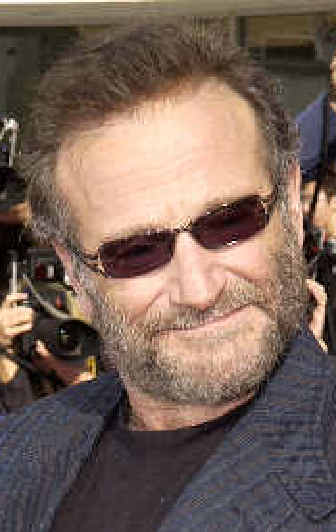
In an ideal world, Robin Williams would have been born a cartoon.
After all, merely human roles rarely give him the chance to free-associate, deliver dozens of accents and leap through his imagination the way no regular person ever does.
When he took the role of the Blue Genie in 1992’s “Aladdin,” Williams crafted one of the most indelible characters in animation history.
But now that “Robots” has hit theaters, it’s possible that Williams addicts will begin calling him “Fender.”
It’s Williams’ first animated role since “Aladdin.” The red robot with a coffeepot for a head may not look much like the 53-year-old comic, but they share a certain manic energy.
Fender is “a Skid Row bum, a man living hand to foot who puts the ‘funk’ in dysfunctional,” Williams says.
He also talks nonstop – sound familiar? – and keeps losing body parts to rust.
The performance makes use of Williams’ hyperactivity without, as he puts it, “my having to train. Animators can create the physicality I could never get near.
“You get a bit of carte blanche,” he adds. “I love doing the voices. I can play and create. You can’t find too many parts that allow you such freedom – and it’s easier to look at myself.”
For “Robots,” director Chris Wedge says all he had to do was turn Williams loose.
“We’d bring Robin ideas and script pages, and he’d very politely read the words we’d written,” Wedge says. “Then he’d start lifting off. He’d hit on something and go off for 20 minutes. The glass in the booth would be full of condensation.”
Although Wedge admits, “We were able to use only about 1 percent of what he created,” they did manage to include his riff on “Singin’ in the Rain.”
And the eventual DVD outtakes probably will feature a sequence in which Fender’s unattached right hand tries to romance his equally on-the-loose left hand – in a heavy Hispanic accent.
Set in a computer-generated world inhabited by mechanical people, “Robots” tells the story of idealistic young Rodney Copperbottom (voiced by Ewan McGregor), who dreams of being an inventor and sets off for the big city with his father’s blessing. Naturally, his life does not go smoothly, even with Fender as a close friend.
Williams related to the follow-your-dreams scenario.
“I loved the scenes between Rodney and his father because of my dad,” he says. “My dad told me, ‘Do what you want to do. I will help you. If you want to be an actor, that’s great. Just have a backup profession.’ “
Since he could easily supply the voices for an entire cast of animated characters, cartoons could be Williams’ main source of income – if he didn’t love doing stand-up comedy and making live-action movies.
Two of the latter will open this year – the coming-of-age tale “House of D” (opening next month) and a black comedy, “The Big White.”
Later this year, he’ll start production on two more. One is the drama “The Night Listener,” based on an Armistead Maupin story. The other is “R.V,” a comedy Williams says is about “a blue-state guy traveling in a red state.”
After some troubled years in which he fought through drug addiction and a messy divorce, Williams seems to be at a peaceful point in his life. Even he has noticed that his comic libido may finally be starting to ebb.
“My wife, Marsha, says that if more than two people come into a room, I go into a certain mode,” he says. “But the older I get, the mode gets less, like, ‘Hello!’
“It’s tiring, but it’s invigorating,” he adds. “Drama is cathartic, but you feed off comedy. It builds you.”