
A Wynn-win situation

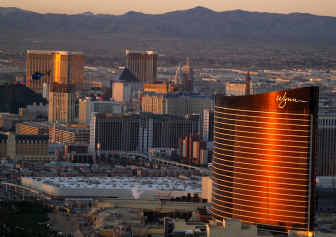
Master casino-builder Steve Wynn becomes a player on the Las Vegas Strip again when his $2.6 billion, 217-acre resort opens next month on the site of the former Desert Inn.
Wynn Las Vegas – a gracefully curving, 50-story bronze tower surrounded by a man-made mountain, lake and golf course – debuts April 28.
A television commercial for the resort recently began appearing in some markets. It shows Wynn standing atop the tower – he really was there, tethered to a pole – introducing himself and saying, “This is my new hotel, the only one I’ve ever signed my name to.”
It marks Wynn’s return to the gaming scene after the 2000 sale of Mirage Resorts to MGM Grand Inc.
In Vegas, Wynn casino openings – such as the Mirage in 1989 and the Bellagio in 1998 – were milestone events, each breaking new ground in casino-resort design, approach and amenities, and compelling other casino operators to aim higher when building their own new properties.
Wynn’s newest creation – set to open on the birthday of his wife, Elaine – is a departure from the geographical themes that dominated casino concepts in the 1990s. Instead, it attempts to establish a sense of elegance and tranquility.
While details have been kept under wraps, Wynn has emphasized fine points such as gardens and intimate spaces when talking about the resort.
And while the hotel, which bears Wynn’s name in a neat script across the top, has more than 2,700 rooms and 110,000 square feet of casino space, walking distances have been minimized by the strategic placement of elevators.
At Bellagio, Wynn created a swimming-pool area that, despite its sweep, had a cozy feel, because each pool was screened from the others by landscaping. At the new resort, sculpted gardens fringe two main pools and an event pool.
The former Desert Inn golf course has been redesigned by architect Tom Fazio and Wynn, and features a 35-foot waterfall at the 18th hole.
Among the 18 restaurants planned, none features the household-name celebrity chefs who became a staple in Las Vegas over the last several years.
Wynn is skeptical about big-name absentee chefs being able to maintain consistent high quality. He has chosen lesser-known chefs who have award-winning pedigrees and will be in their kitchens full-time.
Retail stores are decidedly upscale, with Chanel, Dior, Cartier, and a much-ballyhooed Maserati and Ferrari dealership in the lineup. Guests also will find the recently redone Fashion Show Mall just across Las Vegas Boulevard.
Entertainment at Wynn Las Vegas will include a Franco Dragone production that will likely evoke Cirque du Soleil, the Montreal-based haute circus troupe that Wynn brought to Vegas at Treasure Island and Bellagio.
The show’s title, “Le Reve” (French for “The Dream”), is taken from a Pablo Picasso masterpiece owned by Wynn and was an initial working name for the resort. Actually, the production’s full name is “Le Reve: A Small Collection of Imperfect Dreams.”
It will be performed in an in-the-round theater with a performance surface that includes water. Aquatic and aerial performers will be part of the 70-member cast. The audience experience promises to be intimate, with none of the 2,100 seats more than 42 feet from the performers.
The show opens April 29, with two performances a night, five nights a week (dark Tuesdays and Wednesdays). Tickets are expected to cost about $120.
A second house production, expected to open in the fall, is “Avenue Q,” the 2004 Tony Award winner for best Broadway musical. “Avenue Q’s” characters are puppets and puppeteers, who tell the tale of workaday New Yorkers – with sassy attitude.
After seeing it three times, Wynn decided to build a $40 million, 1,200-seat theater for the show, to attract younger visitors.
The resort’s Web site is taking reservations. A sampling of availability for July showed a price range of $219 a night, for a midweek stay in a 640-square-foot room, to $850 a night for a weekend stay in a 1,950-square-foot suite.
Most prospective guests are probably looking at rates from $280 to $370.
Standard rooms feature wall-to-wall, floor-to-ceiling windows; seating and dining areas; and flat-screen TVs in the living and bathroom areas. (Visitors will note the absence of floor numbers with the numeral 4, since it’s considered bad luck by some Asian gamblers.)