
Cougars still have way to go
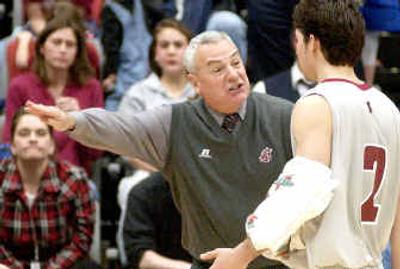
PULLMAN — Before the 2004-05 season Dick Bennett suggested that his team would play a lot of close games, would be better than the year before and might not have a better record.
And months later, with that season in the books, it appears that he was correct on all three fronts.
Save for three games — a 52-point loss at Oklahoma State and two blowout defeats against Washington — Washington State was competitive. The Cougars were the first team since UCLA’s 1994-95 national championship winners to be victorious at Stanford and at Arizona.
But they also lost eight games by three points or fewer, casting a pall over the entire year that lasted right up to the final game, a 60-58 loss to Stanford in the first round of the Pac-10 tournament.
“The closeness of the games was a positive, the fact that we got there,” Bennett said. “We just weren’t good enough to get over the top.
“I realize, having seen the talent in the league and knowing what it’s like in the (NCAA) tournament and knowing what we’re losing, that we still have a distance to go. That’s difficult — to know that you did as well as you can do and you still couldn’t get above .500. It’s painful. Combine that with the number of close games that you lost and it scares you. What are you going to have to do?”
The Cougars may be losing more than anyone would have expected last fall, largely because of a splendid senior season turned in by Thomas Kelati. The two-guard from Walla Walla became the school’s first All-Pac-10 player in seven years, scoring a team-best 14.3 points a game and locking down defensively on some of the league’s best players. They’ll also be without Jeff Varem, who was by far the team’s most athletic player and its second-leading scorer and top rebounder.
Still, as much as WSU had to depend on seniors to lead the way, Bennett’s second year in Pullman was largely defined by freshmen playing tons of minutes. Derrick Low and Robbie Cowgill were consistent starters, Kyle Weaver a spot starter and Daven Harmeling, Josh Akognon and Chris Henry all central role players off the bench.
“It was good for them to get all the experience they did and be in games that mattered,” Bennett said. “This is a very strong group from a character standpoint. If they were just followers, which they kind of had to be this year, I would be more worried. These are not follower-types. These are leader-types, almost to a man. For that reason, I think they will make progress faster now.”
As important as the players have been and will be to the Cougars’ success, no single character would seem to overshadow the head coach himself. Bennett, who flirted with the idea of retiring this off-season, has committed to one more year with WSU and that alone seems to have given Cougar faithful optimism for the future.
The 61-year-old coach has been dealing with a nerve problem in his neck and left shoulder that could require surgery before the 2005-06 season. And while he still enjoys coaching immensely, it’s clear that he is as emotional about each win and loss as any coach in college basketball.
“What’s hardest for me is looking at a rebuilding situation where I doubt whether I’ll be around for the payoff,” Bennett said, speaking from a couch in his office just beneath a picture of his 1999-2000 Wisconsin team huddled on the court at the Final Four, the greatest payoff of his coaching career. “The other places, I got to enjoy some of the fruits. So far there haven’t been any fruits. And that’s been hard.”
To accelerate the ripening of the Cougar program, Bennett and his staff are working around the clock to find a few more players who can step in immediately and contribute. Associate head coach Tony Bennett is in Kansas scouting the national junior college playoffs, and with four open scholarships left, the Cougars have room to bring in a handful of players to surround the rising sophomores.
“There’s no point in dancing around the truth. Next year will be another hard year,” the head coach said. “We need to get upperclassmen as a nucleus. So the recruiting is far from over. The building is far from over. The attitude and the foundation have been established. That’s why I’ve kept saying that it takes three full years to rebuild a program like this. In the fourth year you can tell, but we clearly are not out of the woods.”