
Chiefs won’t bring back Conroy
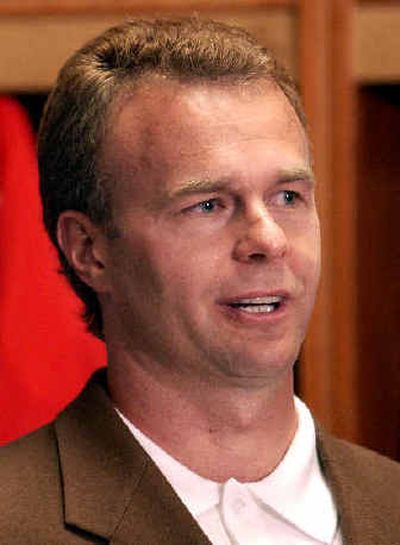
The Spokane Chiefs effectively fired coach Al Conroy on Monday, refusing to exercise a club option for the second year of a two-year contract.
Spokane missed the Western Hockey League playoffs for the first time since 1999, finishing last in the five-team U.S. Division of the Western Conference with a record of 24-38-8-2.
Citing the Chiefs’ 2-8 finish over the last 10 games in particular, Spokane general manager Tim Speltz said, “As an organization we are not intending to shift the responsibility to only our head coach, but in evaluating the situation we did not take the necessary steps this season. I feel a change is necessary to get to the next level as a team.”
Conroy, a former longtime National Hockey League player, was in his third season as Chiefs coach. His teams compiled a record of 82-103-18-13 over that time. He will remain under contract with the Chiefs until May 31.
The status of assistant coaches Rikard Gronborg and Kevin Sawyer will be determined prior to the expiration of their contracts May 31 and they could be potential candidates for the head coaching position. But Speltz said the team has not talked to either assistant yet about their plans.
As for his fate, Conroy was, not surprisingly, disappointed with the team’s decision, but he accepted it.
“I have an extremely high opinion of Tim Speltz and the Spokane Chiefs organization. They’ve done a fantastic job here in Spokane and I have a great amount of respect for them,” Conroy said. “I appreciate the opportunity I was given.
“That being said, I am disappointed to not be coming back. That’s the nature of the business. The responsibility starts and ends with the coach and I accept that. I think there’s sometimes things you want to do different, but at the end of the day I’m proud of the way we did things.”
The Chiefs were primarily done in by spotty play at key times, including a five-game losing streak to end the season as they failed to stay ahead of the archrival Tri-City Americans for the fourth and final playoff spot from the division. One of the key losses for the team was a mid-season injury to 20-year-old defenseman Scott Lynch.
“It’s kind of bad luck, with injuries and everything,” Lynch said. “I think he has a good system and good style of coaching, but it’s a competitive league. If coaches don’t produce, they get the axe. They’re kind of the scapegoat when a team’s not doing good. … I just wish we could have put together a winning team to help him keep his job.”
Conroy had said last week that he would not quit under any circumstance and reiterated Monday, saying, “Sure, the easy way would have been for me to say, ‘Tim, I don’t want to come back.’ But that’s not me and it never will be me.”
All the parties agreed it was not just one thing that doomed Conroy.
“You have to take into account everything,” Speltz said. “One thing is for sure, not any one person is responsible for our lack of success. First, I’m the GM. I make the decisions, for the most part. It’s not fair to say the coach is responsible. From top to bottom, we haven’t had the success we’ve wanted the last two years. …
“From our standpoint, it was real tough, because we sure thought Al was very commited and loyal. At the same time, we didn’t get the results we were capable of.”
The Chiefs will return a core of talented younger players and their two top scorers, Chad Klassen and Jeff Lynch, are eligible to return as 20-year-olds.
“I still believe this team is real close to being real good,” Conroy said. “I think some changes need to be made and I know Tim and I are on the same page there. … At the end of every year, unless you’re Memorial Cup champions, there are changes to make. We’ve got a very good group of guys here, young and old, that are excellent.”
Speltz, who had to shore up the roster with a couple of trades during the season, agreed and doesn’t see the need to make major roster moves.
Instead, he will soon turn his attention to finding the next Mike Babcock. Speltz knows what he’s looking for in the next coach.
“We’d love to have an experienced coach at the junior level who has had success … we’ve sure got our dream coach, if we can find him,” Speltz said.
It wouldn’t be surprising for the process to extend into late May or beyond, a time when most major-junior teams are wrapping up their playoffs. Speltz made it clear there is no timetable, as it depends in what situation the right candidate finds himself.
Both Conroy and Scott Lynch said it is important for the next coach to be a good communicator with younger players.
“With this team, you just have to have a coach that can keep them motivated,” Lynch said. “Read them as people as well as players and get them motivated to do their certain jobs and expand their jobs; get them to add different elements to their game.”
Lynch said Conroy had that with most of his players and that his commitment to their development was unquestioned, but it wasn’t enough.
And for Conroy’s future?
“That’s something I need to sit down with the family and evaluate,” Conroy said. “I certainly can’t say I’ve been looking for jobs, because I thought I had one. … I have a passion to be in the game of hockey.”