
Summer bulbs
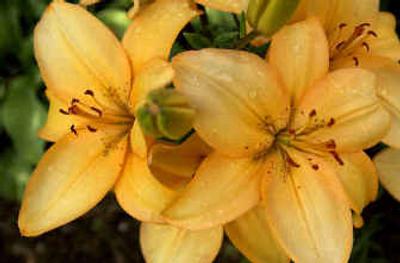
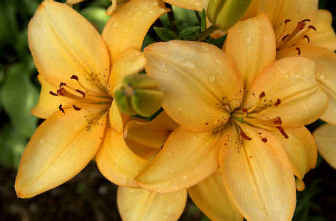
PHILADELPHIA — It’s hard to imagine spring without the colorful contributions of flowering bulbs such as daffodils and tulips.
But the bulbs of summer can add a bit of razzle-dazzle to the garden just as perennials are starting to slow down in the heat. And like their more-famous spring counterparts, most summer bulbs are easy to grow if you give them the conditions they like.
The recent tropical trend in home gardens has put the spotlight on a wider array of exotic summer bulbs, such as pineapple lilies and agapanthus and acidanthera, says Sally Ferguson, director of the Netherlands Flower Bulb Information Center in New York. But lilies, dahlias and cannas are also among summer bulbs.
Nancy Blois wouldn’t be without them. She loves fragrant lilies, and works dozens of them into her Doylestown Township, Pa., garden.
Cannas are a favorite, too, and not just because of their big blooms. The flowers don’t last very long, Blois said, so more and more she relies on their spectacular foliage in her summer landscape.
“Canna `Tropicana’ is gaudy and flashy and all those things — and it is wonderful,” she said of the plant, whose big leaves are striped in yellows, oranges and greens. “By summertime, I always crave big foliage. I think because it feels like the tropics here, you want tropical foliage.”
Dramatic leaf appeal is an inducement to grow many of the summer bulbs, says Judy Glattstein, whose “Bulbs for Garden Habitats” was published by Timber Press this month.
“In shady places, caladium works well in containers, and can be a translucent rose pink, white-and-green, speckled, or combinations of these,” said Glattstein, who gardens on nine acres near Trenton, N.J. “And the foliage from these kinds of plants is dynamite in bouquets.”
For bold garden design, the large leaves of all the elephant ears (Alocasia, Colocasia and Xanthosoma) are hard to beat.
“You can put them in a pot and stick them in a pond, and they are terrific,” Glattstein said.
Blois uses containers planted with plain green and “Black Magic” elephant ears near her swimming pool, because she likes the way the foliage looks with water. Or they can be planted in a moist part of the garden, with the huge leaves offering a contrast of texture and color against the lacy foliage of bright-green ferns.
If you plant cannas or elephant ears directly into the garden, wait until around the first week of June, when the soil warms up, says William Rein, horticulturist for the Henry Schmieder Arboretum at Delaware Valley College in Doylestown. He uses summer bulbs in containers for the public display gardens “because they have such an impact. You get a lot more out of them” for the price.
Summer bulbs are natural showoffs. But not even flowers are immune to fashion’s whims. Like cannas before them, gladioli were once considered fit only for auntie’s garden, but they’re making a comeback with floral trendsetters, Ferguson said.
The smaller Gladiolus nanus, which grows to about 15 inches, mixes better with other plants in a garden bed than the tall variety, Glattstein said. She suggests growing the bigger ones in the vegetable garden, for cut flowers. She also likes “Gladiolus callianthus (often sold as acidanthera, or peacock lily or peacock orchid), which produces a white flower with a burgundy throat.
“I grow it with a purple-leaved canna and “Plectranthus argentatus, which has silver foliage,” Glattstein said. “The silver against the purple is nice, and if you wedge some (peacock lilies) in amongst them, it’s very pretty.
“You can experiment with summer bulbs,” she said, “because most of them don’t come back year after year. They don’t like our winters.”
So gardeners can either dig them up and store them, or treat them as annuals and buy new ones next season. (The exception is lilies, which are winter-hardy.)
Not everything we call a bulb actually is — some are tubers or rhizomes or corms.
“The average gardener doesn’t care. They just want to know which end goes up, and which end goes down,” Glattstein said. “And even that doesn’t really matter — just plant them on their side. So many of these bulbs are really foolproof.”
But even the hardiest won’t thrive if you don’t pay attention to their basic needs. If you know your garden’s idiosyncracies and its microclimates, you can look for plants that like those conditions, Glattstein said. “Do you need something that will thrive in a mucky, wet area? Cannas will, if it’s sunny.”
Of course, there are summer bulbs gardeners might like to grow, but don’t know about, such as Ismene, or Hymenocallis, commonly called the spider lily because its white flowers have tendrils; a couple of varieties like wet places, Glattstein said. Or Zephyranthes, known as rain lilies because they flower in response to rain.
And if you really want to startle your neighbors, try “Dracunculus vulgaris, the so-called dragon lily.
“I love this plant, it is so weird,” Glattstein says. It has fingerlike leaves that are coming up now, and that will grow to 2- 1/2 to 3 feet before dying down in early June.
“The flower comes up in July, naked, on a long spotted stem,” she says. “It has a spathe, devilish and pointed, and it smells like rotten meat. You don’t want to plant this near the house, but it certainly is among the most bizarre of the summer bulbs.”