
Kid Creations

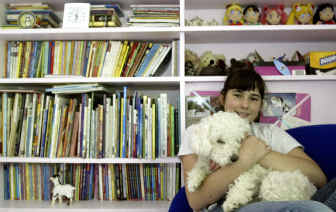
WASHINGTON — Next week, Hannah Rose will take a step that most artists merely dream of: Her work will be featured in an exhibition at one of Washington, D.C.’s, top commercial galleries. It’s only the second time she has shown her art publicly, so it’s perfectly understandable for her to be a bit nervous – uncertain even – as she welcomes a reporter into her home to view and discuss her work before it is moved to Hemphill Fine Arts. She is shy and, well, fidgety at times. Then again, a lot of 12-year-olds are like that.
What does young Hannah create that has put her in the spotlight?
Near the front door are a dozen pairs of her shoes – lined up chronologically from baby shoes to flip-flops – that will be mounted in a vertical trail ascending a gallery wall. On her dining room table are several pieces in which childhood toys are her dominant medium.
“Icebreaker” consists of two stuffed animals separated by a wall of Lego blocks, along with several digital photographs of the scene showing the wall in various stages of deconstruction. Another piece is a four-walled Lego tower with a Barbie doll trapped inside, her hair and arms – frozen in mid-flail – barely visible. Hanging on a wall downstairs is “Barbie Clock,” more than two dozen naked dolls in a circular formation, with the torsos of two dolls mounted in the 3 o’clock position.
“I’m not really an art rules person,” says Hannah when asked to explain her approach.
Her father, Robin, chimes in: “You don’t like people telling you what to do, right, Hannah?”
“Right,” she agrees.
Art aficionados will register Robin Rose’s name as that of the prominent painter. His wife, Judy Penski, a dancer-turned-dentist, calls their daughter “a hothouse flower” for the art-intensive environment Robin’s career contributes to Hannah’s upbringing.
“She’s as used to going to art galleries as she is going to Safeway,” Penski says.
Hannah has long expressed herself through art and visual communication, her parents say, but there was more to it than simply following in her father’s footsteps. She was several years behind in developing spoken-language skills. She’s currently in fifth grade.
When Hannah was 8, word of her artistic inclinations had spread through Rose’s network and Hannah was invited to exhibit in a group show at the Millennium Arts Center curated by Annie Adjchavanich, former executive director of Washington Project for the Artsorcoran. Leafing through a photo album, Penski proudly points out highlights of Hannah’s first exhibit: evening gowns for Powerpuff Girls dolls, interlocking high-heel shoes fashioned into a large heart shape and what Penski calls a Barbie shoe “mandala.”
Gallery owner George Hemphill took note and approached her parents last year about exhibiting what he considers a “prodigious” talent. The exhibition opening next week also features works by Lisa Bertnick, 31, and Tanya Marcuse, 40.
Bertnick who graduated from the Corcoran College of Art and Design in 2001, was initially unsure what to think of showing her work, stylized female portraits, alongside Hannah’s.
“This is definitely the first and most important commercial exhibition I’ve had in my early career,” Bertnick says. “My first reaction was that she’d steal the show.”
Marcuse from Barrytown, N.Y., has an MFA from Yale. “I like shows that have people from diverse places in their careers,” says Marcuse, who will show photographs of undergarments and armor. “I defer to the gallery.”
Hannah’s parents are reluctant to use the word “prodigy,” though they are confident she possesses an artistic gift. Penski finds a particular resonance in Hannah’s work because of her adolescent perspective.
Hannah contemplates “Barbie Clock” momentarily: “I just wanted to make something out of my toys – abstract and unusual things that people wouldn’t really believe you could do.”