
Rioting outside Paris continues with fires
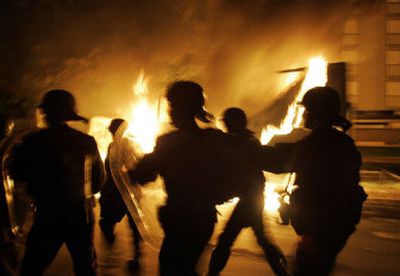

PARIS – French President Jacques Chirac met with his Cabinet Wednesday to map strategy against rioting that spread to 13 immigrant-dominated towns on the outskirts of Paris. After darkness fell Wednesday, youths turned out in several areas for a seventh night of mayhem, setting cars on fire and throwing rocks at police.
“Zones without law cannot exist in the republic,” Chirac told his Cabinet in a closed meeting, according to his spokesman Jean-Francois Cope. The president declared that law would be enforced “firmly” but also acknowledged frustrations in immigrant neighborhoods and urged dialogue.
Chirac has not personally addressed the French public about the unrest that erupted Oct. 27 when two Muslim teenagers of African heritage were electrocuted in a power substation while dodging a police checkpoint in the impoversished town of Chichy-sous-Bois northeast of Paris.
A rapid escalation of the violence Tuesday night appeared to shock the French leadership. Gangs set fire to as many as 228 vehicles in 13 poor, immigrant towns and communities, according to local police and news media.
Youths attacked a fire station in the northern suburban town of Aulnay-sous-Bois, a vacant social center in the southeastern community of Seine-en-Marne, and set fire to cars in Yvelines west of the capital, police reported. Riot police, bunched together behind protective shields, fired rubber-coated bullets, stun grenades and tear gas cannisters in efforts to disperse the attackers.
In a seventh consecutive night of skirmishes, young people threw rocks at police Wednesday and early today in six suburbs in the Seine-Saint-Denis region north of Paris — about a 40-minute drive from the Eiffel Tower.
The violence was contagious in communities of immigrants and second-generation French citizens where unemployment is more than twice the national average, crime is rampant, social services are minimal and residents are packed into the shabby high-rise apartments of subsidized housing.
“This problem is exploding in the face of the government,” said Dominique Moisi, deputy director of the French Institute of International Relations. “They have politicized it so much they are making fools of themselves. There’s the image of Paris burning, and that is very, very bad.”
Chirac’s Cabinet members met throughout the day Wednesday, but announced no concrete plans for countering the spiraling violence.