
Bone broker

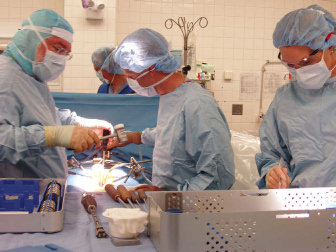
Dozens of Spokane businesses are searching for ways to provide services to the massive over-50 baby boomer generation.
Brent Johnston’s medical equipment firm, Corvus Medical, Inc., is part of that pack. The four-person company, formed two years ago, began by selling imaging devices to area medical practices.But after two years Johnston changed Corvus’s focus to the rapidly growing niche of providing human bone allografts — recycled human bone parts that are implanted by doctors to repair damaged or diseased spines, knees, shoulders, wrists or hips.
“I focus on customer service and providing a wide range of options for doctors,” said the 34-year-old Johnston, who adds that he primarily works with four or five area surgeons.
“For instance, if you wanted a meniscus patella for a knee operation, we can get it for you, for $2,500, by the next day.”
The niche industry of processing and distributing bone and tissue allografts is a flourishing one, say medical industry experts, although exact figures are hard to come by.
Financial firm Piper Jaffray recently estimated the allograft industry totals $900 million, with growth of 10 percent to 15 percent annually.
One industry estimate said surgeons nationwide performed 650,000 allograft transplants in 2002, covering a wide range of tissues, including joints, nerves, heart valves, tendons, bones and ligaments. The largest share involved knee tendons and bones, according to industry reports.
The market is growing so fast that federal regulators are working harder to track the human tissue distribution system. Several instances have occurred, for example, in which companies had to destroy bone and tissue parts that were not processed properly or that came from donors who hadn’t been screened for safety.
Johnston, who’s 36, shares his sales revenue with his two primary allograft providers: Bone Bank Allografts of San Antonio, Texas, and Cortek Inc, of Boston. “Essentially, I’m on a commission basis,” he said.
He also distributes to surgeons a variety of synthetic implants for spine, shoulder, neck, knee or hip surgery made from titanium, stainless steel or high-grade ceramic.
Corvus’ sales in 2005 will reach $1.5 million, with 30 percent coming from implants. Johnston expects sales in 2006 to hit $2.5 million, with about half the revenue from synthetic and human bone implants.
For many surgeries, doctors prefer synthetic implants because they provide structural strength that smaller pieces of bone don’t have.
In a surgery this past week at Deaconess Medical Center, Spokane neurosurgeon Dr. John Demakas inserted a ceramic implant into a patient’s lower spine, where disk damage had created severe pain.
That ceramic insert, made in the United Kingdom and called a Stalif, is one of the new products Corvus distributes in Eastern Washington and North Idaho.
Inside a central cavity within the Stalif implant, Demakas added a putty-like mixture of bone morphogenetic protein (BMP). The Stalif was hammered into a space between two lower spinal disks, then screwed into place with titanium plugs
The BMP protein will trigger the patient’s system to produce more bone to cover the implant and provide a fused, stable disk area, Demakas said.
He said the key drivers for rapid growth in bone and synthetic implants have been a desire by older patients to stay active and increased confidence in bone implants as surgeons use them.
Demakas and other Spokane surgeons have used synthetic and human bone allografts for more than 10 years. All those implants, until recently, came from local representatives of major U.S. providers, like Stryker Spine and DePuy AcroMed.
Those distributors were able to offer surgeons bone allografts and then one specific line of synthetic or metal implants. Johnston says he can provide a far wider range of choices, not being restricted to one company’s products.
Until two years ago, Johnston was working as regional manager for a national medical equipment manufacturer. He grew tired of constant traveling and decided to start his own company, joining with three partners who handle other parts of Corvus’ operations.
He jumped into bone allografts and implants because he noticed a large number of surgeons choosing to use those items in surgeries. Demakas, who’s used a variety of implants, said, “Having Corvus in Spokane means I have more options than before. And Brent provides a reliable level of service.”
Allografts vs. autografts
Some surgeons choose to use autografts, instead of allografts, to repair damaged areas. Autografts are transplants of a patient’s own bone or tissue.
One of the more common autografts involves taking a section of a hip bone and inserting it in the spine to stabilize disk problems.
More and more physicians, however, are opting for using donated allografts from human cadavers instead of using a patient’s own bone or tissue. One reason is chronic pain among patients who’ve gone through an autograft, said Demakas. Allografts also simplify the surgery, typically requiring just one incision to insert the donated tissue, instead of making a cut to remove an autograft and a second one to insert it elsewhere.
“For that reason, allografts will be around for a long time,” Demakas said.
When Demakas performed the recent spine surgery using the Stalif, Johnston was inside the operating room wearing a gown and hospital scrubs. Johnston carries along a sterilized set of tools and a case containing inserts of various sizes.
The tools are usually a specific set that work best for the specific type of implant, either synthetic or bone. The inserts in the case are there if the surgeon needs to switch to a slightly smaller or larger piece during surgery.
“The tools companies now provide (for implants) require surgeons like Dr. Demakas to be engineers also,” said Johnston. “The manufacturers (of synthetic implants) require using their own equipment (to insert implants). So the doctor has to learn to handle those tools so the implants are placed and fixed exactly the way they need to be.”
Three sources of body parts
The network that finds and distributes body parts for such surgeries has three broad categories. The primary agencies are the roughly 75 nonprofit tissue centers that have ongoing relationships with hospitals, and who hire trained staff to harvest tissues and bones from donors.
At the bottom of the network are the hundreds of distributors nationwide like Corvus.
In between are several hundred for-profit companies that work with the tissue centers to obtain donated parts and then develop markets for those items.
The primary tissue and bone processor in this area is the Seattle-based Northwest Tissue Center. It’s the sole processing center for bone and tissue donations in North Idaho, Washington and Montana, said its director Margery Moogk.
The tissue-processing center is a unit of the Puget Sound Blood Center and was established in 1988 through agreements with the University of Washington Department of Orthopedics and the Northwest Kidney Center.
A separate nonprofit entity, LifeCenter Northwest, arranges and processes organ donations and transplant distribution.
Moogk said the Northwest Tissue Center strictly adheres to a nonprofit approach. Its team of medical technologists visits hospitals to recover tendons, bones, nerves and skin from donors.
Some of those items are processed at the tissue center’s Renton, Wash., facility. Other tissues — primarily bones — are shipped to two partner agencies who sterilize the items and then produce allografts in varying sizes and shapes.
The Northwest Tissue Center pays those partners for that work. The allografts then come back to Seattle and the tissue center arranges for them to be delivered to hospitals for surgeries.
For patients in Spokane or North Idaho, the Pacific Tissue Center sends allografts to surgeons who are working with agents of companies that compete with Corvus, such as Stryker Spine. The hospital ends up paying a fee set by the Pacific Tissue Center to cover the cost of processing the allograft. The surgeon typically then shares part of the payment for the surgery with the company that arranged for delivery of the allograft.
The fees vary with the size of the allograft and the degree of processing required. Cervical bone allografts usually cost about $1,000. Larger pieces, for lumbar implants in the lower spine, often cost a hospital between $1,500 and $3,200, Moogk explained.
The Pacific Tissue Center hasn’t formed a working partnership with Corvus, Moogk said.
Moogk said the nonprofit focus that drove the tissue implant industry began changing in the mid-1990s when several private companies began working the allograft business with a close eye on profits.
What used to be a health services sector has changed, said Moogk.
“We have always been careful, here at the tissue center, to choose our words with a lot of respect for the donor and the families. But all that’s changed in the industry. What used to be grafts are now called products,” she said.
“Our issue with the large changes occurring in distribution of tissue is that’s it’s now a commoditization. (That approach) is not respectful of the source, as though it’s just like anything else.”