
Express yourself
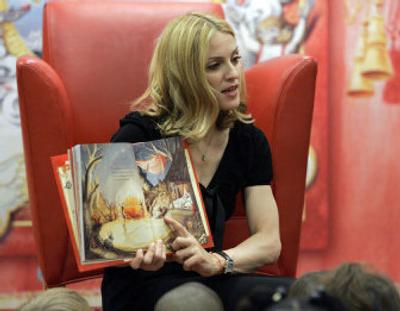
Madonna knows what people are thinking.
She’s well aware that plenty of eyes roll, or glaze over, every time she talks about politics or war or her parental duties or, most of all, her spiritual quest through the Jewish mystical practice of kabbalah.
But since she has insisted on addressing these subjects so often – both during interviews and in her music – the media have come to consider the grown-up Madonna to be as “preachy” as the younger one was thought to be “dangerous.”
“What do you call ‘preachy’?” Madonna asks. “Having an opinion?
“Guilty as charged!” she then proudly announces.
As Madonna holds forth in her Manhattan hotel room, she’s obviously in no mind to go back to playing the party girl of old.
She may be here to promote her new CD, “Confessions on a Dance Floor,” due in stores Tuesday, which returns her to the rousing beats and frothy exuberance of early hits like “Holiday.”
But she says her motivation for recording such an album wasn’t simply to make fun music again, or even to shore up her wobbly recording career.
Instead, it seems, she wanted to, ahem, help mankind.
“It’s that old cliche,” Madonna explains, “when the world gets you down, you need to be lifted up. Look at the state of the world. People need to be inspired and happy.”
Asked why her last CD, “American Life,” was the first disappointing seller of her career (barely going gold), she contends the cool reception was “because I was critiquing America. We had just gone to war in Iraq, and I was criticizing George Bush’s decision.
“People were saying, ‘You’re not supporting the troops. ‘You don’t care.’ … I care a lot. That’s why I didn’t want it to happen. I said the wrong thing at the wrong time.”
Back then, the singer made a very un-Madonna-like move by withdrawing her controversial video for “American Life,” which equated Bush with Saddam Hussein. Now she asserts that the only reason she yanked the video was “because I was worried for my children. I saw what happened with the Dixie Chicks. I didn’t want people to throw rocks at (my kids) on the way to school.”
Not that Madonna’s retreat lasted very long. She addresses politics again in her latest documentary, “I’m Going to Tell You a Secret,” which debuted last month on MTV and VH1.
Though the film covers some of the zippier moments from 2004’s terrific “Re-Invention” tour, it finds Madonna pontificating about the importance of “going against the establishment” and of taking “responsibility for the world around you.”
At one point, she even dresses down her makeup man for not being registered to vote.
The new documentary contrasts tellingly with her old one, “Truth or Dare,” in which Madonna comes off as a flip, provocative, fun-time gal. This time she says things like, “Sometimes fun is overrated.”
The media have had a field day with the transformation. Long ago, it become a staple of gossip columns to giggle over the contrast between the sassy young Madonna and the prim children’s author.
Madonna, who’s now 47, sees no contradiction whatsoever.
“Obviously, my tastes and my priorities have changed,” she says. “But I am still asking the question, ‘Why?’
“Just because I’m a mother doesn’t mean I’m not still a rebel and that I don’t want to go in the face of convention and challenge the system. I never wanted to think in a robotic way, and I don’t want my children to think that way, either. I think parents should be constantly questioning society.”
Some critics, however, assert that Madonna is being reactionary, or even (gasp!) conservative, in her oft-stated refusal to let her kids (Lourdes, 9, and Rocco, 5) watch TV.
“It’s not conservative,” she says. “It’s actually very punk-rock to not watch TV.”
In recent years, Madonna has spent more and more time exploring the inner life through her faith. The shift has inspired more hostility toward her than anything in years.
“It would be less controversial if I joined the Nazi Party,” she says of the kabbalah.
” ‘What do you mean you study the Torah if you’re not Jewish?’ ” she asks rhetorically. ” ‘What do you mean you pray to God and wear sexy clothes? We don’t understand this.’ It frightens people. So they try to denigrate it or trivialize it so that it makes more sense.
“I find it very strange that it’s so disturbing to people. It’s not hurting anybody.”
A song on the new album titled “Isaac,” which uses Jewish musical motifs, has outraged some kabbalist rabbis. They claim the song is about Isaac (or Yitzhak) Luria, a 16th century Jewish mystic; Jewish law forbids the use of his name for profit.
Madonna insists that her song is not about Luria at all but about Yitzhak Sinwani, who sings on the track.
“They’re saying I’m committing a blasphemy, but that’s not what the song is about,” she says. “What are they doing commenting on pop songs? Don’t they have synagogues to pray in?”
In another new song, “Let It Will Be,” one moment she sings about having done whatever it took early in her career to become famous, while in the next she sneers at the culture of fame.
And although the new song “How High” ponders whether she should go on with her work, in the end it’s clearly not a question she takes very seriously.
“I’m not thinking of quitting,” she says with a big laugh. “I ain’t going nowhere.”