
Elder statesmen
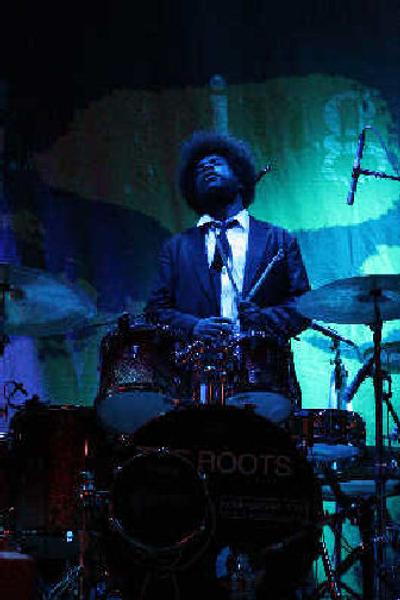
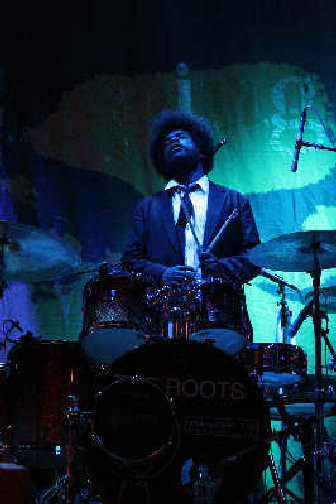
The Roots were all set to go big on Halloween as “Wizard of Oz” characters. Imagine that funky drummer with the big ‘fro sporting an even bigger mane.
But Ahmir “?uestlove” Thompson caught a case of cold ruby slippers. What if Jay-Z showed up in a suit to officially announce the big news that the band had joined his Def Jam label, then had to pose for pictures with a lion and tin man?
“I ix-nayed the elaborate costumes,” Thompson says.
Such are the concessions the hard-touring, Grammy-winning Philadelphia band must make these days, reeling in its wilder instincts and slipping into (then back out of) the pose of hip-hop.
The band recently finished its latest tour of the United States and Canada on a tour sponsored by video game company 2K Sports.
There’s also a two-volume greatest hits CD set, “Home Grown! The Beginner’s Guide to The Roots,” released last Tuesday. It’s a liner notes-packed portrait of a band that after a dozen years and nine albums remains one-of-a-kind in its genre: a group that produces compelling, thoughtful hip-hop using live instrumentation.
“Even though we’re not the Beatles, I think in hip-hop, nine records is a very big deal. Considering the average hip-hop career is a five-year thing, if that,” says Thompson, the band’s driving force and resident music philosopher.
“It’s important for me to really put it in that historical context.”
That historical context: one part critical acclaim for CDs like 1996’s urgent “Illadelph Halflife,” one part slight disdain from the average hip-hop fan. The band, though recognized by even a casual listener, has never caught the attention of the masses enough to go platinum.
But Thompson says he’s happy with the Roots’ sales figures: “It would be nice to aim higher, but I just know that we’re not really doing anything that’s in tune with what’s going on in the marketplace right now.”
So a move to Jay-Z’s label, run by the king of commercially viable hip-pop, seems a bit odd. Sure, the Roots played backup on his 2001 live album, but couldn’t his hustler instincts clash with their stubborn and somewhat obsessive artistry?
Jay-Z understands the Roots, Thompson says. Besides, he adds, it couldn’t get any worse than recording under the Geffen/Interscope umbrella. The group’s attempt to please head honcho Jimmy Iovine there resulted in last year’s “The Tipping Point,” considered a creative failure.
“It was just a very dry record,” Thompson says. “Jay-Z sort of sensed we made that record for Jimmy Iovine. … He just couldn’t see why we would make a record like (2002’s much-praised) ‘Phrenology’ and just do an about-face the next album.”
Negotiations for the label switch were finalized in September with a three-album deal. The first album on Def Jam, “Game Theory,” is 90 percent completed and will be out next September, Thompson said. Guests include Mos Def, Talib Kweli, Common, Saigon and possibly Nas.
Meanwhile, Thompson is lining up an executive gig with Def Jam Left, an imprint he sees as a home to unconventional hip-hoppers who need time and nurturing to catch on, a la Kweli or Little Brother. He’s also hoping to reintroduce a number of aging singers and work with Jay-Z to improve live hip-hop and R&B concerts.
“We have to reintroduce the idea of really giving live performances – entertaining, not just doing your video onstage,” Thompson says. “I’ve got a plan for that. It’s running in motion right now.”
After finishing up production on veteran soulman Al Green’s next CD – which Thompson calls musically more in line with the 1977 “Belle” album than Green’s more recent work – the drummer wants to lure even more unsigned, over-50 singers into the studio with him. His wish list: Bill Withers, Gladys Knight, D.J. Rogers.
He says it’s a push against “the whole disposable nature of black music in general – this ageism thing that’s going on, which doesn’t allow many people over 40 to have a career in black music.”
The Roots may not be in their twilight years yet. But they’re looking more and more like the wise elders of a genre desperately in need of some.