
Potent drug patch increasingly misused
WASHINGTON – Dory Bauler prides herself on staying active despite painful back problems. But earlier this year, she was getting so short of breath that she could barely walk. Doctors could find nothing wrong.
It never occurred to them that the medicinal skin patch she was using to deliver pain relief might also be poisoning her.
“I was just shutting down,” said Bauler, 76, a retired paralegal from Laguna Woods, Calif., who suffers from a severe curvature of the spine.
Bauler’s patch was delivering fentanyl, a narcotic many times more powerful than morphine. Like morphine and other opioid drugs, fentanyl controls pain but also reduces respiratory function. Luckily, Bauler figured out what was happening in time to stop using the drug. Too much fentanyl can shut down the respiratory system.
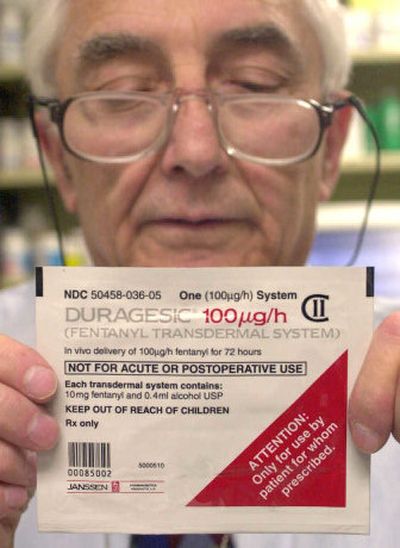
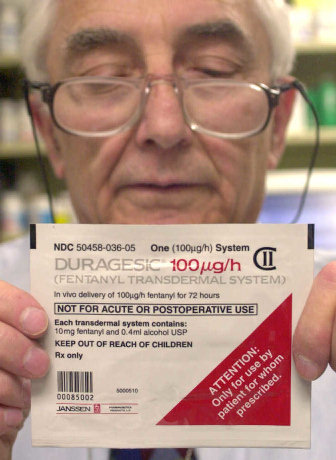
The leading brand of the fentanyl patch is Johnson & Johnson’s Duragesic; last year, pharmacists filled more than 4 million prescriptions for it.
The drug was developed to help people with extreme, unremitting pain, such as cancer patients. But it is increasingly being used for other medical conditions and, in some cases, by drug abusers.
Misuse can be lethal.
The fentanyl patch illustrates a broad and still-unresolved problem with the nation’s system for protecting patients against drug risks: Neither the FDA nor the pharmaceutical industry has a comprehensive system for monitoring what happens after a new drug is approved for market.
Sometimes, as with the highly publicized discovery of heart and stroke risks associated with the painkiller Vioxx, the problem is that dangers show up only after millions of people begin using a drug. At other times, as with fentanyl, the problem is that a drug approved for one purpose and in one context can be prescribed and used for other purposes. Known as off-label use, the risks are not always understood.
Cancer patients, for whom the fentanyl patch was developed, are usually monitored closely by a physician. Increasingly, however, the patches are being prescribed for other patients and conditions, sometimes without close monitoring.
The FDA says it is investigating about 130 fatalities that occurred over a 15-year period. Evidence from autopsies in Los Angeles and Florida suggests the number of fentanyl-related deaths may be much higher. The federal reporting system picks up a fraction of bad drug reactions.
In Los Angeles County, criminalist Daniel T. Anderson of the coroner’s office said the “vast majority” of the 237 people whose deaths involved fentanyl had used the patch. The deaths occurred over a 51/2-year period ending this summer.
Of those, 127 were classified as accidental, suggesting that patients misunderstood how to avoid the drug’s risks.
In Florida, state authorities reported 115 deaths from fentanyl poisoning in 2004, records show. Bruce A Goldberger, whose office handles about one-fourth of the autopsies in the state, said the majority involved the patch.
Drug abuse involving fentanyl also is on the rise. Emergency room mentions of the drug rose from 28 in 1994 to 1,506 last year, according to the federal Substance Abuse and Mental Health Services Administration.
A spokesman for Johnson & Johnson, which makes Duragesic, said the drug met an important need for cancer patients and others with chronic pain. The company is working with the FDA, doctors and patients to make sure it is used safely – and has introduced child-resistant packaging, Doug Arbesfeld said.
“We take the health and safety of the patients who use this product very seriously,” Arbesfeld said. “We work very closely with the FDA to look into all reports of serious adverse consequences, and we believe that the product is safe and effective when used as directed.”