
School proposed near explosives facility
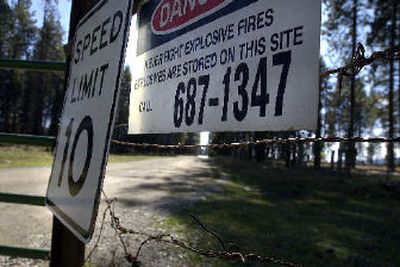
The Lakeland School District’s newest school could be built less than a mile from an explosives storage compound – a facility that many don’t even know exists.
Dyno Nobel is surrounded by farmland at the end of an unmarked drive branching off Scarcello Road near Twin Lakes, Idaho. There are also houses nearby.
No signs indicate the business is there until halfway down that driveway, where the property is gated off with signs warning of explosives with a local phone number for information.
When Paul Morton found out about the facility and the school district’s plan to build an elementary school nearby, he said he went to the district with his concerns. He said he also recently visited the facility himself to ask about the potential threat.
But the vice president of safety for Oslo-based Dyno Nobel, the world’s largest manufacturer of commercial explosives, said there is no threat. The company’s U.S. headquarters is in Salt Lake City.
Dave Millett said the industry is highly regulated, with frequent inspections by the U.S. Bureau of Alcohol, Tobacco, Firearms and Explosives, and is required to maintain a certain distance between the explosives and outside structures. The ATF did not return a call seeking comment.
Millett said the proposed school, and homes and other structures in the area, are well beyond the required setbacks. He said he wasn’t aware of explosions at any of Dyno Nobel’s storage facilities.
The proposed elementary school accounts for $6.2 million of a $14.2 million bond measure the Lakeland School District is putting before voters on Oct. 18. It’s a levy that Morton opposes for several reasons – one of which is the proposed placement of the Twin Lakes school.
The local fire marshal and county officials say they don’t have any concerns.
“We’re pretty comfortable with (the site),” Northern Lakes Fire Marshall Dean Marcus said. If there was a “full blast” at the facility, Marcus said it would likely “not go out as much as it would go up.”
According to Kootenai County Planning Director Rand Wichman, Dyno Nobel is the only permitted explosives operation in the county. He said the company is in compliance with the standards for separation distances from other structures.
Those standards “deal with an immediate blast,” Wichman said. “But it probably doesn’t mean it won’t knock windows out.”
The county’s disaster services director said she also feels comfortable with having a school located near the facility.
“They are an international company and very safety conscious,” Sandy Von Behren said Wednesday. The school site is “basically outside the blast zone. We aren’t concerned.”
Lakeland Superintendent Chuck Kinsey said the school district looked into Morton’s concerns earlier this year. Kinsey said he contacted Dyno Nobel’s local supervisor again this week “to make sure we don’t have a problem.” The district also talked to Marcus and checked with the county, he said.
“Realistically, it’s a nonissue,” Kinsey said. “I really believe it’s not an issue. We’ve got significant housing developments that are much closer than our school that it does not present a danger to.”
In the mid-1990s, another Kootenai County explosives business had a small fire that caused the evacuation of homes within a one-mile radius. That fire at Rimrock Explosives, which is no longer in business, forced the evacuation of hundreds of people. Neighbors were surprised to find out the facility even existed.
Emergency officials at the time said that the blaze could have resulted in an explosion 75 times the blast of the Oklahoma City bombing.
The building contained about 275,000 pounds of explosive material.
According to the most recent records on file with Panhandle Health District, Dyno Nobel’s Scarcello Road facility reported the use or storage of 125,000 pounds of dynamite, 280,000 pounds of prilled ammonium nitrate, 150,000 pounds of blasting agent, 10,000 gallons of diesel and 7,000 gallons of oil.
When the records were filed, the company told the county the facility was used to manufacture blasting agent by mixing ammonium nitrate fertilizer and diesel fuel. The product was packed into bags and stored until shipped to job sites or mines.
The 1995 bombing of the Murrah Federal Building in Oklahoma City used 4,800 pounds of ammonium nitrate and fuel oil.
Millett said Thursday that the Scarcello Road facility is no longer a manufacturing facility, but a storage site for explosives for commercial blasting in construction work or mining.
A county risk assessment in 2000 found no instances in U.S. history of explosions at any commercial explosives site “causing significant injury or damage off-site,” Von Behren said.
“We show the probability of occurrence for this happening as low, and severity of consequences as low,” Von Behren said.