
Sacred fasting
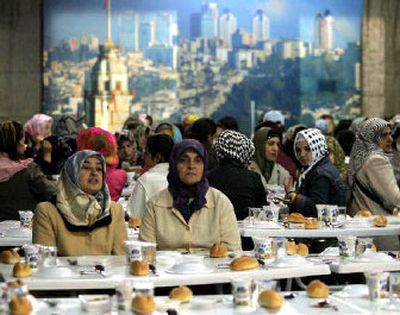
By a coincidence of the calendar, the world’s 1 billion Muslims and 14 million Jews are sharing a religious practice this month: fasting.
Both groups will go without food and drink during the daylight hours of Thursday, observing their faiths’ holiest holidays in fervent prayer and reflection.
Muslims will be observing the holy month of Ramadan, which began Tuesday. From sunrise to sunset for 30 days, they will refrain from eating and drinking.
At the same time, Jews will be midway through the sunset-to-sunset fast day of Yom Kippur, the Day of Atonement. Yom Kippur is the climax of the Ten Days of Awe, which began at sunset Monday with Rosh Hashana, the New Year.
While Muslims and Jews celebrate their holy days, 800 million Hindus the world over are completing the semiannual festival of Navaratri, the Nine Nights of the Divine Mother, which began at sundown Tuesday and ends at midnight Wednesday. Some Hindus take only water during that period, while others eat only small amounts of light food.
From the beginning of recorded history, fasting has played a role in fostering a sense of heightened spirituality. A tradition in many faiths, fasting is believed to concentrate the mind by focusing attention on the divine.
“Fasting has been with us from time immemorial,” says Subhas Tiwari, professor of yoga, meditation and philosophy at Hindu University in Orlando, Fla. “It has to do with satiating one’s desire.”
And refusing to satiate that desire.
Imam Muhammad Musri, president of the Islamic Society of Central Florida, explains: “When the body’s instincts and desires are subdued, it clears the mind and you feel a lot more spiritual. You start seeing a lot of things differently. It has a very magical effect.”
Rabbi Richard Chizever says that by the last service on Yom Kippur, when the Book of Life is being sealed for another year, “the sun is setting, and that’s when people feel the hunger, have the headache, feel all gross and oily; the day has taken its toll.
“That’s the most spiritually fulfilling service because it’s your last-ditch attempt to pray to God and cleave to the divine while your energy is at its lowest. But the spiritual energy of God lifts you up and gives you that last push, that last oomph.”
The intersection of Yom Kippur and Ramadan occurs very rarely. Both Jewish and Muslim holidays are linked to the lunar calendar, but the Jewish high holidays are always in the fall, while Ramadan moves through the year, a few days at a time.
Historically, the fasts are linked.
When the prophet Muhammad migrated from Mecca to Medina, Musri says, “He encountered for the first time the Jewish community that lived on the outskirts of Medina.” The Jews were fasting for Yom Kippur, Musri says, and Muhammad “encouraged Muslims to fast.”
A coalition of religious groups called “The Tent of Abraham, Hagar & Sarah” (tentofabraham.org) has dubbed next week’s coincidence of holidays “God’s October Surprise.” The coalition is asking members of all faiths to join a national fast “for reflection, repentance, reconciliation and renewal” on Thursday, or as near to it as possible.
Christians have their own tradition of fasting.
Roman Catholics fast in a limited way on Ash Wednesday and Good Friday, taking only one full meal. Until the Second Vatican Council, Catholics had to abstain from eating at midnight before they took Communion at Mass.
Since Vatican II, they can eat up to an hour before Communion.
During Lent, the 40 days preceding Easter – Christianity’s holiest day – Catholics traditionally have engaged in fasting, alms giving and prayer, much like Muslims during Ramadan, says the Rev. Gregory Parkes, chancellor of the Diocese of Orlando and pastor of Corpus Christi Catholic Church in Celebration, Fla.
Catholics trace their tradition of fasting to the Jews in the Old Testament, Parkes says.
The modern Protestant practice of fasting “is born out of desperation for God to do something in our nation,” says the Rev. Ronnie Floyd, author of “The Power of Fasting and Prayer: 10 Secrets of Spiritual Strength” (Broadman & Holman, 1997).
In the New Testament Gospels of Matthew and Luke, Jesus was led into the wilderness by the Holy Spirit, where he fasted for 40 days and 40 nights. Fasting helped Jesus to resist the temptations of the Devil, including the power to turn stones into loaves of bread.
Jesus tells Satan: “Man does not live by bread alone, but by every word that comes from the mouth of God.”
For Muslims, fasting applies to more than food and drink. Smoking and sexual activity are out as well, and, Musri says, “You can’t be talking about others in a negative way, thinking negative, listening to anything that’s inappropriate or unlawful.”
Muslims break their fast at sundown each day with a festive meal shared with family, friends and neighbors.
For Jews, Yom Kippur means no food or drink from sundown-to-sundown. Other “sensual pleasures,” such as bathing, sex and wearing leather shoes, also are prohibited.
Most of the day is spent in the synagogue in prayer and reflection. The idea is to “delve into your soul,” Chizever says.
Sixteen-year-old Julian Countess of Longwood, Fla., says that, despite the occasional brain drift (“There’s no two ways about that”), he strives to be an observant Jew, and fasting is a big help with soul-searching.
“If you take something away, you appreciate more of what you do have, which in this case would be your bond with God,” he says. “It’s like private time with God.”