
Fighting for the right to fish on Nisqually
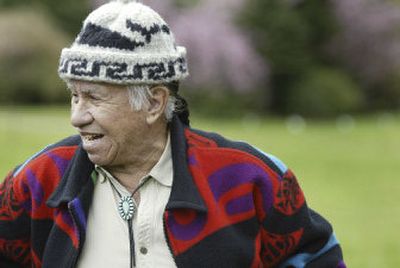
FRANK’S LANDING, Wash. – It’s been 60 years since Billy Frank’s first arrest. He was catching salmon on the river named for his people, the Nisqually. He was 14, doing what his father, his grandfather and countless other generations had done for centuries.
He’s been fighting for his people and the salmon ever since.
“In my estimation, he’s the functional equivalent of Martin Luther King Jr. for African American people, or Cesar Chavez for Hispanic people,” said David Nicandri, director of the Washington State History Museum and a longtime observer of Northwest life.
“One of his great lines is about its taking so many talents and pooling of efforts to get things done,” Nicandri said. “He’ll say, ‘You need the policy people, the scientists – and you need the getting-arrested guy, and I was the getting-arrested guy.’ “
Billy wasn’t looking for trouble when he was arrested for the first time in 1945.
“I never thought anything about it,” Frank said. “Here it is, this is what we do – we fish.”
“When I was a kid, we lived right here. I was born right here,” he said during a recent walk along the river at the landing site, wiped clear of structures by the 100-year flood of 1997.
That first arrest was the first of many.
“What that did, it drove me more underground,” Frank recalled. “I fished at night, I pulled my nets out at dark, I hid my canoes.”
The struggle went on for years as Northwest tribes fought for the right, guaranteed in their treaties, to fish in their usual and accustomed places.
“They always said the treaties are not worth the paper they’re written on,” Frank recalled wryly of the considerable opposition.
But in 1974, U.S. District Judge George Boldt affirmed the tribes’ right to half the fish harvest – and the nation’s obligation to honor the treaties signed more than a century earlier. The U.S. Supreme Court upheld Boldt five years later.
“That for me is one of the biggest decisions of our time – in U.S. history, in world history,” Frank said. “We didn’t have any money, we didn’t have any attorneys and things like that. We didn’t have any infrastructure to work with the state … or the federal government or the neighbors of anybody or the utilities that put the dams on the river.”
The Boldt decision ensured Northwest tribes a place at the table, and laid the foundation for the Northwest Indian Fisheries Commission – a coalition of salmon-treaty tribes of which Frank has since served as chairman.
“So here we are today, still trying to implement the Boldt decision, still trying to implement the recovery of salmon,” Frank said.
Fish still come back to the Nisqually, but not as many, Frank said.
“When I was a kid, I thought there was a lot of salmon,” Frank said. “But when my Dad, who lived to be 104 – when he was young, he thought there was a lot of salmon. But even before that, in the 1800s there was a lot of salmon. I mean millions and millions of salmon. And it dwindled as we all spent our life here on the watershed.”
He still believes the runs can be saved, though he wonders what the region will look like if the population continues to boom.
“This can be gone tomorrow if we pollute the place,” Frank said. “So now these people are important, these non-Indian people who are moving here. They’re the ones who are going to make a decision whether we’re going to have salmon here. I can tell you the story and how important it is and how much it means to Indian people, but what does it mean to these people? Does it mean anything at all?” he wondered.
“There’s more good than bad people,” Frank said. “And so we have to make sure that we never change course. We just stay the course.”
The Nisqually elder has met with judges, senators and presidents, some on less-than-friendly terms.
“They’re retired, some of them are dead and gone, but I’m still here doing what I do, and that’s getting people together and making sure that we find a way to get where we’re going about that salmon,” Frank said.