
Call to the Mall
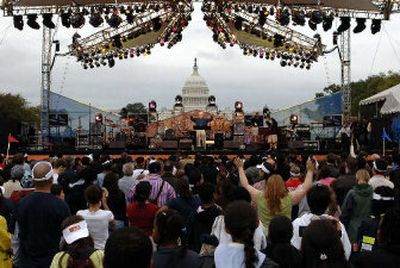
Decades ago, praying civil rights activists gathered there.
This month, an evangelist-led festival and an interfaith gathering of African Americans are happening one weekend apart.
And on Veterans Day, “atheists in foxholes” will take their turn.
Where is the place people of faith, and no faith, gather to make a national statement about religion?
The National Mall in Washington, D.C., of course.
“It is the national green,” says Steve Chavis, director of communications for Promise Keepers, an evangelical Christian ministry that gathered hundreds of thousands of men on the Mall for its Stand in the Gap rally in 1997.
“It is the front lawn,” Chavis says. “The media’s there. … Congress is looking one way and the White House is the other way.”
Whether for sacred or merely political purposes – or a bit of both – the grassy expanse highlighted by the U.S. Capitol, the Washington Monument and the Lincoln Memorial has drawn a wide spectrum of religious crowds.
Scholars and religious officials differ on what’s behind that attraction, but all agree it is as meaningful for the faithful as it is for those who gather there for other reasons.
“I think it’s an honor,” says Andrew Palau, national festival director of the Luis Palau Evangelistic Association, which hosted its “DC Festival” on the Mall last weekend.
“There’s just something very exciting about being on the Mall, such a historic place in the nation’s capital,” he says.
From a variety of perspectives, this stretch of land takes on a kind of sacredness, many say.
“It is a sacred place in that it is extraordinary,” says Edward Linenthal, editor of the Journal of American History and a history professor at Indiana University in Bloomington. “It is … symbolic space unlike the ordinary space that surrounds it.”
Promise Keepers’ Stand in the Gap rally was billed as a “sacred assembly.”
“I think its transformational power is in the intent and the action of the people there,” says Promise Keepers’ Chavis. “It was made holy by prayer and humility and a holy intent, holy practice.”
Anuttama Dasa, spokesman for the International Society for Krishna Consciousness, joins fellow Hare Krishnas on the Mall each Fourth of July, when they offer passers-by free vegetarian food and displays on reincarnation.
“In an environment like that, when we are really uplifting those finer sentiments of the human spirit, it brings us to that mode of goodness,” he says.
“It’s open. It’s grassy. It’s kind of a pure environment that in a sense is a steppingstone toward God, toward the divine.”
Linda Wharton-Boyd, a spokeswoman for the Millions More Movement – today’s 10th-anniversary commemoration of the Million Man March, spearheaded by Nation of Islam leader Louis Farrakhan to bring together African Americans representing an array of religions – says the Mall has an attraction for religious people that is more appealing than gathering in a stadium.
“On the Mall, you’re standing next to people,” she said. “You touch. You feel the energy of people around you.”
American Atheists President Ellen Johnson gathered nonbelievers on the Mall for the Godless Americans March on Washington in 2002 and is making plans for the “Atheists in Foxholes for Honor and Recognition” rally on Nov. 11, Veterans Day.
“I think that the National Mall is a draw for all groups that are entering the political sphere, and religious groups are clearly no different,” she says. “When they go to Washington, D.C., they’re making a political statement with a capital P … and they’re flexing their political muscles. They’re saying, ‘Look at our numbers.’ “
It’s that focus on numbers that turns off Washington-based publicist Bill Carpenter.
“They know that Washington is a media mecca,” he said of religious organizations. “They also know that if you do something on the Mall and it’s fairly large, you’re going to get national TV cameras out here, which will help them when they do their fund-raising drive. … It’s all a show. It’s a PR campaign.”
Whether they focus on publicity, prayer or political power, religious groups are bound to continue taking orchestrated pilgrimages to the Mall, one expert predicts.
“It seems like the growth of the larger churches and attempts to build broad coalitions across the different churches and the role of charismatic leaders mean there’s just a pull to have a national forum,” says Lucy Barber, author of “Marching on Washington: The Forging of an American Political Tradition” (University of California Press, 2002).
“And that’s what the National Mall gives you.”