
China’s space program advancing
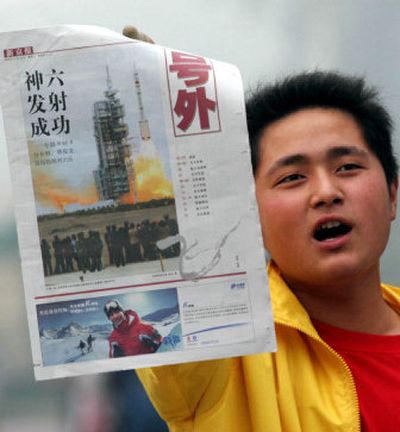
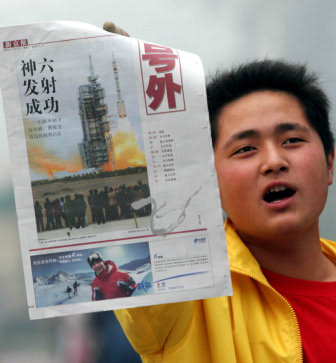
WASHINGTON – With Wednesday’s launch of Shenzhou 6, China’s Communist leadership has won new prestige for its homegrown space program, putting its second crewed spacecraft into Earth orbit and doing it two years after the first one – a bit more quickly than the U.S. space shuttle has managed recently.
Shenzhou 6 and its two astronauts could land as late as Tuesday, according to reports from government news outlets. But regardless of duration, the flight marks a major milestone for a program that has survived the Cultural Revolution and U.S. trade sanctions to make China only the third nation on Earth to develop the full range of skills needed to put humans in space.
Several experts agree that China has little chance of matching the United States in space anytime soon, but Shenzhou 6 is about aspirations as much as attainments. Whether China will ultimately become a U.S. competitor in space, a collaborator or both remains an open question.
“China in space represents a different situation from any other country, because it has its own space capabilities,” said senior analyst Dean Cheng of the Alexandria, Va.-based research organization CNA Corp. “China has ensured that it will not be driven from space. Whether we want to compete with them is in our court.”
The United States has had an arm’s-length relationship with the Chinese space program for the past five years after imposing restrictions on exports of technology that could be construed as “dual-use”: capable also of aiding China’s ballistic missile program. As a result, China recently has relied on itself or on other countries for the space know-how and hardware it needs.
Shenzhou 6, riding atop a Long March 2F rocket, lifted off from Jiuquan Satellite Launch Center in Inner Mongolia on Wednesday, carrying Fei Junlong, 40, and Nie Haisheng, 41, both colonels in the People’s Liberation Army. The mission, capable of staying up for a week, is expected to end with the descent module parachuting into the Gobi Desert.
The mission follows by almost exactly two years the Shenzhou 5 flight that took China’s first astronaut, PLA Lt. Col. Yang Liwei, into space for 14 orbits lasting 21 hours on Oct. 15-16, 2003. Yang, now a national hero, was promoted to colonel after the flight.
The Shenzhou spacecraft is patterned after Russia’s workhorse Soyuz, currently used to ferry astronauts and supplies to and from the international space station while the U.S. space shuttles are grounded.
But “it’s not simply a copy,” Cheng said. At 15,000 to 20,000 pounds, Shenzhou is as much as 10 percent heavier than Soyuz and, besides the descent capsule, has an “orbiting module” that will stay in space several months after the crew has landed. Yang spent all of his short flight in the descent capsule, but the current crew has moved back and forth to the orbit module.
Shenzhou 6 will probably round out the first part of what the U.S. Naval War College’s Joan Johnson-Freese describes as a “three-phase” human spaceflight program: “First, demonstrate manned spaceflight; second, do more sophisticated maneuvers, including (spacewalks) and docking; and third, put together a small space station.”
Completing the program will probably take several years, said Johnson-Freese, chairman of the War College’s National Security Decisionmaking Department, and the station probably will be built from linked orbiting modules. The Long March rockets, with only about one-sixth the lift capacity of the space shuttle, cannot hoist large components into space.