
A love for reading passed along
Don Cutler loved reading books to his children. He watched their imaginations expand and their reading skills improve.
His kids are grown now, involved with careers and academics. But Cutler, a Spokane stock and bond broker, still wanted to share his love of literature.
“I assumed there were plenty of people doing that in the schools,” he said.
There are reading programs, but none quite like the one that Cutler proposed.
Last year, out of the blue, he called Holmes Elementary, Spokane Public Schools’ poorest school, where nine out of 10 kids qualify for free or reduced-priced meals.
Holmes Elementary Principal Steve Barnes met Cutler and ran with the idea.
After some training and background checks, five volunteers began reading weekly with grade-school students. In the summer, Cutler hosted a dinner party where he invited Barnes and more than a dozen potential volunteers.
Now, 15 people have agreed to come for an hour a week to read with grade school students – all because Cutler wanted to share his love of reading.
“This is not normal,” Barnes said. “I’ve never had this happen in 23 years of education.”
Cutler, who’s also studying for his master’s of fine arts in creative writing at Eastern Washington University, had worked with children before. For several years he volunteered with the “Bee Kind” garden, which was set up for abused children.
Garden founder Gayle Kiser said that for years her friend Cutler talked about how children could work through their troubling experiences by writing.
“I think reading partnered right along with that,” Kiser said.
The greatest impact on children often comes in the simplest forms, she said.
“It really isn’t rocket science. It takes the passion of a person and a willingness to shine on a child for a couple of hours. Sometimes that’s all it takes,” Kiser said. “We’ve all had that experience where someone special made us believe in ourselves in ways our family didn’t.”
Sometimes Cutler hears how much the children have been through. He was helping one student last year try to read the word “tent.” He showed the student a picture of a campsite with sleeping bags and asked the student what he saw.
“A house,” the student said.
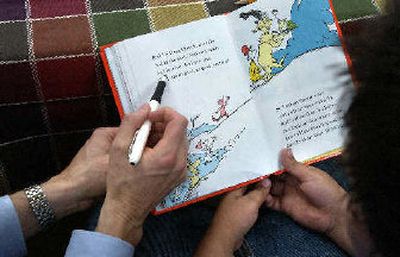
On Wednesday afternoon, Cutler sat in a teachers’ lounge with second-grader Marion Smalley, who was stuck on the word “thanks.”
“Then?” the boy guessed. “That?” he tried again.
Cutler drew on some of the school training and put the word into a context for Marion.
“When someone gives you ice cream what do you say?” Cutler said.
“Thank you!” Marion said and went on reading “Green Eggs and Ham.”
Last year, Marion brought school library books that he had memorized to his reading sessions. But Cutler can now tell when his young friend guesses rather than reads.
He knows that when Marion sighs and leans back in his chair that it’s time to relax more and that he should take over more of the reading.
After the session, Cutler said, “I feel for them. I want it to be easy for them.”
He’s there to hear every struggled word. It’s that one-on-one feedback and interaction that’s so powerful and desirable, Barnes said.
“It’s prime time,” the principal added.
A student enters the weekly session knowing that for the next 30 minutes he or she is the center of the universe, Barnes said. Students even start treating the kid like a mini-celebrity as they wonder where their classmate goes for 30 minutes, Barnes said.
Studies show that, generally, lower-income households have many fewer books than middle- or upper-income families.
Launching the program was a risk for Barnes. Should the volunteers lose interest, or start to regularly miss the reading sessions, more harm than good is done, Barnes said.
“Our kids do not need another disappointment in life,” Barnes said.
So far the risk has paid off, as far as anyone can tell.
“We might not ever see the impact,” Cutler said. “We just have to have faith.”