
Life & Depth
Being gorgeous, successful, stylish, rich, thin and highly sought after isn’t all that great. Oh, wait. Yes, it is.
Charlize Theron, the ballet dancer turned model turned Oscar-winning actress, is surface-of-the sun hot.
Since snagging a best actress win for her amazing performance as serial killer Aileen Wuornos in 2003’s “Monster,” she’s been offered a silver platter of A-list directors, co-stars and projects to choose from.
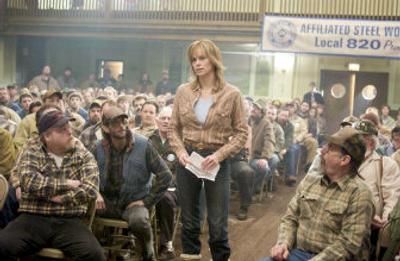
But instead of feasting at the Hollywood box office buffet of easy glamour roles and romantic comedies, she chose a meaty part as a blue-collar woman and a serious film about a tough topic: sexual harassment.
“North Country,” in theaters today, is based on the real-life saga of former Minnesota miner Lois Jensen, who was so mistreated by her male co-workers and bosses that she filed a landmark class-action sexual harassment suit in the early 1990s. It eventually was settled out of court.
The aftershock spread across the country as similar class-action suits were filed in other professions.
Theron stars as Josey Aimes, a woman who flees an abusive husband with her two children and gets a job in an iron mine. She is joined by a stellar cast that includes fellow best actress Oscar winners Frances McDormand and Sissy Spacek, along with Woody Harrelson.
In the wake of “Monster,” Theron was knocked in some circles for choosing another “ugly, dirty-hair movie,” which she finds preposterous.
The 30-year-old actress has no interest in pretty-girl roles, yearning more for movies that examine family relationships or social injustice.
“I was really shocked that this case only happened 15 years ago,” says Theron. “You can’t even call it history, it was just the other day.
“I was very naive, like, ‘This stuff only happened in the ‘60s and that’s why there was the feminist movement and we burned our bras. This doesn’t happen anymore.’ “
One element that drew Theron to the project was the grittiness of northern Minnesota.
“I love the social structure of that world, it’s very reminiscent of where I grew up – small town, harsh landscape, no luxury to kind of sit back and wallow in self-pity and sorrow and feel sorry for yourself,” she says.
Theron grew up on a farm in Benoni, South Africa. When she was 15, her abusive father came home one night threatening his wife and daughter, firing a gun. Theron’s mother, Gerda, shot and killed him in self-defense.
The following year, mother and daughter moved to New York where Theron became a ballerina with the Joffrey Ballet.
She segued into films in the mid-‘90s with parts in “2 Days in the Valley” and Tom Hanks’ “That Thing You Do!” and stood out opposite Al Pacino and Keanu Reeves in “The Devil’s Advocate” in 1997.
Since then, she has worked with directors as diverse as Robert Redford, Woody Allen and John Frankenheimer. But none of them struck a chord with her like New Zealander Niki Caro, who directed “North Country.”
Caro directed the brilliant “Whale Rider” in 2003, in which a young Maori girl, played by Keisha Castle-Hughes, tries desperately to win the respect of her grandfather. One of the movie’s biggest fans was Theron.
” ‘Whale Rider’ was primarily why I ended up making ‘North Country,’ ” she says. “The fact that there was this little girl just bubbling over with so much emotion. It was so raw, so true, it felt so organic.
“The first time I met Niki, I couldn’t stop asking her how she got that performance out of Keisha. As an actor I was like, ‘I want some of that.’
“I just really like her process. And how she’s not manipulative. Niki just has this incredible knack for understanding the human condition.”
Caro took the cast to Minnesota for three weeks. Theron spent time in the mines and hung out with the local women who worked in them, going bowling, snowmobiling, ice fishing, bar-hopping.
“They were kind enough to invite me into their homes; it was incredible,” she says. “It was really nice to see them with their families and their children. They were incredibly open, generous and funny.”
She was encouraged by her hosts to play a woman who was not the obvious, extroverted muckraker.
“Josey is not the quintessential character that you see in films, where you go, ‘She’s going to be the one,’ ” Theron says. “I thought Glory, Frances’ character, was more that woman, very much like a Norma Rae, or (Karen) Silkwood, or Erin Brockovich. Instead, Josey is kind of a wallflower. And yet she was the one who found the strength to stand up and fight. …
“She was really, really scared, terrified. But at the end of the day she had two kids to take care of, and her survival instinct kicked in and said, ‘I have to do this, even though I’m not built to do this.’ “
Theron hopes viewers will come away from “North Country” with an appreciation for how nasty workplaces can get when harassment goes unchecked, when management retaliates and drives women who can least afford to lose paychecks to want to quit and run away.
“I just loved the strength of these women,” she says. “The breaking point wasn’t, ‘I can’t take this anymore.’ The breaking point was, ‘I’m not going to take this anymore.’
“You have to make that choice – ‘I’m not going to sacrifice myself or my dignity anymore. This has to change.’ “