
Old-fashioned efficiency
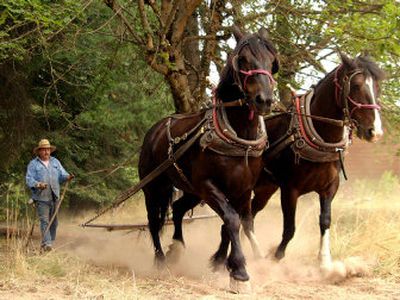
“Whoa, back, back,” Bruce Spencer orders Manley Stanley and Highfalutin’, a brother-sister team weighing close to 3 tons. And that’s all it took.
His pair of draft horses took a step backward and waited for the next command. “Back,” and again the pair take a step or two back and stop.
This time Spencer wraps a chain around a tamarack log, chirps to the team, and the horses surge forward, pulling a 30-inch diameter, 16-foot log as Spencer maneuvers his horses around trees, outbuildings and seedlings to the log deck.
That’s one of the things about horse logging that landowner Rick Davis likes, “the low impact and the maneuverability.” And that is the main reason why Davis and his wife, Susan DiGiacomo, chose horse logging.
Davis, who worked for the U.S. Forest Service and now is a student, and his wife, a Forest Service botanist, talked to many people before deciding to use horses to log their four acres for habitat improvement.
The objective is to log pockets of diseased trees and try to improve the lot while preserving the beauty of the stand.
Davis is happy with the result so far. “It even has less impact than I thought,” he said.
In this era of efficient mechanized logging equipment, many people don’t think about horses when sizing up a logging job. But Bob Rehnborg, in charge of small sales on the Coeur d’Alene Ranger District, sees horse logging as a viable alternative.
He recently designed a 44-acre commercial thin project specifically for horses in the old Mountain View picnic site that overlooks Coeur d’Alene.
“Viable,” said Rehnborg, “because it is lighter on the land, reducing the visual ground disturbance. Compared to an 8-foot-wide skidder, horse logging is just the width of the tree and that’s good in places like campgrounds, picnic sites or areas with considerable regeneration under the larger trees.”
When Spencer first decided to horse-log in 1981, many people thought he was nuts. As a logger, operating a skidder at the time, “I saw a lot of little trees being damaged, and I didn’t like that,” he said.
So Spencer decided to quit traditional logging and buy a team of horses.
“With horses,” Spencer explains, “there is less impact on the land, and I can go around little trees so our next generations of trees survive. Every time my horses lift their tails, I also fertilize the land. I saw it as the only way to go.”
The Forest Service and private landowners who are Spencer’s and other horse loggers’ clients say it is the perfect answer to logging small areas of land without destroying the land or damaging trees not selected for cutting.
“I like horse logging because it is a neat historical system,” Rehnborg says. “And I think there are circumstances where it is valuable today. I would hate to see it disappear.”
Spencer would like to see state and federal forest managers put up more timber sales requiring horse logging. There is at least 10 horse loggers located in a 100-mile radius of Coeur d’Alene who could bid on projects.
Besides logging, Spencer uses his horses for carriage rides and competing in pulling contests. He also breaks and trains new teams.
Although Spencer says his wife would like to see him get out of logging, “I like the opportunity to work in God’s creation and manage it a little.”
One of his best horse-logging experiences, Spencer said, was up the river in two feet of snow, letting the horses drink out of the river with the sun peaking over the mountains, the light glistening off the snow.
“It was awesome,” he says.