
Evacuees arrive in state
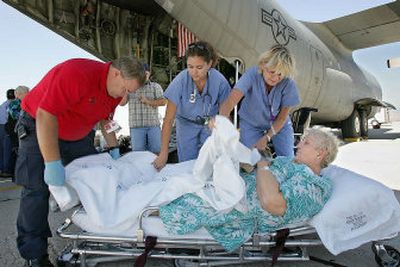
BOISE – Some of the most fragile, ill and elderly evacuees from the Gulf Coast hurricane are now resting in nursing homes and hospitals in Idaho, and beds are being readied around the state for more.
“None of these people even knew where Idaho was when we left – they just knew that they were going someplace better,” said Ken Sheldon, flight paramedic and LifeFlight manager for St. Alphonsus Regional Medical Center in Boise, who helped bring 10 evacuees from the Houston Astrodome to Boise early Monday. “The state of Idaho is absolutely committed to bringing back as many people as we can,” he said.
After a Nampa nursing home offered beds to hurricane victims on Friday, state Health and Welfare officials scrambled. On the Friday night of the Labor Day holiday weekend, the staff of the state’s long-term care unit in Lewiston came in to work and started calling around the state “to find out what type of beds were available and where,” said Health and Welfare spokesman Ross Mason. “They came up with 671 of them for skilled nursing home care.”
Ten of those beds, at two Nampa nursing homes, were filled by the first planeload of evacuees, who were rolled off an Idaho National Guard C-130 cargo plane in wheelchairs at 3 a.m. Monday after a flight from Houston. Another half-dozen arrived on Tuesday afternoon from Meridian, Miss., and were headed to Boise hospitals and nursing homes.
The planes left Idaho packed with donated bottled water, Power Bars and other supplies bound for New Orleans, along with medical teams from Boise hospitals to treat the patients on their way back to the state.
“If the state of Idaho has the means to provide relief and hope to those who have been displaced, we have a duty to do it,” said Gov. Dirk Kempthorne. “So far, Idaho’s response to Katrina and her aftermath has been proactive and well-received.”
Sheldon said he was shocked by the situation at the Astrodome, which he said rivaled Third World countries he’s visited. There were just 85 showers for 24,000 people, he said, and a form of “mob rule” had erupted.
As he was putting one woman on the airplane, Sheldon said, he asked whether there was anything she needed. “She looked at me and said, ‘No, sweetie pie, this is the first time I haven’t been afraid in 10 days.’ “
Lt. Tony Vincelli, public affairs officer for the Idaho Air National Guard, said there are no additional evacuation flights scheduled at this point, due to “some issues with getting those folks out of wherever they’re being treated and getting them medically cleared to fly aboard a C-130 aircraft. We don’t want to put ‘em on an aircraft if that’s potentially going to jeopardize their health.”
But Sheldon said he and a representative of Boise’s St. Luke’s Regional Medical Center will be returning to the Astrodome on Thursday to stay for 10 days to two weeks, set up a triage system, and evacuate another 400 patients to Idaho.
And two Idaho National Guard C-130s will head back to Naval Air Station New Orleans today loaded with thousands of 1.5-liter bottles of Idaho water. They’ll return to Boise tonight.
Kempthorne also sent five National Guard tanker trucks to the gulf region, each loaded with 2,500 gallons of gasoline to fuel police cars and ambulances.
The governor also appointed a Task Force on Refugee Resettlement to look into shelter, food, clothing, education, jobs, health care and more, for evacuees who might come to the state.
“We’re really kind of just getting our arms around this whole idea and how big of a task it’s going to be,” said Mike Journee, press secretary to the governor. “We’re considering all options that we can to help the people of the Gulf Coast.”
Mason said, “We don’t know, we may get five, 10, we may get several thousand. It’s a real fluid situation and we just don’t know what’s going to happen right now.”
The Federal Emergency Management Agency was so impressed with Idaho’s quick job of identifying spots for nursing home patients that it called state Health and Welfare Director Karl Kurtz, who worked on the effort throughout the holiday weekend, for advice.
“They were interested in how we had responded so quickly to it,” Mason said. “These are people that it’s difficult to move; it’s generally pretty traumatic. They’re going to a whole different world – some of ‘em have probably never been out of Louisiana in their life and then all of a sudden they’re cast up in some place called Idaho that some of ‘em may never have heard of.”
The 671 identified beds are in 45 nursing homes from Sandpoint and Coeur d’Alene to Boise and Idaho Falls, Mason said.
Because nearly 85 percent of nursing home patients nationwide are on Medicaid, the program likely will pay for their stay regardless of which state they land in.
“It’s just a matter of getting them into the Idaho system,” Mason said.