
U.S. mobilizes broad relief effort after Rita

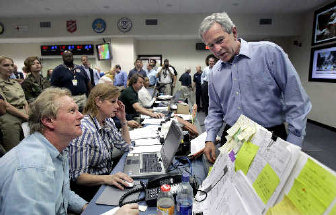
WASHINGTON – The Bush administration, eager to avoid repeating the error-prone response to Hurricane Katrina, mounted a broad mobilization of government assistance on Saturday to areas of Texas and Louisiana slammed by Hurricane Rita.
As the military quickly moved troops, amphibious vehicles and equipment into the stricken area, FEMA fielded more than 1,000 rescue workers. President Bush cautioned residents against returning home too quickly.
“People who are safe now ought to remain in safe conditions,” said Bush, who monitored the storm from an Air Force command post in Colorado and then flew to Austin, Texas, for more briefings.
“The first order of business now is the search-and-rescue teams, to pull people out of harm’s way,” Bush said in Colorado Springs. In Austin, at the state Emergency Operations Center, he added an admonition for evacuees to stay put – and not contribute to a repeat of Friday’s miles-long traffic jams.
At Federal Emergency Management Agency briefing, acting agency director R. David Paulison warned that “most of the fatalities, most of the injuries, are after the hurricane is over,” but he said that there has yet to be a reported casualty since the storm hit.
However, on Friday, a bus of Rita evacuees caught fire in gridlocked traffic south of Dallas, killing as many as 24 nursing-home residents.
Urban search and rescue teams already were in the stricken area and “we got quite a few people out,” Paulison said. He said medical teams were already treating people in Houston.
Paulison said he had no assessment yet on the damage to the oil industry.
“Although the winds have died down a bit, there’s still a tremendous amount of rain,” he said. “There could be flooding all the way up to Arkansas.”
Paulison called the breaching of some levees in New Orleans because of heavy rain from Rita a setback that can be overcome.
“We will have to go back and repair those levees and pump out the water again,” the FEMA official said. “It will probably set us back two or three days.”
Though Rita’s destruction was far less than it could have been, early FEMA assessments did show some problem areas.
Large swaths of southwest Louisiana, including parts of Interstate 10 and other major highways, were flooded, said FEMA deputy operations director Mike Lowder. The agency helped coordinate getting food to people in a Tyler County, Texas, shelter and providing water to a Beaumont hospital.
Additionally, the Coast Guard rescued an 8-month-pregnant woman and her 4-year-old son from their home in Port Fourchon, La.
Sen. John Cornyn, R-Texas, called coordination among different levels of government much better this time than for Katrina.
“But we’re still not out of the woods,” Cornyn said in an interview. He said highway tie-ups like those that confronted residents on Friday as they left the area could be just as bad now as people begin to return.
Many service stations along the routes have not yet been resupplied with gasoline, Cornyn said. “People who get on the road could well run out of gas and be frustrated. They might as well stay safe and dry where they are now,” he said.
Five hundred troops from the 82nd Airborne Division headed to Lafayette, La., about 135 miles west of New Orleans, to help with search-and-rescue efforts, said division commander Maj. Gen. Bill Caldwell. He said about 3,200 of his soldiers would be prepared to go to Lafayette by today if needed.
Military briefers said there are 17,000 active duty military and 36,700 Guard personnel in the areas affected by the two hurricanes.
Several Navy ships that had been in New Orleans and were sent to sea to avoid Rita were heading back Saturday to position themselves about 50 miles off the coast of Port Arthur, Texas.
At the Northern Command headquarters in Colorado Springs, Bush was briefed on the storm and on the reflooding of parts of New Orleans.
“All the forces are postured for rapid response. I think we’re in good shape,” said Navy Capt. Brad Johanson.
Coast Guard Capt. Dan Lloyd told Bush there were still some 61,000 people in shelters – down from a high of 253,000.
The American Red Cross is apparently close to having the capability of serving 300,000 meals a day, Lloyd said.