
WWP turns up the power
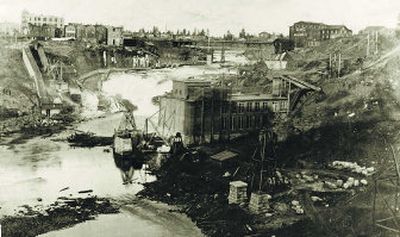
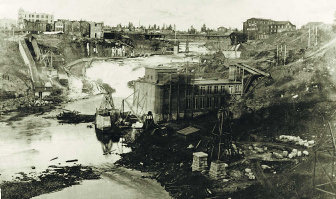
The early history of Spokane is largely a story of water power – or should we say, of the Washington Water Power Co. Few other entities have been so closely tied to the city’s progress and, in some ways, its very existence. After all, the city founders chose the Spokane Falls location precisely because the roaring falls were a massive source of energy. The early pioneers, however, thought of it in terms of flour mills and sawmills.
But as early as 1885, a certain George A. Fitch had the bright idea to take a primitive dynamo (generator) from a ship and install it in the basement of a Spokane flour mill. He hooked it up to 10 arc lights, and soon a block or two of Spokane’s muddy downtown was electrically, if somewhat dimly, illuminated.
The little town was ahead of its time. Only three years earlier, Thomas Edison had built the first central generating station in New York, according to Steve Blewett’s “A History of the Washington Water Power Company, 1889-1989,” to which I am indebted for much of the information in this story.
In 1886, some local businessmen became intrigued by the possibilities of electricity, and they installed an Edison electrical generator in a bay near the Post Street bridge. This plant allowed the streetlights to be extended all the way south to Sixth Avenue; it also powered the lights for one of Spokane’s first opera performances.
The demand for electricity kept growing and growing – the presses of the Spokane Chronicle went electric in 1888 – and a more powerful generator was soon lowered into the river. Because of the town’s ideal location for power generation, Spokane became one of the most lit-up cities in the Northwest, with 1,200 lamps. Only Hailey, Idaho, had more.
By early 1889, several competing companies were generating power in Spokane, including The Edison Co. Another new trend was driving demand for electricity – the advent of electric street railways (streetcars), which were replacing the horse-drawn variety.
The Great Fire razed most of downtown Spokane in August 1889, yet it was immediately apparent that the city would not stay dark for long. Edison Co. workers spent the next day rewiring the burned zone using everything from baling wire to barbed wire, according to Blewett. By the next evening, the city’s street lights flickered on according to schedule.
A few months earlier in 1889, a group of local businessmen had organized the Washington Water Power Co.; their plan was to harness the Spokane River’s prodigious Lower Falls. After the fire, they immediately began work on what came to be known as the Monroe Street project. When it was completed in 1890, it generated more electricity than the other plants combined. By 1891 WWP had bought out the Edison Co.’s local holdings. The city’s streets were looking increasingly bright, and so was its future.
WWP also began buying out the city’s various streetcar lines, most of which had been built by real estate developers as a way of enticing homebuyers to live outside of downtown. Then in 1895, as a way of encouraging more people to ride the streetcars, WWP bought Twickenham Park on the Spokane River, built a swimming pool and amusement rides, and renamed it Natatorium Park.
By the turn of the century, WWP was adding more generating capacity and making plans to go regional. It sent electricity out to the Great Northern Railway yards in Hillyard and it built a high-voltage transmission line all the way to the Silver Valley mines. According to some accounts, it was the longest high-voltage transmission line in the world.
Yet in 1900, electricity was still a novelty for daily domestic use; most people had no electrical appliances. Over the next two decades, WWP leaped wholeheartedly into appliance marketing, and by the 1920s, the company had one of the highest rates of electric range and water heater use in the nation. It helped that a WWP employee, Lloyd Copeman, invented a crucial device for electric ranges: an automatic thermostat control. He later sold his patent to Westinghouse.
By 1906, WWP was providing electricity to more than 100 towns.
In the next two decades, the company built hydroelectric projects at Post Falls, Ross Park, Little Falls, Long Lake, Upper Falls and Chelan.
The company’s progress has been tied to the region’s progress ever since. And for those of you new to the Inland Northwest, who have never heard of Washington Water Power – well, you still probably write a check to the company every month.
The company changed its name to Avista in 1998.