
Bush’s childhood home dedicated after restoration
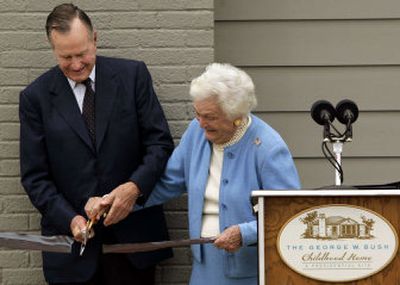

MIDLAND, Texas – Former President Bush and his wife returned Tuesday to the small home they shared in the 1950s to dedicate a $1.8 million restoration of the house where their eldest child, President Bush, spent part of his youth.
The George W. Bush Childhood Home has been renovated to appear much as it did when the family lived there and the elder Bush worked in the oil business.
Barbara Bush recalled thinking the house was enormous when they bought it.
“You all look at it as a little house,” she told a crowd of 700 people at the ceremony. “It was a terrific house to live in. We loved it here.”
President Bush was about 5 when his parents moved to the home in late 1951. It was the second home the couple had owned and one of 27 the family lived in. The house was home to two future presidents, two future governors and a future first lady.
After a floor-to-ceiling restoration, workers brought in vintage appliances, light fixtures and even 1950s-era wallpaper and toys.
First lady Laura Bush’s mother, Jenna Welch, who is in her 80s and still lives in Midland, donated a greenish-blue 1955 refrigerator from her home for the renovation.
Laura Bush joined her in-laws for the ribbon cutting.
“You know, George doesn’t like to think of his childhood home as historic yet,” she said. The president turns 60 this year.
The Bush family occupied the house until late 1955, when the family moved to a larger home in Midland. They moved to Houston in 1959.
Organizers used family photos from the elder Bush’s presidential library and museum at Texas A&M University to research the colors of the home, as well as wall decorations and furniture.
The group was able to match the paint, but the family’s furniture is long gone, so organizers found similar pieces for the exhibits that occupy three of the home’s seven small rooms.
The exhibits – on baseball’s place in President Bush’s childhood, the oil industry in the 1950s and a display of family photos – will eventually be moved to a museum scheduled to open across the street within five years.
The project was funded mostly by private donors, with a few contributions from charitable foundations in Texas.