
A century after ‘The Jungle,’ meatpacking still has some problems

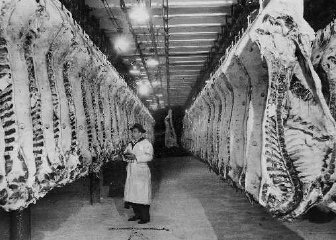
OMAHA, Neb. — He works in a world of long knives and huge saws, blood and bone, arctic chill and sweltering heat. For Martin Cortez, this is life on the line as a meatpacker.
It’s no place for the squeamish, but Cortez has been at it more than 30 years.
He doesn’t recommend the work. The thrashing animals and the heavy lifting make for a backbreaking day.
This, some would say, is The Jungle of 2006.
It’s not anywhere near as horrible as the world muckraker Upton Sinclair surveyed 100 years ago in his sensational book “The Jungle.” A harrowing portrait of an immigrant’s oppressive life in meatpacking, the novel angered President Theodore Roosevelt, sent meat sales into a tailspin and inspired consumer-protection laws.
Even the harshest critics acknowledge government regulations and inspectors have made meatpacking far cleaner and safer than it was when Sinclair described rats scurrying over piles of meat and sick animals stumbling to slaughter.
But 100 years later, the industry that produces the meat for America still faces some of the same tensions and troubles that Sinclair exposed.
In 1906, there were accusations the meatpacking giants exploited immigrants, battles over unions and complaints of paltry pay for hazardous work.
In 2006, the problems persist — though the names have changed. The eastern Europeans who flocked to Chicago’s bustling stockyards 100 years ago have been replaced by Mexican and Central American immigrants chasing their own dreams in the remote reaches of the rural Midwest and Southeast.
“It’s not as bad as it was in the sense of the sheer brutality of 100 years ago — before labor laws and food safety laws,” says Lance Compa, a Cornell University labor law expert who wrote a stinging Human Rights Watch report on the meat and poultry industry last year. “But for the times we’re in now, the situation is much in line with what it was 100 years ago.”
The American Meat Institute, the trade group founded the same year Sinclair’s book was published, dismisses those claims. It says wages (about $25,000 a year) are competitive, turnover is wildly exaggerated and safety has dramatically improved in recent years.
“If Upton Sinclair walked through our plants today, he’d say he was a successful reformer,” says J. Patrick Boyle, the institute’s president. “He’d be astonished and, I think, impressed with the changes that have occurred.”
Some changes came almost immediately.
Within months after “The Jungle” was published, two landmark measures became law: the Pure Food and Drug Act and the Meat Inspection Act of 1906. More legislation and improved technology followed.
Boyle says in the last 15 years, there has been a new emphasis on partnerships — the union, the federal Occupational Safety and Health Administration and companies — collaborating to improve ergonomics and equipment.
It appears to have paid off: Federal figures show illnesses and injuries in the meat and poultry industry fell by half from 1992 to 2001 — from 29.5 to 14.7 per 100 full-time workers, according to a 2005 Government Accountability Office report.
But the GAO also cautions injuries and illnesses still appear to be underreported — immigrants may fear retaliation or job loss and others may be reluctant to report problems if there are financial incentives for keeping a safe workplace.
In Sinclair’s day, Lithuanians, Poles and other eastern Europeans crowded into the shadow of big-city slaughterhouses in hopes of building a better life.
Thousands of immigrants still come, as they did a century ago.
Some are refugees from Somalia, Sudan and Vietnam; many more journey across the Mexican border and head to Nebraska, Kansas or other states where giant meat plants seem to have an inexhaustible need for labor.
Both the meatpacking companies and the United Food and Commercial Workers union — which says it represents more than 50 percent of meat and poultry workers nationwide — have adapted to large numbers of foreign-born workers, offering, among other things, classes in English.