
Israel cuts Lebanon’s ‘umbilical cord’
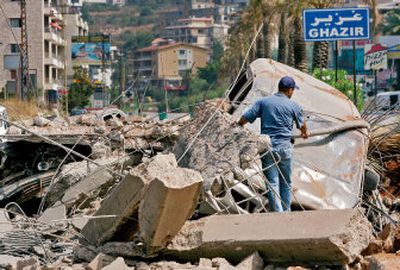
BEIRUT, Lebanon – Israel and Hezbollah fought bloody ground battles and exchanged fierce air and missile strikes Friday – including bombing raids that severed Lebanon’s last major supply link to Syria and the outside world, and the deepest rocket attack inside Israel to date.
Explosions resounded in Beirut early today as Israeli warplanes renewed their onslaught, carrying out several strikes on southern suburbs, local media said. Israeli helicopters, meanwhile, attacked suspected Hezbollah positions in the southern city of Tyre, though Hezbollah’s TV station claimed that fighters repelled helicopter-borne troops who tried to land, killing one soldier. Israel declined to comment.
After days of desultory diplomacy, Washington said it was near agreement with France on a U.N. cease-fire resolution, possibly by early next week. But Israel and Hezbollah showed no signs of holding their fire.
Israeli aircraft on a mission to destroy weapons caches hit a refrigerated warehouse where farmworkers were loading fruit, killing at least 28 near the Lebanon-Syria border. And three Hezbollah rockets landed near Hadera, 50 miles south of the Israel-Lebanon border; 188 rockets rained on other towns, killing three Israeli Arabs.
Israeli military officials said Friday they completed the first phase of the offensive, securing a 4-mile buffer zone in south Lebanon, though pockets of Hezbollah resistance remained.
Defense Minister Amir Peretz told top army officers to begin preparing for a push to the Litani, about 20 miles north of the border – a move that would require Cabinet approval. Peretz vowed that his forces would complete “the whole mission” of driving guerrilla fighters out of missile range, a defiant response to the Hezbollah leader’s threat to launch missiles into Tel Aviv, Israel’s largest city.
Israeli airstrikes destroyed four key bridges after dawn, severing Beirut’s final major connection to Syria and raising the threat of severe shortages of food, gasoline and medicines within days. The attack in the Christian heartland just north of Beirut killed four civilians and a Lebanese soldier.
Israel said it targeted the bridges to stop the flow of weapons to Hezbollah from Iran through Syria. Those weapons include not only missiles, but sophisticated anti-tank rockets said to be responsible for most of the 44 Israeli soldiers killed in more than three weeks of fighting.
However, aid workers said the destroyed highway was a vital conduit for much-needed food and supplies, with Christiane Berthiaume of the World Food Program calling it Lebanon’s “umbilical cord.”
“This (road) has been the only way for us to bring in aid. We really need to find other ways to bring relief in,” she said in Geneva, Switzerland.
Hospitals were in danger of closing soon because medicines, hospital supplies and fuel for generators was running out. Staples like milk, rice and sugar were growing short across the country. Lines at Beirut filling stations stretch longer by the day.
Dr. George Tomey, acting president of the American University of Beirut, said its Medical Center, one of the best known medical facilities in the Middle East, will stop receiving new patients as of Monday, except for emergency cases.
Dr. Ghassan Hammoud, who runs a 320-bed hospital packed with war wounded in the southern port city of Sidon, said he may have to shut down within 10 days.
On the 24th day of the conflict, the State Department said Friday that the United States and France were nearing completion of a U.N. resolution designed to halt the fighting in Lebanon and to set out principles for a lasting cease-fire.
“We are very close to a final draft with the French on a text,” department spokesman Sean McCormack said.
Lebanese Prime Minister Fuad Saniora said 1 million people – or about a quarter of Lebanon’s population – have fled the fighting. Others estimate 800,000 Lebanese have been made refugees.
More than 300,000 Israelis have fled their homes in the north, Israeli officials said.
Lebanese security officials and the state news agency said Israeli airstrikes flattened two southern houses Friday and that more than 50 people were buried in the rubble. Israel denied attacking the villages, Aita al-Shaab and Taibeh.
Friday’s attack on the refrigerated warehouse in Lebanon’s eastern Bekaa Valley killed at least 28 farm laborers as they loaded peaches and apples onto trucks bound for the Syrian market, Lebanese security and hospital officials said. Syria’s official news agency, SANA, reported that 33 people were killed in the raid, including 23 Syrian workers.
Israeli army spokesman Capt. Jacob Dallal said the army suspected the warehouse was used for arms because it tracked a truck it believed was carrying weapons that went into the warehouse from the Syrian side. He said the truck stayed inside for about 90 minutes before returning to Syria.
Israel contends that Hezbollah gets almost all of its weaponry from Syria and by extension Iran.
On Friday, the army confirmed a Hezbollah anti-tank missile killed three soldiers and wounded two others in southeastern Lebanon.