
The governor’s tax shift
BOISE – Run the numbers of Gov. Jim Risch’s tax reform plan, which would lower property tax and raise sales tax, and the big surprise is how little most Idaho families would be affected.
“It’s pretty much not much,” said Boise economist Don Reading.
Virtually all property owners would see a tax cut from Risch’s plan to eliminate the basic school operations levy, which would take nearly $3 per $1,000 of taxable value off everyone’s property tax bill. But the net result, after paying an increased sales tax of 6 percent instead of 5 percent, would be small for most taxpayers. Only very large property owners who pay little sales tax – major manufacturers and utilities, for instance – would see big gains under the Risch plan, up for debate in a special legislative session Aug. 25.
“It seems to me like it’s a massive windfall for big business, and that has me really ticked off,” said Fran Ciarlo, an Orofino café owner. She’d benefit from the Risch plan because she owns two rental homes, but Ciarlo worries that with home values continuing to rise, future value increases will eat up the gain. “Houses have doubled in price, but they’re lowering it 25 percent. We’re just pedaling furiously going backwards the whole time,” she said.
Homeowners wouldn’t gain much under the Risch plan, in part because the tax that will be reduced already was trimmed this year with an increase in the homeowner’s exemption. Landlords and vacation-home owners would get the full reduction of just under $3 per $1,000 of property value. Renters would lose – they’d pay more sales tax with no direct benefit from the property tax cut. But the numbers are small.
Where the numbers are largest is for the state’s highest-value property owners. Micron Technology in Boise, the state’s largest private employer, has a taxable value of $800 million in Ada County and would see a $2.3 million property tax cut. Avista Corp., the largest single owner of taxable property in Kootenai County, would see a reduction of more than $330,000 in its property tax bill.
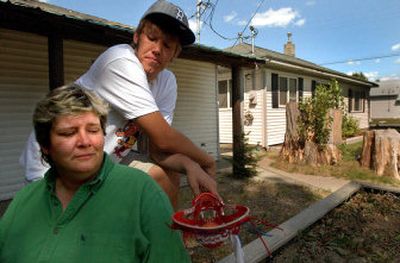
Laura Bry, a single working mom from Sandpoint who rents her home, wants property tax relief, even though she’d get no direct benefit.
“Right now, where I live is affordable. But should my landlord have to deal with amazing hikes in property taxes, it’s going to make it pretty difficult for me if he makes a major jump in my rent, that’s for sure,” Bry said.
Statewide, 27.6 percent of Idahoans rent rather than own their homes, according to U.S. Census Bureau data from 2004.
Bry likely would spend another $80 a year in increased sales taxes under the Risch plan. “I’m not even going to notice,” she said. “I wouldn’t mind if they raise the sales tax a little bit.”
But she worries about school funding – she has a son in high school – and fears that Idaho’s tax system is increasingly shifting taxes away from businesses and onto residents. “I don’t think that’s a great idea either,” she said. “I’m really concerned about older people who are on fixed incomes like my mom. … A longer-term fix needs to be made.”
Though the largest aggregate benefit from the Risch tax plan’s property tax cut goes to homeowners – $105 million of the $260 million reduction – there are lots of homeowners to divide that up.
The average Coeur d’Alene home sells for $234,000 right now. After taking into account the homeowner’s exemption of $75,000, the owners of a home of that value would get a property tax cut of $410. But that would be trimmed by a quarter, to $308, if they itemize on their federal tax return, as do 31 percent of Idaho taxpayers. That’s because local property taxes are deductible against federal income taxes.
Then, if the owners have a household income of about $50,000, they’d likely spend about $144 a year more to pay the higher sales tax, if their spending patterns are typical. That brings their net benefit to $164.
The tradeoff between the property tax cut and the sales tax increase may not bring much benefit to some Idaho businesses, either.
Businesses pay close to half of the sales tax in Idaho, according to the state Division of Financial Management. But the impact depends on the type of business. The construction industry, for example, pays lots of sales tax because building materials are fully taxed. Manufacturers, on the other hand, are exempt from sales tax on equipment or supplies they use in production.
Tom Keenan, a Coeur d’Alene landscape maintenance contractor, doesn’t think he’ll gain. He’s seen property taxes on his home jump 40 percent in the past year. But his property tax cut in the governor’s plan comes to just $271. And he figures he’d pay more sales taxes on equipment for his business or other purchases.
“Someone might be doing remodeling projects a particular year, might need to buy some new equipment, might need to buy a car,” he said. “It’s close enough to be a wash.”
Others have a similar view. Vickie Roberge, who’s lived in Coeur d’Alene 17 years, said, “It seems like it’s a shift of taxes and not a savings, so it’s not real tax relief. It’s just shifting from one source to another.”
June Nelson, of Post Falls, a retiree who will turn 80 in November, sees it differently. “I’m sure that eventually it would be more beneficial for us,” she said. “The way I look at it is the sales tax is going to have more of an impact on the people who are spending all their gobs and gobs of money. The property tax is the one that affects retired folks like us.”
Charlie Burnham, of Coeur d’Alene, likes the governor’s plan. “I think we’ve got to do something,” Burnham said. “Who doesn’t want their taxes reduced? Everybody does, at least as far as I know.”
But he said he’s most concerned in the long term about how property values are assessed.
“It’s by the assessment that they really get you,” Burnham said. “I think that growth should pay for itself. If my taxes go up because (Duane) Hagadone or whoever builds another set of condos someplace, why, I don’t feel that that’s really a square deal.”
Kootenai County Assessor Mike McDowell said he’s a “big proponent” of the Risch plan. “Frankly, we need some serious property tax relief,” he said.
The school operations levy that Risch wants to eliminate has been “the single largest source of our property tax increase in Kootenai County in the last three years,” McDowell said.
That’s because the levy is directly tied to property values, and values, particularly of homes, have been shooting up in North Idaho’s hot real estate market.
Other parts of Idahoans’ property tax bills, including the funding for cities and counties, are subject to a 3 percent annual growth cap. That means if values grow by more than 3 percent – other than as a result of new construction – tax rates must be lowered so the total take doesn’t surpass the 3 percent limit.
The school operations levy has no cap. Some other levies, such as voter-approved bonds, also are exempt from the cap.
Bill Hauf, of Lewiston, isn’t happy that he’s paying $4,000 a year in property taxes on the home and acreage where he’s lived for 36 years.
“When I bought this place, the taxes on it were $185,” he said. The Risch tax plan would cut his taxes by about $364 and would “probably be a good deal for me,” he said. But he has a different idea: “I think I would’ve rather that each city or county be allowed to collect 1 percent sales tax. And then maybe the need to raise the property tax would go down a little bit.”
Coeur d’Alene retiree Phil Waring would come out $437 ahead under the Risch tax plan. “I think it’s nice, of course, but I look at the bigger picture,” said Waring, whose home value in the hot Sanders Beach area has doubled in the last few years. Shifting to sales taxes will hurt low-income people, he said. He’d favor instead eliminating all of Idaho’s many sales tax exemptions. “That would solve the state’s financial problems right there.”
Bry, the single mom in Sandpoint, said consumption taxes like the sales tax seem fairer to her, but Idaho shouldn’t tax food – it’s one of a minority of states that does. “That’s the regressive part that I don’t like,” she said.