
World Trade Center
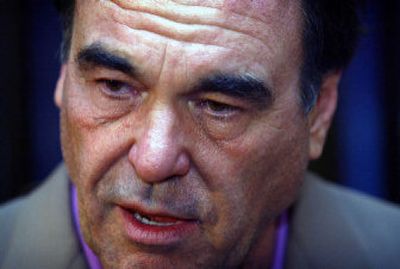
Oliver Stone is delighted that maverick filmmaker and political activist Michael Moore came along.
“It takes the heat off me,” Stone says with a laugh as he awaits the critical reception for “World Trade Center,” opening Wednesday – a film that finds him at a crucial and once again controversial juncture in his career.
Stone and the critics haven’t gotten along in a while, and he takes it personally. Nearing 60, he is a three-time Oscar winner who finds it difficult to get a film made in the new Hollywood.
“WTC” is a chance for renewal – and resurrection.
“I’m a sponge that grows in strange places,” he suggests. “I try to stay in touch with my own inner self and sometimes I score at the edge of the business.”
“Platoon,” for which he won a Best Director Oscar in 1986, made him famous. And a resume that includes “Wall Street” (1987), “Born on the Fourth of July” (1989), “JFK” (1991) and “The Doors” (1991) assures him a place in cinema history.
Still, Stone admits, ” ‘Nixon’ was a big disaster for me. So was ‘Heaven and Earth,’ which I loved. That was a complete disaster. So was ‘U-Turn.’ ‘Alexander’ was the ultimate disaster for me.
“I’m down four times. So ‘World Trade Center’ means a lot to me.”
He was home in bed on the West Coast when the Twin Towers were hit by terrorists who commandeered two planes on Sept. 11, 2001.
“I saw it on TV,” Stone says. “I was surprised a little. I had lived through Vietnam, the assassination of JFK, Watergate, the Oklahoma City bombing.
“The older you get, the more perceptive you become. I looked at it as murder, not the end of the world. It was 2,800 murders.”
He admits that “WTC” is not a “typical” Oliver Stone movie, except in the sense that it deals with men confined to small spaces.
“Oliver came to us and told us he wanted to do the movie,” recalls producer Michael Shamberg. “He told me, ‘I know men like this under pressure.’
“I said to Oliver, ‘You’re really just a poet.’ His movies have always been about finding the truth.”
Stone finds it amusing that some conservative groups are embracing his true-life drama about two Port Authority Police Department first-responders who survived 22 hours of being crushed under debris from the concourse between the Twin Towers.
Syndicated columnist Cal Thomas praises it as “one of the greatest pro-American, pro-family, pro-male, flag-waving, God Bless America films you will ever see.”
Brent Bozell, president of the conservative Media Research Center, calls it “a masterpiece (that) must be seen by as many people as possible,” adding: “It’s more than a movie – it’s a vivid reminder of the love, heroism, faith and patriotism that comprise the fabric of our country.”
“I never thought any right-wingers would be excited about a movie I made,” Stone says, chuckling.
Shamberg thinks the conservative response is great.
“The movie’s message reminds us that on that day we felt a part of the same country. It has a spiritual message, not a political one,” he says.
The film is also being marketed to teens. That pleases Stone, who has regularly made the rounds of colleges to lecture about his films.
The director decided that the only archival footage he would use in “World Trade Center” would be on television screens, since the two main characters didn’t have the whole story when they plunged into the concourse. Only the shadow of a plane crossing the WTC is shown to illustrate the first crash.
For authenticity, actors Nicolas Cage and Michael Pena spent time with the real-life subjects of the film: John McLoughlin, a 21-year PAPD veteran from Long Island, and fellow first-responder William Jimeno of New Jersey.
To assure that a re-creation of the WTC site would be authentic, Stone had more than 5,000 digital photos taken at the location. The first responders seen at the end of the film are the actual men who came to the rescue on Sept. 11.
While he has a reputation for badgering his actors to give good performances, actress Maria Bello, who plays McLoughlin’s wife, Donna, in the film, says Stone “was so nurturing to me. He knew instinctively that I’d be in a fetal position if he ever treated me otherwise.”
Bello was in New York the day of the attacks, in town with her mother for a movie premiere.
“I hadn’t smoked for years, but I started again that day,” she recalls. “My mom is a nurse and she and I walked up 6th Avenue to St. Vincent’s (hospital) where they were taking people so she could help.
“And I remember seeing a homeless man in a pink tutu comforting a man in a business suit. It was about the humanity and grace that came out of it.”